Setting Up the Table
Preparando a mesa
Grace and Jack set up their yard sale table and put out the items. They make sure the prices are easy to see.
Grace e Jack montam a mesa para a venda de garagem e colocam os itens à mostra. Eles se certificam de que os preços estejam fáceis de ver.
Diálogo8
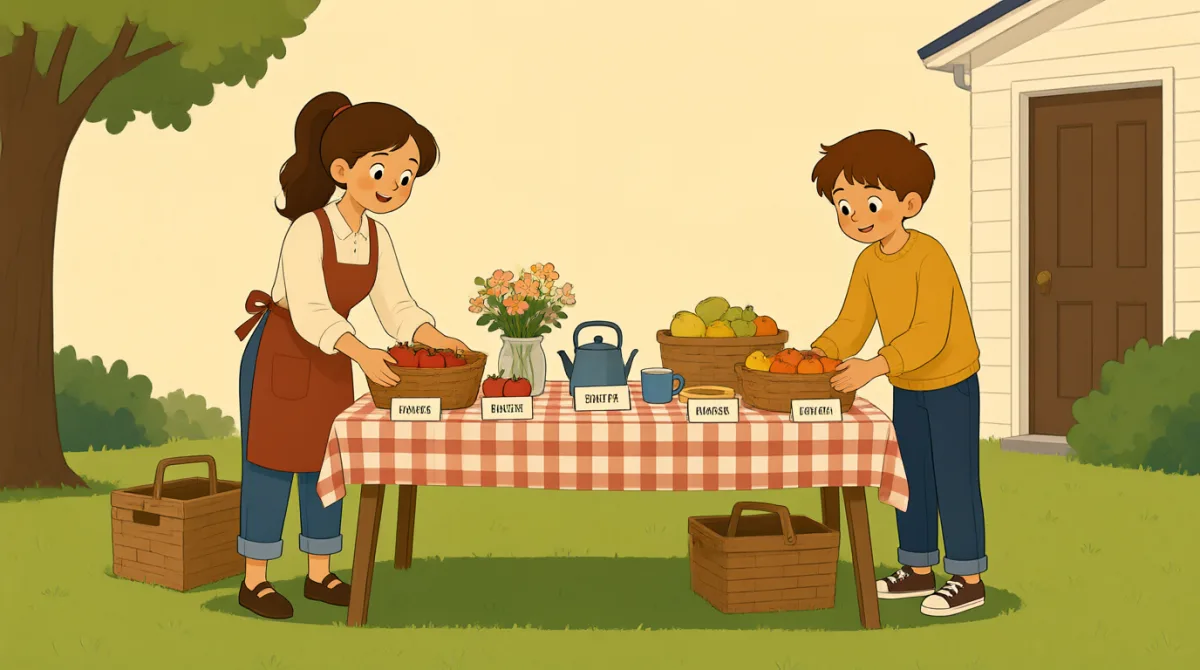

Let’s put the table near the driveway. People will see it from the street.
Vamos colocar a mesa perto da entrada da garagem. As pessoas vão vê-la da rua.

Good idea. I’ll carry the table over. Can you bring out the boxes?
Boa ideia. Vou levar a mesa para lá. Você pode trazer as caixas?
Sure. Let’s put the books on one side and the kitchen things on the other.
Claro. Vamos colocar os livros de um lado e as coisas de cozinha do outro.
Where should I put the lamp? I don’t want it to fall off the table.
Onde devo colocar o abajur? Não quero que ele caia da mesa.
Put it in the middle, away from the edge. I’ll set the prices beside everything.
Coloque-o no meio, longe da borda. Vou colocar os preços ao lado de cada coisa.
These price tags are small. I’ll write the prices bigger so people can see them.
Estas etiquetas de preço são pequenas. Vou escrever os preços com letras maiores para as pessoas conseguirem vê-los.
Great. Please make sure each tag stays with the right item.
Ótimo. Por favor, confira se cada etiqueta fica junto do item certo.
All set. The table looks neat, and every price is easy to read.
Pronto. A mesa está organizada, e todos os preços estão fáceis de ler.
Vocabulário8
- near the drivewayperto da entrada da garagem
Close to the driveway. Use this phrase to say where you want to put something.
Perto da entrada da garagem. Use essa expressão para dizer onde você quer colocar alguma coisa.
- carry the table overlevar a mesa para lá
Move the table to another place by carrying it. You can use “carry ... over” for other things you move by hand.
Mover a mesa para outro lugar carregando-a. Você também pode usar “carry ... over” para falar de outras coisas que move carregando.
- bring out the boxestrazer as caixas para fora
Take the boxes from inside to a place outside. “Bring out” is useful when setting up for an event.
Levar as caixas de dentro para um lugar externo. “Bring out” é útil na hora de preparar um evento.
- on one sidede um lado
In one area or part of a space. Use it to describe where you put things.
Em uma área ou parte de um espaço. Use essa expressão para descrever onde você coloca as coisas.
- fall off the tablecair da mesa
Drop from the table onto the ground. Use “fall off” when something moves down from a surface.
Cair da mesa no chão. Use “fall off” quando algo cai de uma superfície.
- away from the edgelonge da borda
Not close to the outer side of something. Use this phrase to give instructions about where to place an item.
Sem ficar perto da parte externa de alguma coisa. Use essa expressão para dizer onde colocar um item.
- price tagsetiquetas de preço
Small labels that show how much things cost. They help shoppers see the prices.
Pequenas etiquetas que mostram quanto as coisas custam. Elas ajudam os compradores a ver os preços.
- easy to readfácil de ler
Clear enough to understand by looking at the words or numbers. Use it to describe writing that is not too small or unclear.
Claro o bastante para entender as palavras ou os números só de olhar. Use essa expressão para descrever algo escrito com letras grandes e legíveis.
Frases-chave8
- 1
Let’s put the table near the driveway.
Vamos colocar a mesa perto da entrada da garagem.
Use “Let’s” to suggest doing something together. Replace “the table” and “near the driveway” with another item and location.
Use “Let’s” para sugerir que vocês façam algo juntos. Troque “the table” e “near the driveway” por outro item e outro lugar.
- 2
Can you bring out the boxes?
Você pode trazer as caixas para fora?
This is a polite way to ask someone to take things outside. You can replace “the boxes” with other items.
Essa é uma maneira gentil de pedir a alguém que leve coisas para fora. Você pode substituir “the boxes” por outros itens.
- 3
Let’s put the books on one side and the kitchen things on the other.
Vamos colocar os livros de um lado e as coisas de cozinha do outro.
Use this sentence pattern to organize two groups of items in two places. Replace the items and locations to fit your situation.
Use esse padrão de frase para organizar dois grupos de itens em lugares diferentes. Troque os itens e os lugares de acordo com a situação.
- 4
I don’t want it to fall off the table.
Não quero que ele caia da mesa.
Use “I don’t want it to...” to explain what you hope to avoid. You can change the ending to describe another unwanted result.
Use “I don’t want it to...” para explicar o que você espera evitar. Você pode mudar o final para descrever outro resultado indesejado.
- 5
Put it in the middle, away from the edge.
Coloque-o no meio, longe da borda.
This gives a clear instruction about where to place something. Use it when you want an item to stay safely on a surface.
Essa frase dá uma instrução clara sobre onde colocar alguma coisa. Use-a quando quiser que um item fique seguro sobre uma superfície.
- 6
I’ll write the prices bigger so people can see them.
Vou escrever os preços com letras maiores para as pessoas conseguirem vê-los.
Use “I’ll” to say what you plan to do. “So” explains the reason for your action.
Use “I’ll” para dizer o que você pretende fazer. “So” explica o motivo da sua ação.
- 7
Please make sure each tag stays with the right item.
Por favor, confira se cada etiqueta fica junto do item certo.
Use “Please make sure” to politely ask someone to check that something is correct. You can replace “each tag” and “the right item” with other things to check.
Use “Please make sure” para pedir com educação que alguém confira se algo está correto. Você pode substituir “each tag” e “the right item” por outras coisas que precisam ser conferidas.
- 8
The table looks neat, and every price is easy to read.
A mesa está organizada, e todos os preços estão fáceis de ler.
Use this sentence to describe an organized display and clear prices. Replace “the table” and “every price” to talk about other things.
Use essa frase para descrever uma exposição organizada e preços claros. Troque “the table” e “every price” para falar de outras coisas.