Setting Up the Table
Den Tisch aufstellen
Grace and Jack set up their yard sale table and put out the items. They make sure the prices are easy to see.
Grace und Jack stellen ihren Tisch für den Hofflohmarkt auf und legen die Sachen darauf. Sie achten darauf, dass die Preise gut zu sehen sind.
Dialog8
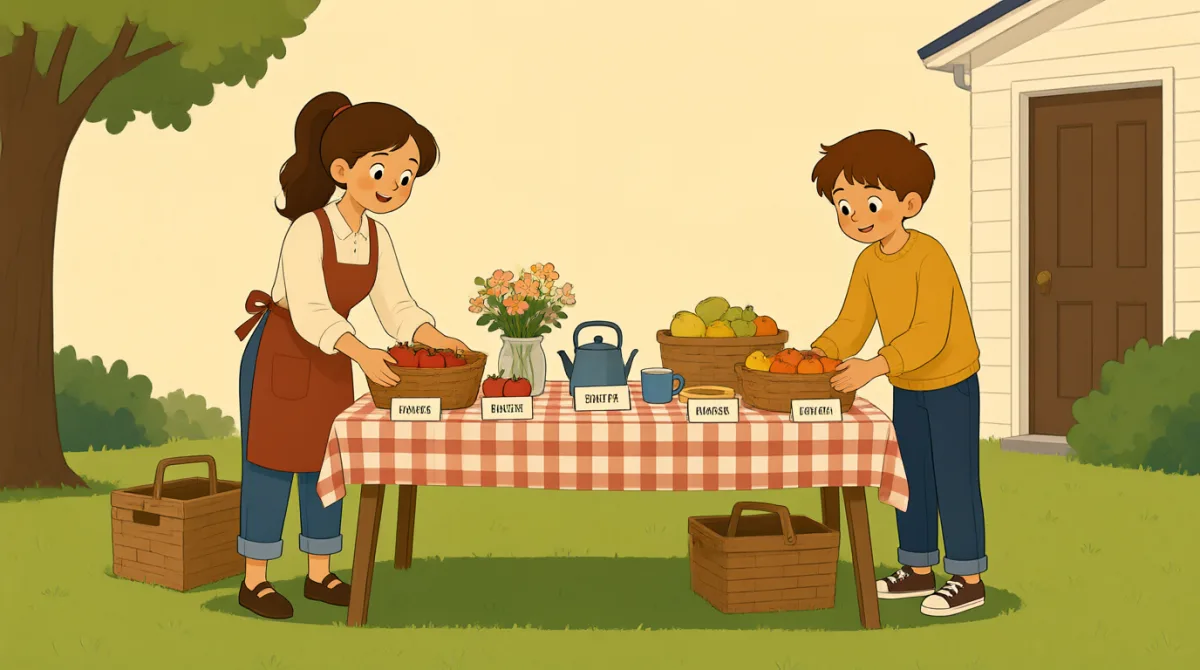

Let’s put the table near the driveway. People will see it from the street.
Stellen wir den Tisch in die Nähe der Einfahrt. Von der Straße aus können ihn die Leute dann sehen.

Good idea. I’ll carry the table over. Can you bring out the boxes?
Gute Idee. Ich trage den Tisch rüber. Kannst du die Kartons rausbringen?
Sure. Let’s put the books on one side and the kitchen things on the other.
Klar. Legen wir die Bücher auf die eine Seite und die Küchensachen auf die andere.
Where should I put the lamp? I don’t want it to fall off the table.
Wohin soll ich die Lampe stellen? Ich will nicht, dass sie vom Tisch fällt.
Put it in the middle, away from the edge. I’ll set the prices beside everything.
Stell sie in die Mitte, weg von der Kante. Ich lege die Preisschilder zu den Sachen.
These price tags are small. I’ll write the prices bigger so people can see them.
Diese Preisschilder sind klein. Ich schreibe die Preise größer, damit die Leute sie sehen können.
Great. Please make sure each tag stays with the right item.
Super. Achte bitte darauf, dass jedes Schild bei der richtigen Sache bleibt.
All set. The table looks neat, and every price is easy to read.
Alles fertig. Der Tisch sieht ordentlich aus, und alle Preise sind gut lesbar.
Wortschatz8
- near the drivewayin der Nähe der Einfahrt
Close to the driveway. Use this phrase to say where you want to put something.
Das bedeutet, dass etwas nahe an der Einfahrt ist. Mit dieser Wendung sagst du, wo du etwas hinstellen möchtest.
- carry the table overden Tisch rübertragen
Move the table to another place by carrying it. You can use “carry ... over” for other things you move by hand.
Den Tisch an einen anderen Ort bringen, indem du ihn trägst. „carry ... over“ kannst du auch für andere Dinge verwenden, die du von Hand an einen anderen Ort bringst.
- bring out the boxesdie Kartons rausbringen
Take the boxes from inside to a place outside. “Bring out” is useful when setting up for an event.
Die Kartons von drinnen nach draußen bringen. „bring out“ ist nützlich, wenn du etwas für eine Veranstaltung vorbereitest.
- on one sideauf einer Seite
In one area or part of a space. Use it to describe where you put things.
In einem bestimmten Bereich oder Teil einer Fläche. Mit dieser Wendung beschreibst du, wo du Dinge hinlegst.
- fall off the tablevom Tisch fallen
Drop from the table onto the ground. Use “fall off” when something moves down from a surface.
Vom Tisch auf den Boden fallen. „fall off“ verwendest du, wenn etwas von einer Fläche herunterfällt.
- away from the edgeweg von der Kante
Not close to the outer side of something. Use this phrase to give instructions about where to place an item.
Nicht nahe am äußeren Rand von etwas. Mit dieser Wendung kannst du sagen, wo etwas hingelegt werden soll.
- price tagsPreisschilder
Small labels that show how much things cost. They help shoppers see the prices.
Kleine Schilder, auf denen steht, wie viel etwas kostet. So können Käufer die Preise sehen.
- easy to readgut lesbar
Clear enough to understand by looking at the words or numbers. Use it to describe writing that is not too small or unclear.
So klar, dass man Wörter oder Zahlen ohne Mühe erkennen kann. Damit beschreibst du Schrift, die nicht zu klein oder undeutlich ist.
Wichtige Sätze8
- 1
Let’s put the table near the driveway.
Stellen wir den Tisch in die Nähe der Einfahrt.
Use “Let’s” to suggest doing something together. Replace “the table” and “near the driveway” with another item and location.
Mit „Let’s“ schlägst du vor, etwas gemeinsam zu machen. Du kannst „the table“ und „near the driveway“ durch einen anderen Gegenstand und einen anderen Ort ersetzen.
- 2
Can you bring out the boxes?
Kannst du die Kartons rausbringen?
This is a polite way to ask someone to take things outside. You can replace “the boxes” with other items.
So bittest du jemanden höflich, etwas nach draußen zu bringen. Du kannst „the boxes“ durch andere Dinge ersetzen.
- 3
Let’s put the books on one side and the kitchen things on the other.
Legen wir die Bücher auf die eine Seite und die Küchensachen auf die andere.
Use this sentence pattern to organize two groups of items in two places. Replace the items and locations to fit your situation.
Mit diesem Satzmuster verteilst du zwei Gruppen von Dingen auf zwei Plätze. Passe die Gegenstände und Orte an deine Situation an.
- 4
I don’t want it to fall off the table.
Ich will nicht, dass es vom Tisch fällt.
Use “I don’t want it to...” to explain what you hope to avoid. You can change the ending to describe another unwanted result.
Mit „I don’t want it to...“ erklärst du, was du vermeiden möchtest. Du kannst den Satz anders beenden, um ein anderes unerwünschtes Ergebnis zu beschreiben.
- 5
Put it in the middle, away from the edge.
Stell es in die Mitte, weg von der Kante.
This gives a clear instruction about where to place something. Use it when you want an item to stay safely on a surface.
Damit sagst du genau, wo etwas hingelegt werden soll. Verwende den Satz, wenn ein Gegenstand sicher auf einer Fläche stehen oder liegen soll.
- 6
I’ll write the prices bigger so people can see them.
Ich schreibe die Preise größer, damit die Leute sie sehen können.
Use “I’ll” to say what you plan to do. “So” explains the reason for your action.
Mit „I’ll“ sagst du, was du vorhast. „So“ erklärt den Grund für deine Handlung.
- 7
Please make sure each tag stays with the right item.
Achte bitte darauf, dass jedes Schild bei der richtigen Sache bleibt.
Use “Please make sure” to politely ask someone to check that something is correct. You can replace “each tag” and “the right item” with other things to check.
Mit „Please make sure“ bittest du jemanden höflich zu prüfen, ob etwas stimmt. Du kannst „each tag“ und „the right item“ durch andere Dinge ersetzen, die überprüft werden sollen.
- 8
The table looks neat, and every price is easy to read.
Der Tisch sieht ordentlich aus, und alle Preise sind gut lesbar.
Use this sentence to describe an organized display and clear prices. Replace “the table” and “every price” to talk about other things.
Mit diesem Satz beschreibst du eine ordentliche Auslage und gut lesbare Preise. Ersetze „the table“ und „every price“, wenn du über andere Dinge sprechen möchtest.