Setting Up the Table
Przygotowanie stołu
Grace and Jack set up their yard sale table and put out the items. They make sure the prices are easy to see.
Grace i Jack przygotowują stół na wyprzedaż garażową i wykładają rzeczy. Dbają o to, żeby ceny były dobrze widoczne.
Dialog8
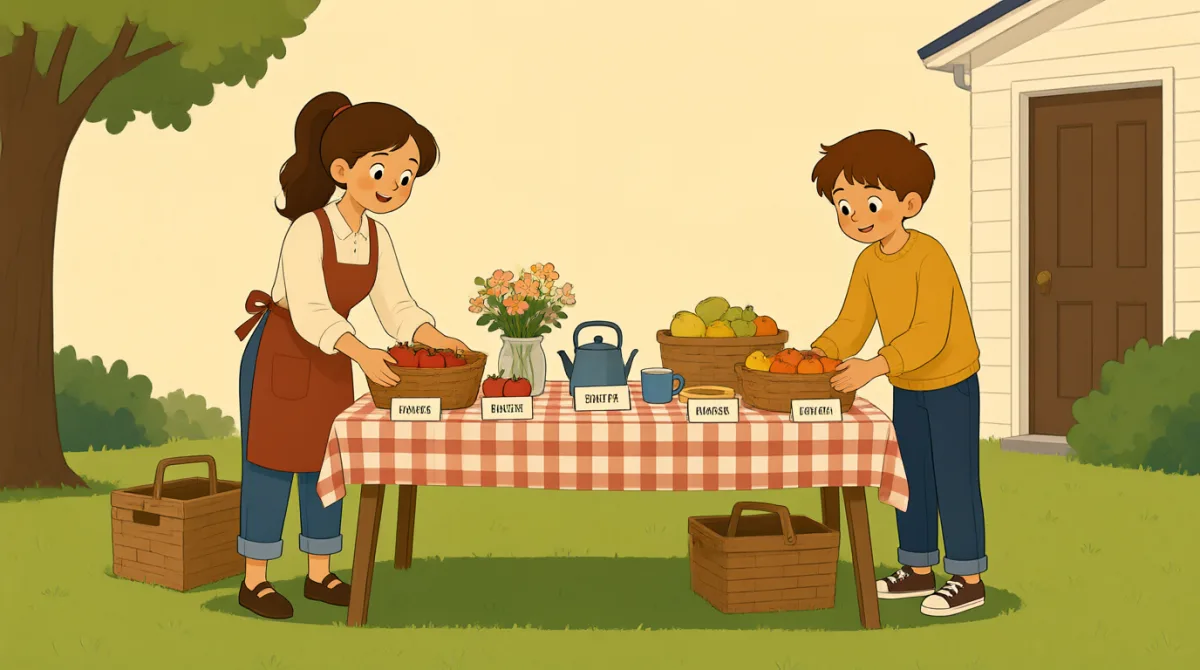

Let’s put the table near the driveway. People will see it from the street.
Połóżmy stół blisko podjazdu. Ludzie zobaczą go z ulicy.

Good idea. I’ll carry the table over. Can you bring out the boxes?
Dobry pomysł. Przeniosę stół. Możesz wynieść pudła?
Sure. Let’s put the books on one side and the kitchen things on the other.
Jasne. Połóżmy książki po jednej stronie, a rzeczy kuchenne po drugiej.
Where should I put the lamp? I don’t want it to fall off the table.
Gdzie mam postawić lampę? Nie chcę, żeby spadła ze stołu.
Put it in the middle, away from the edge. I’ll set the prices beside everything.
Postaw ją na środku, z dala od krawędzi. Ustawię ceny obok wszystkiego.
These price tags are small. I’ll write the prices bigger so people can see them.
Te metki z cenami są małe. Napiszę ceny większymi literami, żeby ludzie mogli je zobaczyć.
Great. Please make sure each tag stays with the right item.
Świetnie. Dopilnuj, proszę, żeby każda metka została przy właściwym przedmiocie.
All set. The table looks neat, and every price is easy to read.
Gotowe. Stół wygląda schludnie, a każdą cenę łatwo odczytać.
Słownictwo8
- near the drivewayblisko podjazdu
Close to the driveway. Use this phrase to say where you want to put something.
Blisko podjazdu. Użyj tego wyrażenia, żeby powiedzieć, gdzie chcesz coś położyć.
- carry the table overprzenieść stół
Move the table to another place by carrying it. You can use “carry ... over” for other things you move by hand.
Przenieść stół w inne miejsce. Wyrażenia “carry ... over” możesz używać także w odniesieniu do innych rzeczy przenoszonych ręcznie.
- bring out the boxeswynieść pudła
Take the boxes from inside to a place outside. “Bring out” is useful when setting up for an event.
Zabrać pudła ze środka na zewnątrz. “Bring out” przydaje się podczas przygotowań do wydarzenia.
- on one sidepo jednej stronie
In one area or part of a space. Use it to describe where you put things.
W jednej części lub na jednym obszarze przestrzeni. Użyj tego wyrażenia, żeby opisać, gdzie kładziesz różne rzeczy.
- fall off the tablespaść ze stołu
Drop from the table onto the ground. Use “fall off” when something moves down from a surface.
Spaść ze stołu na ziemię. “Fall off” stosujemy, gdy coś zsuwa się lub spada z powierzchni.
- away from the edgez dala od krawędzi
Not close to the outer side of something. Use this phrase to give instructions about where to place an item.
Nie przy zewnętrznej stronie czegoś. Użyj tego wyrażenia, żeby powiedzieć, gdzie należy położyć przedmiot.
- price tagsmetki z cenami
Small labels that show how much things cost. They help shoppers see the prices.
Małe etykiety pokazujące, ile kosztują rzeczy. Pomagają klientom zobaczyć ceny.
- easy to readłatwy do odczytania
Clear enough to understand by looking at the words or numbers. Use it to describe writing that is not too small or unclear.
Wystarczająco wyraźny, żeby można go było zrozumieć, patrząc na słowa lub liczby. Użyj tego wyrażenia, żeby opisać napis, który nie jest zbyt mały ani niewyraźny.
Kluczowe zdania8
- 1
Let’s put the table near the driveway.
Połóżmy stół blisko podjazdu.
Use “Let’s” to suggest doing something together. Replace “the table” and “near the driveway” with another item and location.
Użyj “Let’s”, żeby zaproponować wspólne zrobienie czegoś. Zastąp “the table” i “near the driveway” innym przedmiotem i miejscem.
- 2
Can you bring out the boxes?
Możesz wynieść pudła?
This is a polite way to ask someone to take things outside. You can replace “the boxes” with other items.
To uprzejmy sposób, żeby poprosić kogoś o wyniesienie rzeczy na zewnątrz. Możesz zastąpić “the boxes” innymi przedmiotami.
- 3
Let’s put the books on one side and the kitchen things on the other.
Połóżmy książki po jednej stronie, a rzeczy kuchenne po drugiej.
Use this sentence pattern to organize two groups of items in two places. Replace the items and locations to fit your situation.
Użyj tego wzoru zdania, żeby uporządkować dwie grupy rzeczy w dwóch miejscach. Zastąp przedmioty i miejsca wyrażeniami pasującymi do danej sytuacji.
- 4
I don’t want it to fall off the table.
Nie chcę, żeby spadła ze stołu.
Use “I don’t want it to...” to explain what you hope to avoid. You can change the ending to describe another unwanted result.
Użyj “I don’t want it to...”, żeby wyjaśnić, czego chcesz uniknąć. Możesz zmienić zakończenie, aby opisać inny niepożądany skutek.
- 5
Put it in the middle, away from the edge.
Postaw ją na środku, z dala od krawędzi.
This gives a clear instruction about where to place something. Use it when you want an item to stay safely on a surface.
To jasne polecenie dotyczące tego, gdzie coś położyć. Użyj go, gdy chcesz, żeby przedmiot bezpiecznie pozostał na powierzchni.
- 6
I’ll write the prices bigger so people can see them.
Napiszę ceny większymi literami, żeby ludzie mogli je zobaczyć.
Use “I’ll” to say what you plan to do. “So” explains the reason for your action.
Użyj “I’ll”, żeby powiedzieć, co zamierzasz zrobić. “So” wyjaśnia powód twojego działania.
- 7
Please make sure each tag stays with the right item.
Dopilnuj, proszę, żeby każda metka została przy właściwym przedmiocie.
Use “Please make sure” to politely ask someone to check that something is correct. You can replace “each tag” and “the right item” with other things to check.
Użyj “Please make sure”, żeby uprzejmie poprosić kogoś o sprawdzenie, czy wszystko się zgadza. Możesz zastąpić “each tag” i “the right item” innymi rzeczami, które trzeba sprawdzić.
- 8
The table looks neat, and every price is easy to read.
Stół wygląda schludnie, a każdą cenę łatwo odczytać.
Use this sentence to describe an organized display and clear prices. Replace “the table” and “every price” to talk about other things.
Użyj tego zdania, żeby opisać uporządkowaną ekspozycję i wyraźne ceny. Zastąp “the table” i “every price”, gdy chcesz mówić o innych rzeczach.