Setting Up the Table
Preparando la mesa
Grace and Jack set up their yard sale table and put out the items. They make sure the prices are easy to see.
Grace y Jack preparan la mesa para la venta de garaje y colocan los artículos. Se aseguran de que los precios se vean bien.
Diálogo8
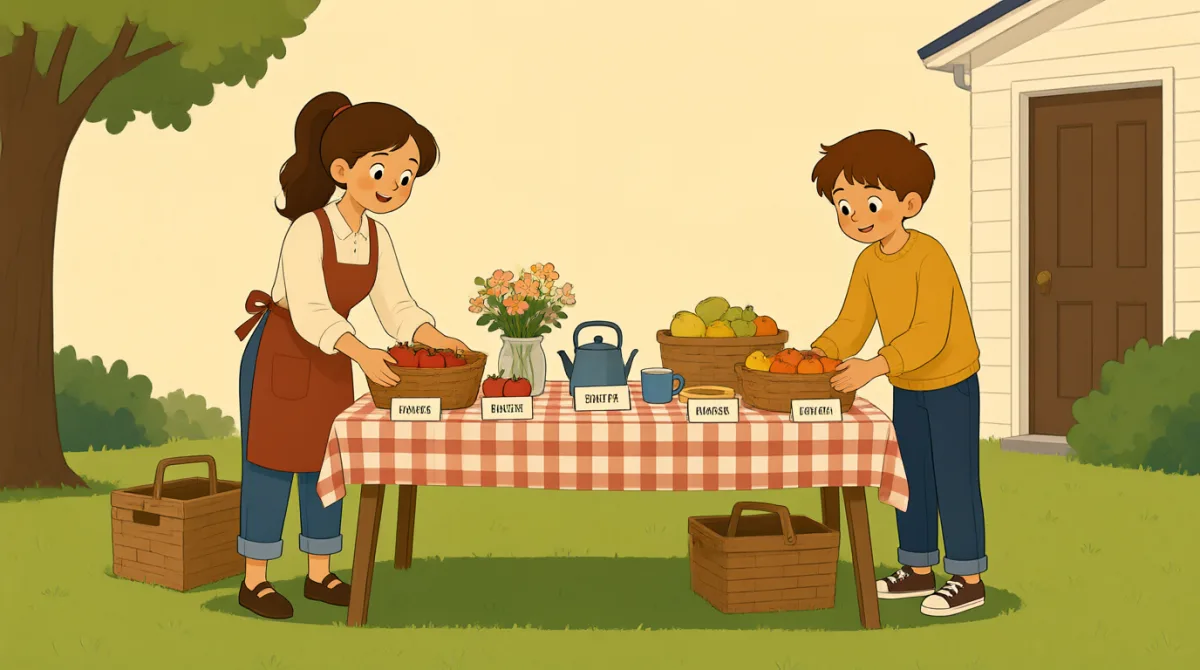

Let’s put the table near the driveway. People will see it from the street.
Pongamos la mesa cerca de la entrada para autos. La gente la verá desde la calle.

Good idea. I’ll carry the table over. Can you bring out the boxes?
Buena idea. Llevo la mesa. ¿Puedes sacar las cajas?
Sure. Let’s put the books on one side and the kitchen things on the other.
Claro. Pongamos los libros de un lado y las cosas de cocina del otro.
Where should I put the lamp? I don’t want it to fall off the table.
¿Dónde pongo la lámpara? No quiero que se caiga de la mesa.
Put it in the middle, away from the edge. I’ll set the prices beside everything.
Ponla en el medio, lejos del borde. Voy a poner los precios al lado de cada cosa.
These price tags are small. I’ll write the prices bigger so people can see them.
Estas etiquetas de precio son pequeñas. Voy a escribir los precios más grandes para que la gente pueda verlos.
Great. Please make sure each tag stays with the right item.
Genial. Asegúrate de que cada etiqueta quede con el artículo correcto.
All set. The table looks neat, and every price is easy to read.
Listo. La mesa se ve ordenada y todos los precios se leen fácilmente.
Vocabulario8
- near the drivewaycerca de la entrada para autos
Close to the driveway. Use this phrase to say where you want to put something.
Cerca de la entrada para autos. Usa esta expresión para decir dónde quieres poner algo.
- carry the table overllevar la mesa
Move the table to another place by carrying it. You can use “carry ... over” for other things you move by hand.
Mover la mesa a otro lugar cargándola. Puedes usar “carry ... over” para hablar de otras cosas que mueves con las manos.
- bring out the boxessacar las cajas
Take the boxes from inside to a place outside. “Bring out” is useful when setting up for an event.
Llevar las cajas de adentro a un lugar afuera. “Bring out” es útil cuando preparas algo para un evento.
- on one sidede un lado
In one area or part of a space. Use it to describe where you put things.
En una zona o parte de un espacio. Usa esta expresión para describir dónde pones las cosas.
- fall off the tablecaerse de la mesa
Drop from the table onto the ground. Use “fall off” when something moves down from a surface.
Caer de la mesa al suelo. Usa “fall off” cuando algo se mueve hacia abajo desde una superficie.
- away from the edgelejos del borde
Not close to the outer side of something. Use this phrase to give instructions about where to place an item.
No estar cerca del extremo exterior de algo. Usa esta expresión para indicar dónde colocar un objeto.
- price tagsetiquetas de precio
Small labels that show how much things cost. They help shoppers see the prices.
Etiquetas pequeñas que indican cuánto cuestan las cosas. Ayudan a los compradores a ver los precios.
- easy to readfácil de leer
Clear enough to understand by looking at the words or numbers. Use it to describe writing that is not too small or unclear.
Lo bastante claro como para entender las palabras o los números al mirarlos. Se usa para describir algo escrito que no es demasiado pequeño ni confuso.
Frases clave8
- 1
Let’s put the table near the driveway.
Pongamos la mesa cerca de la entrada para autos.
Use “Let’s” to suggest doing something together. Replace “the table” and “near the driveway” with another item and location.
Usa “Let’s” para proponer hacer algo juntos. Puedes sustituir “the table” y “near the driveway” por otro objeto y otro lugar.
- 2
Can you bring out the boxes?
¿Puedes sacar las cajas?
This is a polite way to ask someone to take things outside. You can replace “the boxes” with other items.
Esta es una forma amable de pedirle a alguien que lleve cosas afuera. Puedes sustituir “the boxes” por otros objetos.
- 3
Let’s put the books on one side and the kitchen things on the other.
Pongamos los libros de un lado y las cosas de cocina del otro.
Use this sentence pattern to organize two groups of items in two places. Replace the items and locations to fit your situation.
Usa esta estructura para organizar dos grupos de objetos en dos lugares. Cambia los objetos y los lugares según la situación.
- 4
I don’t want it to fall off the table.
No quiero que se caiga de la mesa.
Use “I don’t want it to...” to explain what you hope to avoid. You can change the ending to describe another unwanted result.
Usa “I don’t want it to...” para explicar qué esperas evitar. Puedes cambiar el final para describir otro resultado que no quieres.
- 5
Put it in the middle, away from the edge.
Ponla en el medio, lejos del borde.
This gives a clear instruction about where to place something. Use it when you want an item to stay safely on a surface.
Esta frase da una instrucción clara sobre dónde colocar algo. Úsala cuando quieras que un objeto quede seguro sobre una superficie.
- 6
I’ll write the prices bigger so people can see them.
Voy a escribir los precios más grandes para que la gente pueda verlos.
Use “I’ll” to say what you plan to do. “So” explains the reason for your action.
Usa “I’ll” para decir lo que piensas hacer. “So” explica el motivo de tu acción.
- 7
Please make sure each tag stays with the right item.
Asegúrate de que cada etiqueta quede con el artículo correcto.
Use “Please make sure” to politely ask someone to check that something is correct. You can replace “each tag” and “the right item” with other things to check.
Usa “Please make sure” para pedirle amablemente a alguien que compruebe que algo esté correcto. Puedes sustituir “each tag” y “the right item” por otras cosas que quieras revisar.
- 8
The table looks neat, and every price is easy to read.
La mesa se ve ordenada y todos los precios se leen fácilmente.
Use this sentence to describe an organized display and clear prices. Replace “the table” and “every price” to talk about other things.
Usa esta frase para describir una exposición ordenada y precios claros. Sustituye “the table” y “every price” para hablar de otras cosas.