Signing the Card
Assinando o cartão
Jack brings a birthday card to work, and the coworkers write short messages inside. They make sure everyone has signed it.
Jack leva um cartão de aniversário para o trabalho, e os colegas escrevem mensagens curtas dentro dele. Eles conferem se todos assinaram.
Diálogo8
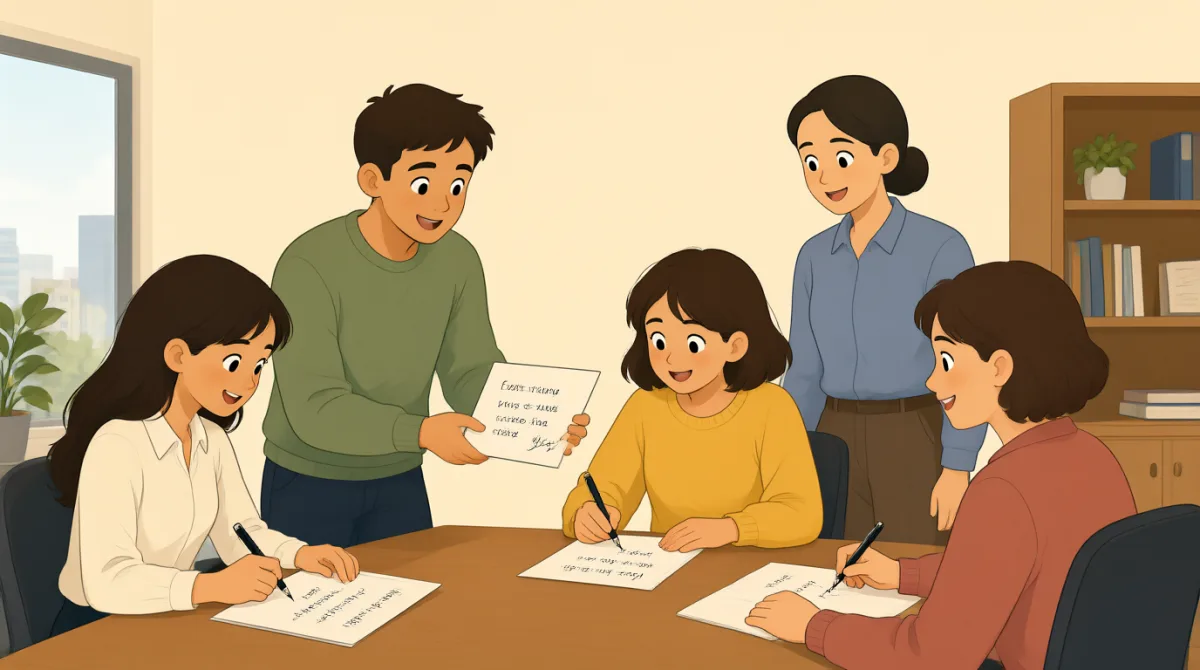

I brought the birthday card. Let’s sign it before the meeting starts.
Trouxe o cartão de aniversário. Vamos assiná-lo antes de a reunião começar.

Good idea! Who should write the first message?
Boa ideia! Quem deve escrever a primeira mensagem?

Jack, you brought the card, so why don’t you start?
Jack, você trouxe o cartão, então por que não começa?
Sure. I’ll write, “Happy birthday! Hope you have a wonderful day.”
Claro. Vou escrever: “Feliz aniversário! Espero que você tenha um dia maravilhoso.”
That sounds nice. I’ll add a message about the travel mug.
Ficou legal. Vou acrescentar uma mensagem sobre a caneca térmica.
I’ll sign underneath. Have you both signed your names?
Vou assinar embaixo. Vocês dois já assinaram?
Yes, I signed here. Jack, did you sign too?
Sim, assinei aqui. Jack, você também assinou?
Yes, right here. Great, everyone has signed the card.
Sim, bem aqui. Ótimo, todo mundo já assinou o cartão.
Vocabulário7
- birthday cardcartão de aniversário
A card you give someone to celebrate their birthday. You can write a personal message inside it.
Um cartão que você dá a alguém para comemorar o aniversário dessa pessoa. Você pode escrever uma mensagem pessoal dentro dele.
- before the meeting startsantes de a reunião começar
This means before the meeting begins. Use “before” to say that one thing happens earlier than another.
Isso quer dizer antes de a reunião começar. Use “before” para dizer que uma coisa acontece antes de outra.
- write the first messageescrever a primeira mensagem
To be the first person to write something inside the card. You can use this phrase when people are taking turns.
Ser a primeira pessoa a escrever algo dentro do cartão. Você pode usar essa expressão quando as pessoas vão se revezar.
- why don’t you start?por que você não começa?
A friendly way to suggest that someone begin. You can use it when inviting someone to do something first.
Uma maneira simpática de sugerir que alguém comece. Você pode usar essa expressão para convidar alguém a fazer algo primeiro.
- add a messageacrescentar uma mensagem
To write an extra note. You can use “add” when putting more words or information into something.
Escrever uma mensagem extra. Você pode usar “add” quando acrescenta mais palavras ou informações a alguma coisa.
- sign underneathassinar embaixo
To write your name below another message or signature. “Underneath” tells you where to write.
Escrever seu nome abaixo de outra mensagem ou assinatura. “Underneath” indica onde escrever.
- signed your namesassinaram seus nomes
This means each person wrote their name on the card. Use “Have you signed…?” to check whether something is done.
Isso quer dizer que cada pessoa escreveu seu nome no cartão. Use “Have you signed…?” para perguntar se algo já foi feito.
Frases-chave8
- 1
I brought the birthday card.
Trouxe o cartão de aniversário.
Use this simple past sentence to say that you brought something. You can replace “the birthday card” with another item, such as “the tickets” or “the snacks.”
Use esta frase no passado simples para dizer que você trouxe alguma coisa. Você pode substituir “the birthday card” por outro item, como “the tickets” ou “the snacks.”
- 2
Let’s sign it before the meeting starts.
Vamos assiná-lo antes de a reunião começar.
“Let’s” is a friendly way to suggest doing something together. Use “before” to say when you want to do it.
“Let’s” é uma maneira simpática de sugerir que vocês façam algo juntos. Use “before” para dizer quando você quer fazer isso.
- 3
Who should write the first message?
Quem deve escrever a primeira mensagem?
Use this question to ask who ought to do something first. You can replace “write the first message” with another action.
Use esta pergunta para saber quem deveria fazer algo primeiro. Você pode substituir “write the first message” por outra ação.
- 4
I’ll write, “Happy birthday! Hope you have a wonderful day.”
Vou escrever: “Feliz aniversário! Espero que você tenha um dia maravilhoso.”
Use “I’ll” to say what you plan to do now or in the near future. This sentence also gives a short, friendly birthday message.
Use “I’ll” para dizer o que você planeja fazer agora ou em breve. Esta frase também traz uma mensagem de aniversário curta e simpática.
- 5
I’ll add a message about the travel mug.
Vou acrescentar uma mensagem sobre a caneca térmica.
This is a useful way to say you will include an extra note about something. Replace “the travel mug” with the topic you want to mention.
Esta é uma maneira útil de dizer que você vai incluir uma mensagem extra sobre alguma coisa. Substitua “the travel mug” pelo assunto que você quer mencionar.
- 6
Have you both signed your names?
Vocês dois já assinaram?
Use this question to check whether two people have finished signing. Change “both” to “all” when asking a larger group.
Use esta pergunta para confirmar se duas pessoas já terminaram de assinar. Troque “both” por “all” ao perguntar a um grupo maior.
- 7
Jack, did you sign too?
Jack, você também assinou?
Use this simple past question to check whether someone did something. “Too” means that you are asking if they did it as well.
Use esta pergunta no passado simples para confirmar se alguém fez alguma coisa. “Too” significa que você quer saber se essa pessoa também fez isso.
- 8
Great, everyone has signed the card.
Ótimo, todo mundo já assinou o cartão.
Use this sentence to say that all the people have finished signing. “Everyone has” is followed by a singular verb.
Use esta frase para dizer que todos terminaram de assinar. “Everyone has” é seguido por um verbo no singular.