Signing the Card
Die Karte unterschreiben
Jack brings a birthday card to work, and the coworkers write short messages inside. They make sure everyone has signed it.
Jack bringt eine Geburtstagskarte mit zur Arbeit, und seine Kollegen schreiben kurze Nachrichten hinein. Sie achten darauf, dass alle unterschrieben haben.
Dialog8
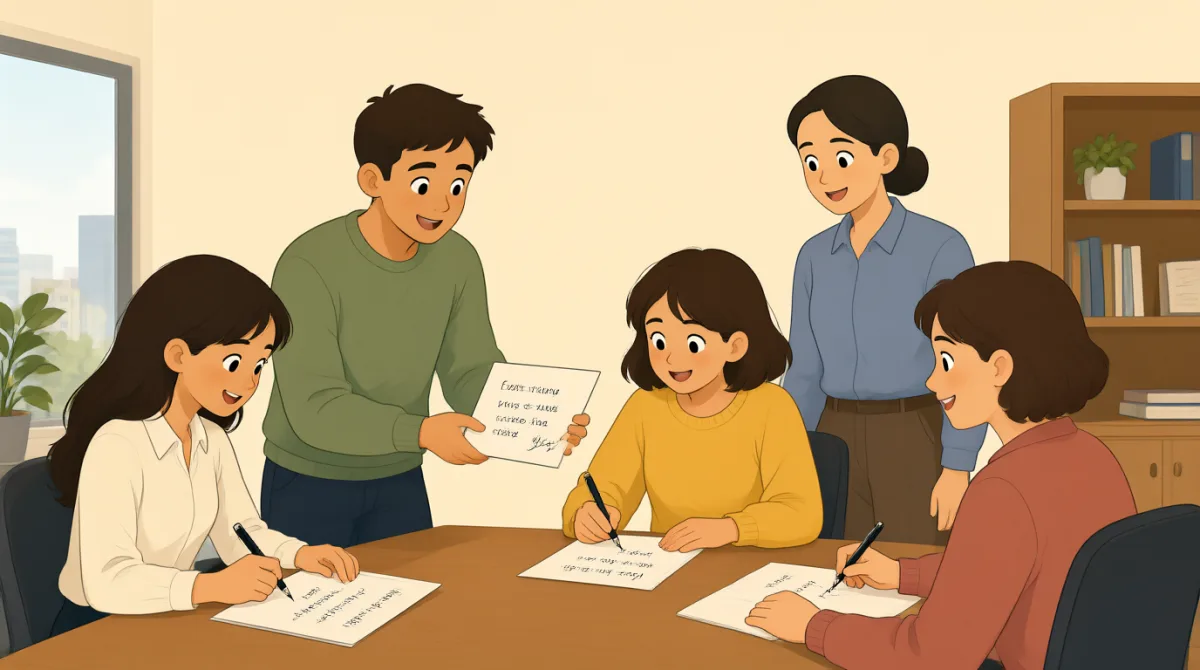

I brought the birthday card. Let’s sign it before the meeting starts.
Ich habe die Geburtstagskarte mitgebracht. Lass sie uns unterschreiben, bevor das Meeting anfängt.

Good idea! Who should write the first message?
Gute Idee! Wer soll die erste Nachricht schreiben?

Jack, you brought the card, so why don’t you start?
Jack, du hast die Karte mitgebracht. Warum fängst du nicht an?
Sure. I’ll write, “Happy birthday! Hope you have a wonderful day.”
Klar. Ich schreibe: „Alles Gute zum Geburtstag! Ich hoffe, du hast einen wunderbaren Tag.“
That sounds nice. I’ll add a message about the travel mug.
Das klingt schön. Ich schreibe noch etwas über den Thermobecher dazu.
I’ll sign underneath. Have you both signed your names?
Ich unterschreibe darunter. Habt ihr beide schon unterschrieben?
Yes, I signed here. Jack, did you sign too?
Ja, ich habe hier unterschrieben. Jack, hast du auch unterschrieben?
Yes, right here. Great, everyone has signed the card.
Ja, genau hier. Super, jetzt haben alle auf der Karte unterschrieben.
Wortschatz7
- birthday cardGeburtstagskarte
A card you give someone to celebrate their birthday. You can write a personal message inside it.
Eine Karte, die du jemandem zum Geburtstag schenkst. Innen kannst du eine persönliche Nachricht hineinschreiben.
- before the meeting startsbevor das Meeting anfängt
This means before the meeting begins. Use “before” to say that one thing happens earlier than another.
Das bedeutet: bevor das Meeting beginnt. Mit “before” sagst du, dass etwas früher passiert als etwas anderes.
- write the first messagedie erste Nachricht schreiben
To be the first person to write something inside the card. You can use this phrase when people are taking turns.
Als erste Person etwas in die Karte schreiben. Diese Formulierung passt, wenn sich mehrere Personen abwechseln.
- why don’t you start?Warum fängst du nicht an?
A friendly way to suggest that someone begin. You can use it when inviting someone to do something first.
Eine freundliche Art, jemandem vorzuschlagen, anzufangen. Du kannst die Wendung verwenden, wenn du jemanden einlädst, etwas als Erstes zu tun.
- add a messageeine Nachricht hinzufügen
To write an extra note. You can use “add” when putting more words or information into something.
Eine zusätzliche Notiz schreiben. Du kannst “add” verwenden, wenn du einem Text oder etwas anderem weitere Worte oder Informationen hinzufügst.
- sign underneathdarunter unterschreiben
To write your name below another message or signature. “Underneath” tells you where to write.
Deinen Namen unter eine andere Nachricht oder Unterschrift schreiben. “Underneath” zeigt an, wo du schreiben sollst.
- signed your nameseure Namen unterschrieben
This means each person wrote their name on the card. Use “Have you signed…?” to check whether something is done.
Das bedeutet, dass jede Person ihren Namen auf die Karte geschrieben hat. Mit “Have you signed…?” fragst du nach, ob etwas erledigt ist.
Wichtige Sätze8
- 1
I brought the birthday card.
Ich habe die Geburtstagskarte mitgebracht.
Use this simple past sentence to say that you brought something. You can replace “the birthday card” with another item, such as “the tickets” or “the snacks.”
Mit diesem Satz im simple past sagst du, dass du etwas mitgebracht hast. Du kannst “the birthday card” durch einen anderen Gegenstand ersetzen, zum Beispiel durch “the tickets” oder “the snacks”.
- 2
Let’s sign it before the meeting starts.
Lass sie uns unterschreiben, bevor das Meeting anfängt.
“Let’s” is a friendly way to suggest doing something together. Use “before” to say when you want to do it.
“Let’s” ist eine freundliche Art vorzuschlagen, etwas gemeinsam zu tun. Mit “before” sagst du, wann ihr es tun wollt.
- 3
Who should write the first message?
Wer soll die erste Nachricht schreiben?
Use this question to ask who ought to do something first. You can replace “write the first message” with another action.
Mit dieser Frage fragst du, wer etwas als Erstes tun sollte. Du kannst “write the first message” durch eine andere Handlung ersetzen.
- 4
I’ll write, “Happy birthday! Hope you have a wonderful day.”
Ich schreibe: „Alles Gute zum Geburtstag! Ich hoffe, du hast einen wunderbaren Tag.“
Use “I’ll” to say what you plan to do now or in the near future. This sentence also gives a short, friendly birthday message.
Mit “I’ll” sagst du, was du jetzt oder in naher Zukunft vorhast. Dieser Satz enthält auch eine kurze, freundliche Geburtstagsnachricht.
- 5
I’ll add a message about the travel mug.
Ich schreibe noch etwas über den Thermobecher dazu.
This is a useful way to say you will include an extra note about something. Replace “the travel mug” with the topic you want to mention.
So kannst du sagen, dass du noch eine zusätzliche Notiz zu einem Thema hinzufügen wirst. Ersetze “the travel mug” durch das Thema, das du erwähnen möchtest.
- 6
Have you both signed your names?
Habt ihr beide schon unterschrieben?
Use this question to check whether two people have finished signing. Change “both” to “all” when asking a larger group.
Mit dieser Frage prüfst du, ob zwei Personen mit dem Unterschreiben fertig sind. Wenn du eine größere Gruppe fragst, kannst du “both” durch “all” ersetzen.
- 7
Jack, did you sign too?
Jack, hast du auch unterschrieben?
Use this simple past question to check whether someone did something. “Too” means that you are asking if they did it as well.
Mit dieser Frage im simple past fragst du nach, ob jemand etwas getan hat. “Too” bedeutet, dass du wissen möchtest, ob die Person es ebenfalls getan hat.
- 8
Great, everyone has signed the card.
Super, jetzt haben alle auf der Karte unterschrieben.
Use this sentence to say that all the people have finished signing. “Everyone has” is followed by a singular verb.
Mit diesem Satz sagst du, dass alle mit dem Unterschreiben fertig sind. Auf “Everyone has” folgt ein Verb in der Einzahl.