Following the Recipe
Làm theo công thức
The class follows the recipe and adds the ingredients to a pot. Grace explains when to stir and how long to cook the food.
Cả lớp làm theo công thức và cho các nguyên liệu vào nồi. Grace hướng dẫn khi nào cần khuấy và nấu trong bao lâu.
Hội thoại9
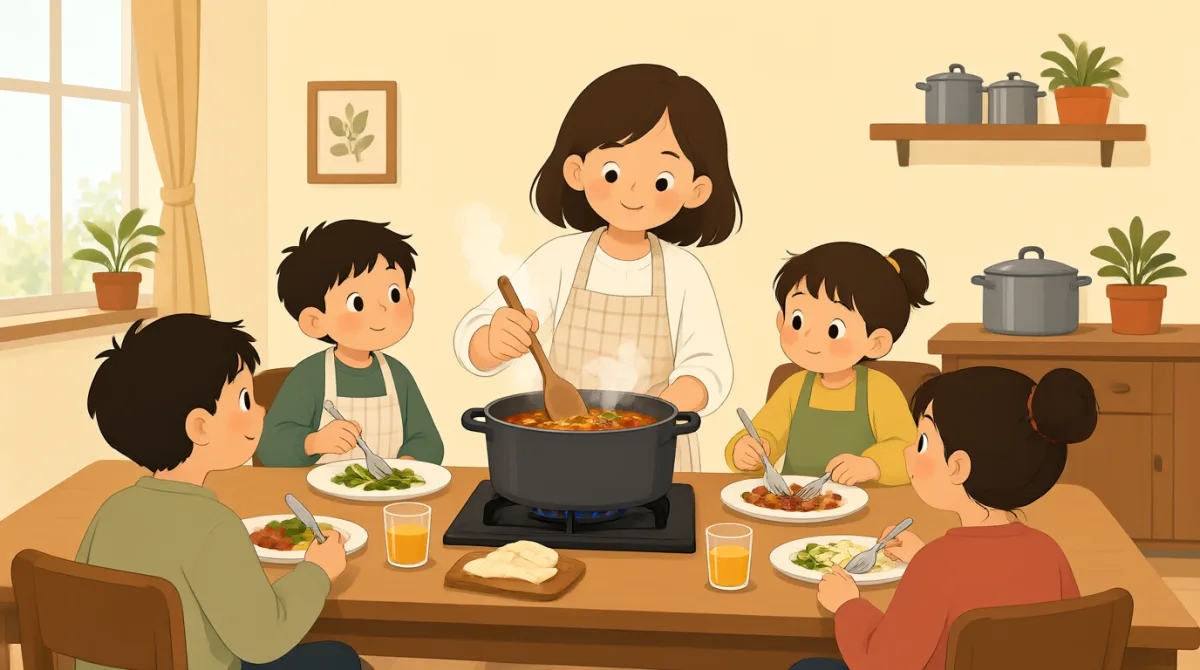

Now, read the recipe. First, pour two cups of water into the pot.
Giờ đọc công thức nhé. Đầu tiên, đổ hai cốc nước vào nồi.

Should I add the tomatoes now, or wait until the water gets hot?
Mình cho cà chua vào bây giờ hay đợi đến khi nước nóng?
Wait until it boils. Then add the tomatoes, beans, and a little salt.
Đợi đến khi nước sôi. Sau đó cho cà chua, đậu và một chút muối vào.

How long should we cook everything? I don't want to burn lunch.
Mình nên nấu tất cả trong bao lâu? Tớ không muốn làm cháy bữa trưa đâu.
Cook it for ten minutes. Stir it gently every few minutes.
Nấu trong mười phút nhé. Cứ vài phút thì khuấy nhẹ một lần.
The soup is bubbling now. Should I turn the heat down?
Súp đang sôi lục bục rồi. Mình có nên vặn nhỏ lửa không?
Yes, turn it down to low. Keep stirring so nothing sticks.
Ừ, vặn lửa xuống mức nhỏ nhé. Cứ khuấy để thức ăn không bị dính đáy nồi.
I stirred it, and the beans feel soft. Can we taste it now?
Tớ khuấy rồi, đậu mềm rồi. Bây giờ mình nếm thử được chưa?
Sure. Take a small spoonful, and tell me if it needs more salt.
Được chứ. Múc một thìa nhỏ rồi cho tớ biết có cần thêm muối không nhé.
Từ vựng8
- pour two cups of waterđổ hai cốc nước
This means to put two cups of water into the pot. You can use “pour” when adding a liquid to a container.
Cụm này có nghĩa là cho hai cốc nước vào nồi. Bạn có thể dùng “pour” khi thêm chất lỏng vào vật đựng.
- until it boilsđợi đến khi nước sôi
This means to wait until the water gets very hot and starts bubbling. You can say “until it boils” when explaining when to do something.
Cụm này có nghĩa là đợi đến khi nước thật nóng và bắt đầu sủi bọt. Bạn có thể nói “until it boils” để giải thích khi nào nên làm việc gì đó.
- add the tomatoescho cà chua vào
This means to put the tomatoes into the pot. Use “add” when putting an ingredient into food.
Cụm này có nghĩa là cho cà chua vào nồi. Dùng “add” khi cho một nguyên liệu vào món ăn.
- stir it gentlykhuấy nhẹ
This means to mix the food slowly and carefully with a spoon. You can use “stir gently” when giving cooking instructions.
Cụm này có nghĩa là khuấy thức ăn bằng thìa một cách chậm rãi và cẩn thận. Bạn có thể dùng “stir gently” khi hướng dẫn cách nấu.
- turn it down to lowvặn lửa xuống mức nhỏ
This means to lower the heat to a low setting. You can use this phrase when a dish needs to cook more slowly.
Cụm này có nghĩa là giảm nhiệt xuống mức nhỏ. Bạn có thể dùng cụm này khi cần nấu món ăn chậm hơn.
- sticksbị dính
Here, “sticks” means food gets attached to the bottom of the pot. You can say “so nothing sticks” when explaining why you should stir.
Ở đây, “sticks” có nghĩa là thức ăn dính vào đáy nồi. Bạn có thể nói “so nothing sticks” để giải thích vì sao cần khuấy.
- a small spoonfulmột thìa nhỏ
This means a small amount of food that fits on a spoon. Use it when tasting food or serving a little.
Cụm này có nghĩa là một lượng thức ăn nhỏ vừa trên thìa. Dùng cụm này khi nếm món ăn hoặc múc một ít.
- needs more saltcần thêm muối
This means the food may need extra salt to taste better. You can use this phrase when asking someone to check the flavor.
Cụm này có nghĩa là món ăn có thể cần thêm muối để ngon hơn. Bạn có thể dùng cụm này khi nhờ ai đó nếm thử và nhận xét hương vị.
Câu trọng tâm8
- 1
First, pour two cups of water into the pot.
Đầu tiên, đổ hai cốc nước vào nồi.
This gives a clear first step in a recipe. You can reuse the pattern “First, pour [amount] of [liquid] into the [container].”
Câu này nêu rõ bước đầu tiên trong công thức. Bạn có thể dùng lại cấu trúc “First, pour [amount] of [liquid] into the [container].” (Đầu tiên, đổ [lượng] [chất lỏng] vào [vật đựng].)
- 2
Should I add the tomatoes now, or wait until the water gets hot?
Mình cho cà chua vào bây giờ hay đợi đến khi nước nóng?
This is a useful way to ask whether to do something now or later. Replace “add the tomatoes” with another task to ask about the right time.
Đây là cách hữu ích để hỏi nên làm việc gì đó ngay bây giờ hay để sau. Thay “add the tomatoes” bằng một việc khác để hỏi thời điểm thích hợp.
- 3
Cook it for ten minutes.
Nấu trong mười phút nhé.
This tells someone how long to cook something. You can use “Cook it for [time]” to give a simple cooking instruction.
Câu này cho biết nên nấu món ăn trong bao lâu. Bạn có thể dùng “Cook it for [time]” để đưa ra hướng dẫn nấu ăn đơn giản.
- 4
Stir it gently every few minutes.
Cứ vài phút thì khuấy nhẹ một lần.
This gives both the action and how often to do it. You can change “gently” or “every few minutes” to give different instructions.
Câu này vừa nêu hành động vừa cho biết tần suất thực hiện. Bạn có thể thay “gently” hoặc “every few minutes” để đưa ra hướng dẫn khác.
- 5
Yes, turn it down to low.
Ừ, vặn lửa xuống mức nhỏ nhé.
This is a short, practical instruction for lowering the heat. You can replace “low” with another heat setting, such as “medium.”
Đây là hướng dẫn ngắn gọn, thiết thực để giảm nhiệt. Bạn có thể thay “low” bằng một mức nhiệt khác, chẳng hạn “medium.”
- 6
Keep stirring so nothing sticks.
Cứ khuấy để thức ăn không bị dính đáy nồi.
This explains what to keep doing and why. Use “Keep [verb]-ing so [result]” to give a helpful reminder.
Câu này giải thích việc cần tiếp tục làm và lý do. Dùng “Keep [verb]-ing so [result]” để nhắc nhở một cách hữu ích.
- 7
Can we taste it now?
Bây giờ mình nếm thử được chưa?
This is a simple way to ask if it is okay to try some food. You can replace “taste it” with another action to ask permission.
Đây là cách đơn giản để hỏi xem mình có thể nếm thử món ăn không. Bạn có thể thay “taste it” bằng một hành động khác để xin phép.
- 8
Take a small spoonful, and tell me if it needs more salt.
Múc một thìa nhỏ rồi cho tớ biết có cần thêm muối không nhé.
This gives someone two clear steps: taste a little and say what the food needs. You can replace “more salt” with another ingredient or seasoning.
Câu này đưa ra hai bước rõ ràng: nếm một chút rồi cho biết món ăn cần thêm gì. Bạn có thể thay “more salt” bằng một nguyên liệu hoặc gia vị khác.