Following the Recipe
레시피 따라 하기
The class follows the recipe and adds the ingredients to a pot. Grace explains when to stir and how long to cook the food.
수업에서 레시피를 따라 냄비에 재료를 넣어요. 그레이스가 언제 저어야 하는지, 음식을 얼마나 오래 익혀야 하는지 설명해요.
대화9
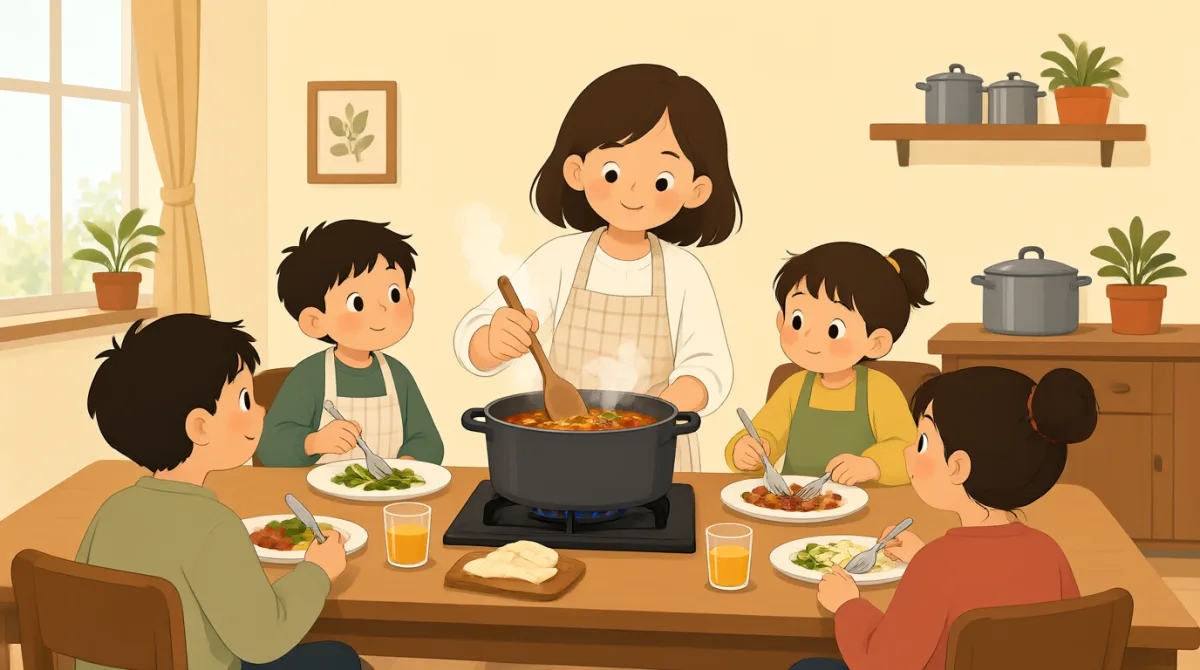

Now, read the recipe. First, pour two cups of water into the pot.
자, 레시피를 읽어 봐. 먼저 냄비에 물 두 컵을 부어.

Should I add the tomatoes now, or wait until the water gets hot?
토마토를 지금 넣을까, 물이 뜨거워질 때까지 기다릴까?
Wait until it boils. Then add the tomatoes, beans, and a little salt.
물이 끓을 때까지 기다려. 그런 다음 토마토와 콩, 소금을 조금 넣어.

How long should we cook everything? I don't want to burn lunch.
전부 얼마나 오래 익혀야 해? 점심을 태우고 싶진 않아.
Cook it for ten minutes. Stir it gently every few minutes.
10분 동안 익혀. 몇 분마다 살살 저어 줘.
The soup is bubbling now. Should I turn the heat down?
수프가 이제 보글보글 끓어. 불을 낮출까?
Yes, turn it down to low. Keep stirring so nothing sticks.
응, 약불로 낮춰. 냄비 바닥에 눌어붙지 않게 계속 저어 줘.
I stirred it, and the beans feel soft. Can we taste it now?
저었더니 콩이 부드러워. 이제 맛봐도 돼?
Sure. Take a small spoonful, and tell me if it needs more salt.
그럼. 작은 숟가락으로 조금 떠서 먹어 보고, 소금이 더 필요한지 말해 줘.
어휘8
- pour two cups of water물 두 컵을 붓다
This means to put two cups of water into the pot. You can use “pour” when adding a liquid to a container.
냄비에 물 두 컵을 넣는다는 뜻이에요. 액체를 용기에 넣을 때 “pour”를 쓸 수 있어요.
- until it boils물이 끓을 때까지
This means to wait until the water gets very hot and starts bubbling. You can say “until it boils” when explaining when to do something.
물이 아주 뜨거워져서 보글보글 끓기 시작할 때까지 기다린다는 뜻이에요. 어떤 일을 언제 해야 하는지 설명할 때 “until it boils”라고 할 수 있어요.
- add the tomatoes토마토를 넣다
This means to put the tomatoes into the pot. Use “add” when putting an ingredient into food.
냄비에 토마토를 넣는다는 뜻이에요. 음식에 재료를 넣을 때 “add”를 써요.
- stir it gently살살 젓다
This means to mix the food slowly and carefully with a spoon. You can use “stir gently” when giving cooking instructions.
숟가락으로 음식을 천천히 조심스럽게 섞는다는 뜻이에요. 요리 방법을 알려 줄 때 “stir gently”라고 할 수 있어요.
- turn it down to low불을 약불로 낮추다
This means to lower the heat to a low setting. You can use this phrase when a dish needs to cook more slowly.
불을 약한 단계로 낮춘다는 뜻이에요. 음식을 더 천천히 익혀야 할 때 이 표현을 쓸 수 있어요.
- sticks눌어붙다
Here, “sticks” means food gets attached to the bottom of the pot. You can say “so nothing sticks” when explaining why you should stir.
여기서 “sticks”는 음식이 냄비 바닥에 붙는다는 뜻이에요. 왜 저어야 하는지 설명할 때 “so nothing sticks”라고 할 수 있어요.
- a small spoonful작은 숟가락 한 술
This means a small amount of food that fits on a spoon. Use it when tasting food or serving a little.
숟가락에 담기는 적은 양의 음식을 뜻해요. 음식을 맛보거나 조금 덜어 줄 때 쓸 수 있어요.
- needs more salt소금이 더 필요하다
This means the food may need extra salt to taste better. You can use this phrase when asking someone to check the flavor.
음식 맛을 더 좋게 하려면 소금을 더 넣어야 할 수도 있다는 뜻이에요. 누군가에게 간을 확인해 달라고 할 때 이 표현을 쓸 수 있어요.
핵심 문장8
- 1
First, pour two cups of water into the pot.
먼저 냄비에 물 두 컵을 부어.
This gives a clear first step in a recipe. You can reuse the pattern “First, pour [amount] of [liquid] into the [container].”
레시피의 첫 단계를 분명하게 알려 주는 문장이에요. “First, pour [amount] of [liquid] into the [container].”라는 패턴을 활용해 “먼저 [용기]에 [액체] [양]을 부어.”라고 말할 수 있어요.
- 2
Should I add the tomatoes now, or wait until the water gets hot?
토마토를 지금 넣을까, 물이 뜨거워질 때까지 기다릴까?
This is a useful way to ask whether to do something now or later. Replace “add the tomatoes” with another task to ask about the right time.
어떤 일을 지금 할지 나중에 할지 물어볼 때 유용한 표현이에요. 알맞은 시점을 물어보려면 “add the tomatoes”를 다른 할 일로 바꿔 보세요.
- 3
Cook it for ten minutes.
10분 동안 익혀.
This tells someone how long to cook something. You can use “Cook it for [time]” to give a simple cooking instruction.
무언가를 얼마나 오래 익혀야 하는지 알려 주는 문장이에요. 간단한 요리 지시를 할 때 “Cook it for [time]”을 활용할 수 있어요.
- 4
Stir it gently every few minutes.
몇 분마다 살살 저어 줘.
This gives both the action and how often to do it. You can change “gently” or “every few minutes” to give different instructions.
무엇을 해야 하는지와 얼마나 자주 해야 하는지를 함께 알려 줘요. 지시를 다르게 하고 싶다면 “gently”나 “every few minutes”를 바꿔 보세요.
- 5
Yes, turn it down to low.
응, 약불로 낮춰.
This is a short, practical instruction for lowering the heat. You can replace “low” with another heat setting, such as “medium.”
불을 낮추라고 짧고 실용적으로 말하는 표현이에요. “low”를 “medium”처럼 다른 불 세기로 바꿀 수 있어요.
- 6
Keep stirring so nothing sticks.
냄비 바닥에 눌어붙지 않게 계속 저어 줘.
This explains what to keep doing and why. Use “Keep [verb]-ing so [result]” to give a helpful reminder.
무엇을 계속 해야 하는지와 그 이유를 설명해요. 도움이 되는 주의를 줄 때 “Keep [verb]-ing so [result]”를 활용할 수 있어요.
- 7
Can we taste it now?
이제 맛봐도 돼?
This is a simple way to ask if it is okay to try some food. You can replace “taste it” with another action to ask permission.
음식을 조금 먹어 봐도 되는지 물어보는 간단한 표현이에요. 허락을 구할 때 “taste it”을 다른 행동으로 바꿔 말할 수 있어요.
- 8
Take a small spoonful, and tell me if it needs more salt.
작은 숟가락으로 조금 떠서 먹어 보고, 소금이 더 필요한지 말해 줘.
This gives someone two clear steps: taste a little and say what the food needs. You can replace “more salt” with another ingredient or seasoning.
조금 맛본 다음 음식에 무엇이 필요한지 말해 달라는 두 가지 지시를 분명하게 해요. “more salt”를 다른 재료나 양념으로 바꿔 쓸 수 있어요.