Checking for Holes
Emma checks the jacket for holes and other signs of wear. Mia helps her look it over.
Dialogue8
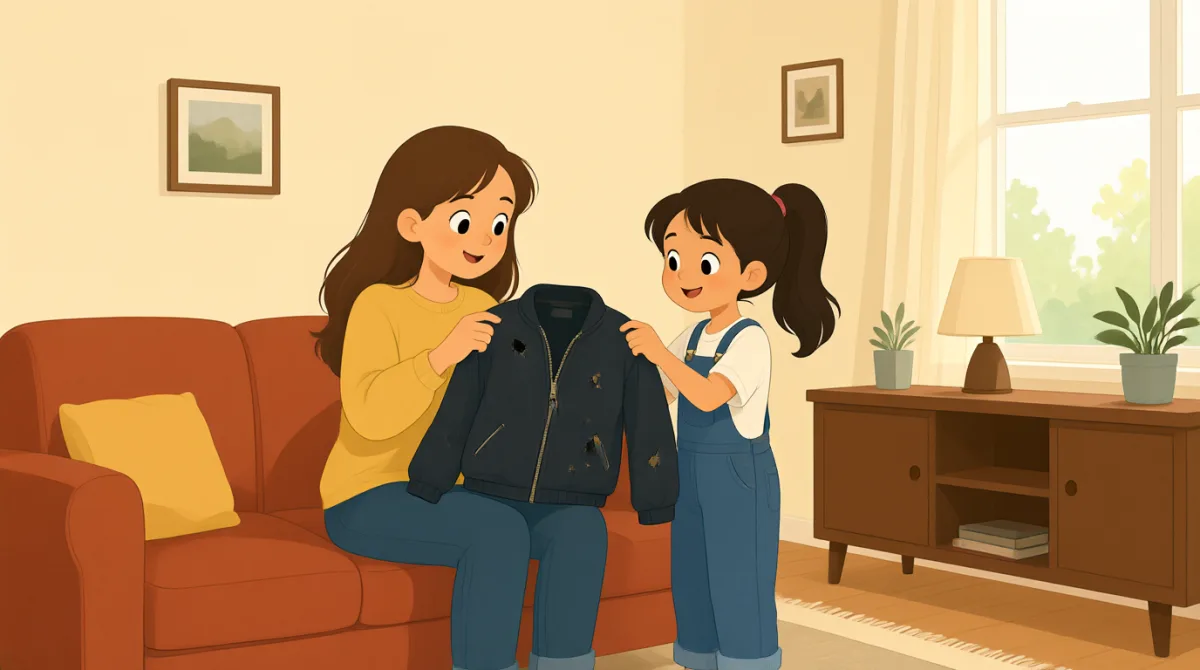

I like this jacket. Can you help me check it for holes?

Sure. Let’s look at the sleeves first. I don’t see any holes.
What about the pockets? The fabric looks a little thin here.
You’re right. But it’s not torn. Let’s check the buttons, too.
They all look good. I see some small marks near the collar.
They might come out in the wash. The lining looks clean, though.
Great. I don’t mind a few marks if the jacket is in good shape.
It looks pretty good overall. Check the zipper before you decide.
Vocabulary7
- check it for holes
Look carefully to see if something has holes. You can use this phrase when checking the condition of clothing.
- sleeves
The parts of a jacket or shirt that cover your arms. You can check the sleeves for holes or stains.
- fabric
The material that clothes are made from. Use this word to describe how clothing looks or feels.
- torn
Damaged because the fabric has been pulled or cut apart. A small hole is not always a tear.
- marks
Small spots or lines on a surface. On clothing, marks may be dirt or stains.
- in the wash
Washed in a washing machine or by hand. This phrase is often used to talk about cleaning clothes.
- in good shape
In good condition, with little damage. You can use this phrase when deciding whether to buy something used.
Key Sentences8
- 1
Can you help me check it for holes?
Use this question to ask someone to help inspect an item. Replace “it” with the thing you want to check.
- 2
I don’t see any holes.
This is a simple way to say that you have looked and found no holes. You can replace “holes” with another problem, such as stains.
- 3
The fabric looks a little thin here.
Use this sentence to point out a part of clothing that may be worn. Replace “thin” with another description, such as “dirty” or “rough.”
- 4
But it’s not torn.
This sentence says that something is not ripped or damaged in that way. You can use “But it’s not…” to add a reassuring detail.
- 5
They all look good.
Use this sentence to say that several things seem to be in good condition. It works for buttons, shoes, or other items.
- 6
They might come out in the wash.
Use this sentence when you think marks or stains may disappear after washing. “Might” shows that you are not completely sure.
- 7
I don’t mind a few marks if the jacket is in good shape.
This sentence explains that a small problem is acceptable if the item is otherwise in good condition. You can replace “marks” and “jacket” with other details.
- 8
Check the zipper before you decide.
Use this sentence to suggest checking something before making a choice. Replace “the zipper” with another part or feature to inspect.