Looking for a Sofa
Emma visits a furniture store and tells Jack, a sales assistant, that she needs a sofa for her apartment. They look at a few options.
Dialogue8
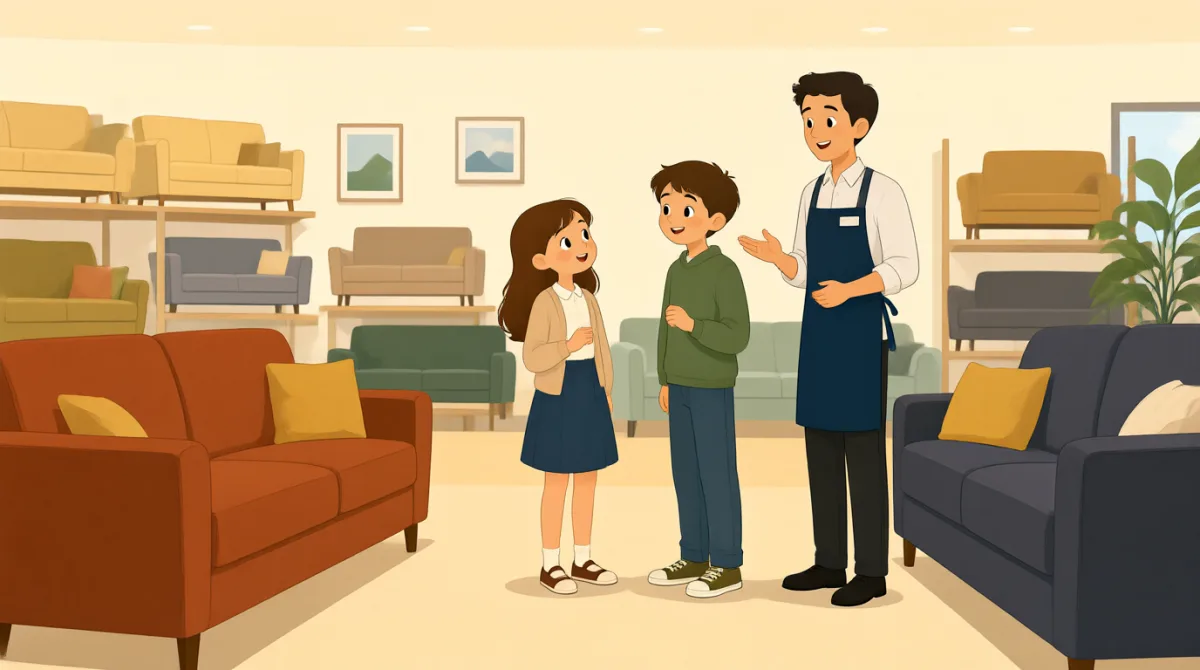

Hi, I’m looking for a sofa for my apartment.

Sure! Are you looking for something big or small?
Something small, please. My living room isn’t very big.
This sofa is a good choice. It’s comfortable and not too large.
It looks nice. Do you have other sofas I can see?
Yes, we have a few styles over there. You can try them out.
Great! I want to look at a few before I choose.
Of course. Let me show you the other options.
Vocabulary8
- looking for
This means trying to find something. Use it to tell a shop assistant what you want.
- a good choice
This means something is suitable or a good option. You can use it when recommending or choosing an item.
- comfortable
This means pleasant to sit or relax on. You can use it to describe furniture, clothes, or a place.
- not too large
This means something is not bigger than you want. Use it to describe a size that works for your space.
- other sofas
This means sofas that are different from the one you are looking at. Use “other” before a plural noun when asking about more options.
- try them out
This means test something to see if you like it. In a store, you can try out a sofa by sitting on it.
- look at a few
This means examine several things. Use it when you want to compare options before choosing.
- show you
This means help you see or find something. A shop assistant may use this phrase when offering to guide you.
Key Sentences7
- 1
I’m looking for a sofa for my apartment.
This is a useful way to tell a shop assistant what you need. Replace “a sofa” with another item, such as “a table” or “a lamp.”
- 2
Are you looking for something big or small?
Use this question to ask about the size someone wants. You can replace “big or small” with other choices, such as “light or dark.”
- 3
My living room isn’t very big.
This sentence explains why you need something small. You can use “isn’t very” before an adjective to describe a room or another thing.
- 4
Do you have other sofas I can see?
Use this polite question to ask about more options. Replace “sofas” with another item, such as “chairs” or “tables.”
- 5
You can try them out.
This is a simple way to tell someone they can test a few items. Use “try it out” for one item and “try them out” for more than one.
- 6
I want to look at a few before I choose.
Use this sentence when you want to compare options before making a decision. You can replace “look at” with “try” or “compare.”
- 7
Let me show you the other options.
This is a friendly way to offer help and introduce different choices. You can replace “options” with a specific item, such as “the other sofas.”