Asking About the Size
Emma asks Jack how wide the sofa is and checks whether it will fit in her living room. Jack helps her compare its measurements.
Dialogue8
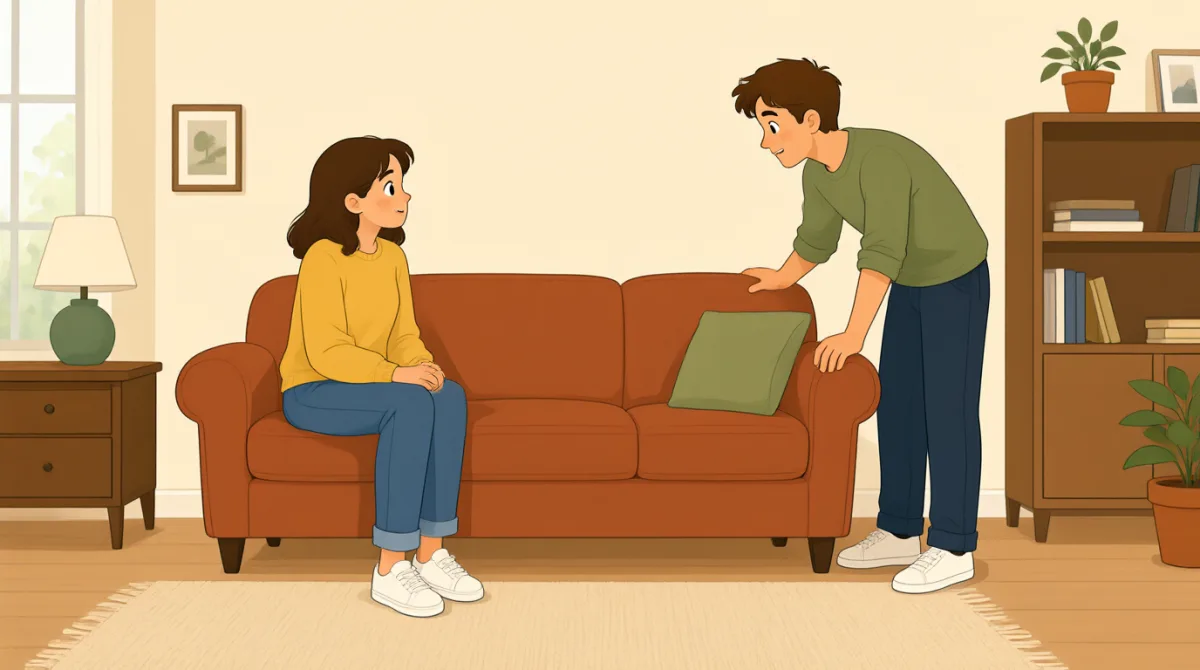

How wide is this sofa? I want to make sure it fits in my living room.

It's eighty inches wide, and the seat is thirty-six inches deep.
My living room is about nine feet wide. Is that enough space?
It should fit, but leave some room to walk around it.
I measured the wall yesterday. It's ten feet long.
That gives you about two feet on each side of the sofa.
What about the depth? Will it leave enough room in front?
If you leave three feet between the sofa and the table, you'll have room to walk.
Vocabulary8
- make sure
To check that something is true or will happen. Use it when you want to confirm that furniture will fit.
- fits in my living room
Means that something is the right size to go in your living room. You can use “fits in” to talk about whether an item will go in a space.
- wide
Describes the measurement from one side to the other. Ask “How wide is it?” to find out an item's width.
- deep
Describes how far something goes from front to back. Ask “How deep is it?” to check how much space it needs.
- leave some room
Means to keep some space free. Use it when planning where to put furniture so people can move around.
- measured the wall
Means checked how long or wide the wall is. You can measure a room or wall before buying furniture.
- on each side
Means on both sides of something. Use it to describe how space is divided around an object.
- room to walk
Means enough open space for people to move around. You can use this phrase when arranging furniture.
Key Sentences8
- 1
How wide is this sofa?
A simple way to ask for the width of an item. You can replace “sofa” with another piece of furniture.
- 2
I want to make sure it fits in my living room.
Use this to explain that you are checking an item's size before buying it. Replace “living room” with another space.
- 3
My living room is about nine feet wide.
This sentence gives an approximate measurement. Use “about” when you are not giving an exact number.
- 4
It should fit, but leave some room to walk around it.
This gives a helpful opinion about fit and space. Use “It should fit, but…” to mention a condition or concern.
- 5
I measured the wall yesterday.
Use this to say that you checked a wall's size in the past. You can replace “the wall” with “the room” or another object.
- 6
What about the depth?
A short way to ask about another measurement. Use “What about…?” to bring up a new detail.
- 7
Will it leave enough room in front?
This asks whether there will be enough open space in front of an item. You can use it when planning a room layout.
- 8
If you leave three feet between the sofa and the table, you'll have room to walk.
This explains how much space to leave so people can move around. Use “If you leave [space] between [items], you'll have room to walk” for other furniture.