Waiting at the School Gate
Emma waits at the school gate with Mia, another parent. They talk while the children come out.
Dialogue6
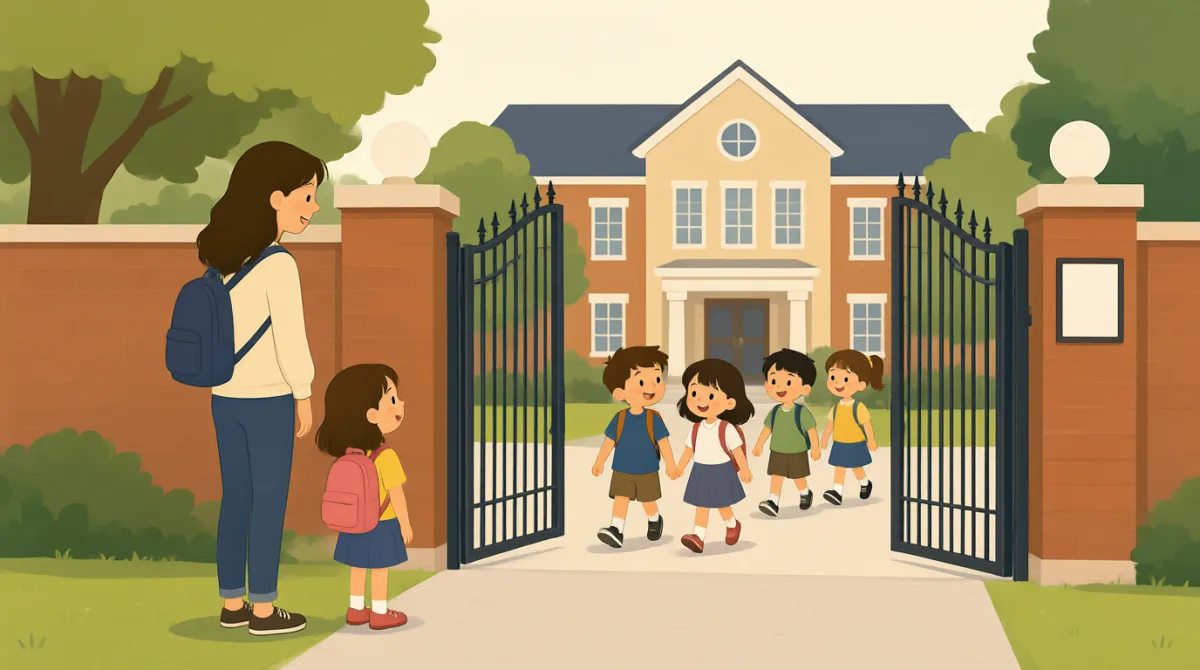

Hi, Mia. Are you waiting for your child, too?

Yes. School ends at three today.
I’m glad the weather is nice.
Me too. The children are coming out now.
I see my son. He has his blue bag.
There’s my daughter, too. Let’s go say hi.
Vocabulary6
- waiting for your child
This means staying until your child arrives. You can use “waiting for” when you are expecting someone.
- ends at three
This tells the time when school finishes. You can say “The movie ends at six” to give an end time.
- the weather is nice
This means the weather is pleasant. You can use it to make friendly conversation.
- coming out
Here, this means the children are leaving the school building. You can use “coming out” when people leave a place.
- blue bag
This means a bag that is blue. You can use a color before a thing to describe it.
- say hi
This means to greet someone. You can say “Let’s go say hi” when you want to greet a person.
Key Sentences8
- 1
Are you waiting for your child, too?
Use this question to ask if someone is waiting for their child as well. Change “your child” to another person or thing to ask what someone is waiting for.
- 2
School ends at three today.
This gives the time school finishes. You can use “___ ends at ___” to talk about when an event finishes.
- 3
I’m glad the weather is nice.
This is a friendly way to say you feel happy about the pleasant weather. You can change “the weather is nice” to share another reason you are glad.
- 4
The children are coming out now.
Use this to say that children are leaving a place at this moment. You can replace “the children” with other people, such as “The students are coming out now.”
- 5
I see my son.
This is a simple way to say you can see your son. You can replace “my son” with another person or thing you notice.
- 6
He has his blue bag.
Use this sentence to describe what someone has with them. You can change “blue bag” to another item, such as “a red coat.”
- 7
There’s my daughter, too.
Use this when you notice someone and want to point them out. “Too” shows that she is there as well.
- 8
Let’s go say hi.
This is a friendly way to suggest greeting someone together. You can use “Let’s go” to suggest doing an activity with another person.