Picking Up a Friend's Child
Mia asks Emma to take her child home, too. Emma checks the child's name before they leave.
Dialogue6
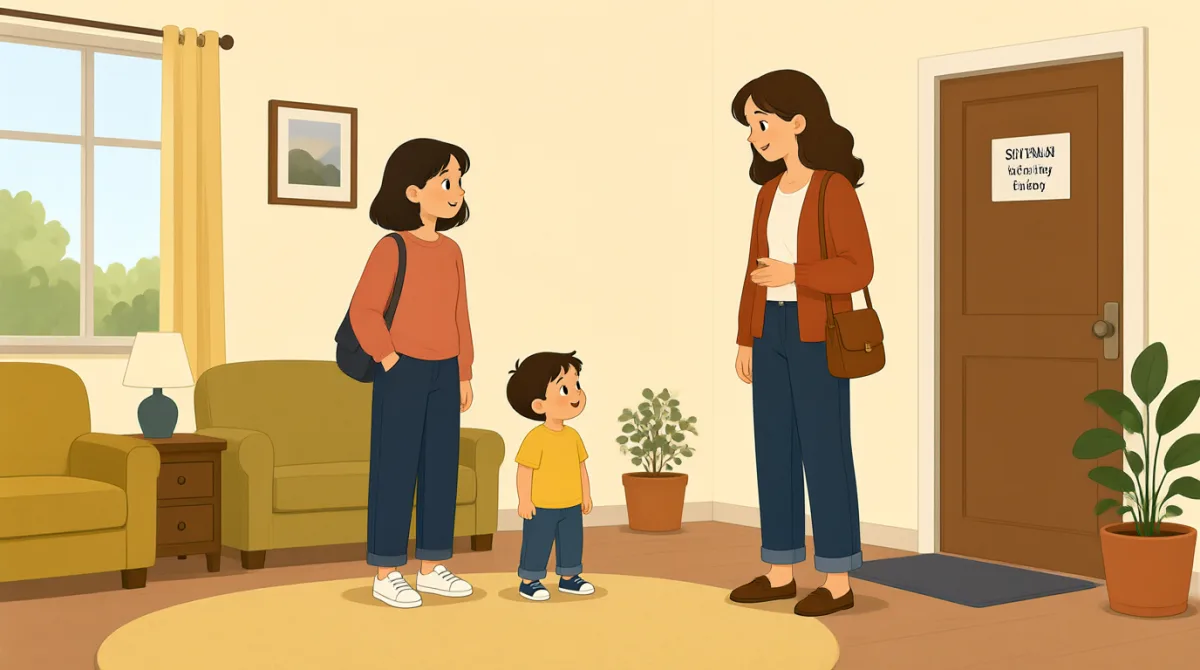

Emma, can you take my child home, too?

Sure. What is your child's name?
Her name is Lily. She is by the gate.
Okay. Is she wearing a blue coat?
Yes, that's her. Thank you so much.
You're welcome. Let's go find her.
Vocabulary8
- take my child home
This means to bring my child to their home. Use “take [someone] home” when you offer to bring someone home.
- Sure.
This is a friendly way to say yes. You can use it when someone asks you for help.
- What is your child's name?
Use this question to ask for a child's name. You can also ask, “What is his name?” or “What is her name?”
- by the gate
This means near the gate. Use “by” to say that a person or thing is next to a place.
- wearing a blue coat
This describes clothes someone has on. You can replace “a blue coat” with another item of clothing.
- that's her
This means the person you see is the girl you are talking about. Use “that's him” for a boy.
- Thank you so much.
This is a warm way to say thank you. Use it when someone does something helpful for you.
- Let's go find her.
This means “Let us go and look for her.” Use “Let's go find [someone]” to suggest looking for a person together.
Key Sentences8
- 1
Emma, can you take my child home, too?
Use “Can you…?” to make a polite request. You can replace “take my child home” with another helpful action.
- 2
Sure.
This is a simple, friendly way to agree. You can use it to accept a request or offer.
- 3
What is your child's name?
Use this question to ask someone for their child's name. You can change “your child” to “your son” or “your daughter.”
- 4
Her name is Lily.
Use “Her name is…” to tell someone a girl's name. For a boy, say “His name is…”.
- 5
She is by the gate.
This tells someone where a girl is. Replace “by the gate” with another place to give a different location.
- 6
Is she wearing a blue coat?
Use this yes-or-no question to check what someone is wearing. You can replace “a blue coat” with another clothing item.
- 7
Yes, that's her.
Use this to confirm that a girl is the person you mean. For a boy, say “Yes, that's him.”
- 8
Let's go find her.
Use “Let's…” to suggest doing something together. Replace “find her” with another action, such as “go home.”