Waiting at the School Gate
Okul Kapısında Beklerken
Emma waits at the school gate with Mia, another parent. They talk while the children come out.
Emma, başka bir veli olan Mia’yla okul kapısında bekliyor. Çocuklar çıkarken sohbet ediyorlar.
Diyalog6
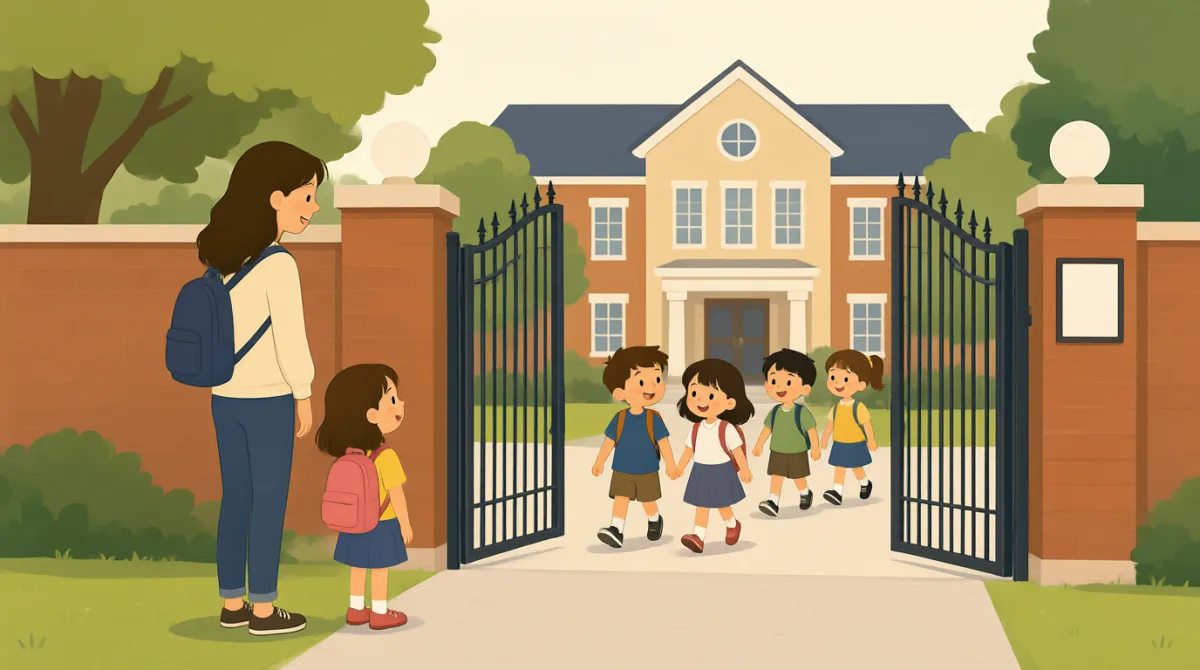

Hi, Mia. Are you waiting for your child, too?
Merhaba, Mia. Sen de çocuğunu mu bekliyorsun?

Yes. School ends at three today.
Evet. Bugün okul saat üçte bitiyor.
I’m glad the weather is nice.
Havanın güzel olmasına sevindim.
Me too. The children are coming out now.
Ben de. Çocuklar şimdi çıkıyor.
I see my son. He has his blue bag.
Oğlumu gördüm. Mavi çantası var.
There’s my daughter, too. Let’s go say hi.
Kızım da orada. Hadi gidip merhaba diyelim.
Kelime Bilgisi6
- waiting for your childçocuğunu beklemek
This means staying until your child arrives. You can use “waiting for” when you are expecting someone.
Bu, çocuğun gelene kadar beklemek demek. Birini beklediğinde “waiting for” ifadesini kullanabilirsin.
- ends at threesaat üçte bitmek
This tells the time when school finishes. You can say “The movie ends at six” to give an end time.
Bu ifade, okulun ne zaman bittiğini söyler. Bitiş saatini belirtmek için “The movie ends at six” diyebilirsin.
- the weather is nicehava güzel
This means the weather is pleasant. You can use it to make friendly conversation.
Bu, havanın hoş olduğu anlamına gelir. Samimi bir sohbet başlatmak için bu ifadeyi kullanabilirsin.
- coming outdışarı çıkmak
Here, this means the children are leaving the school building. You can use “coming out” when people leave a place.
Burada çocukların okul binasından çıktığı anlamına gelir. İnsanlar bir yerden çıkarken “coming out” ifadesini kullanabilirsin.
- blue bagmavi çanta
This means a bag that is blue. You can use a color before a thing to describe it.
Bu, mavi renkte bir çanta demek. Bir şeyi tanımlamak için önüne rengini söyleyebilirsin.
- say himerhaba demek
This means to greet someone. You can say “Let’s go say hi” when you want to greet a person.
Bu, birini selamlamak demek. Birini selamlamak istediğinde “Let’s go say hi” diyebilirsin.
Önemli Cümleler8
- 1
Are you waiting for your child, too?
Sen de çocuğunu mu bekliyorsun?
Use this question to ask if someone is waiting for their child as well. Change “your child” to another person or thing to ask what someone is waiting for.
Birinin de çocuğunu bekleyip beklemediğini sormak için bu soruyu kullan. Birinin neyi beklediğini sormak için “your child” yerine başka bir kişi ya da şey söyleyebilirsin.
- 2
School ends at three today.
Bugün okul saat üçte bitiyor.
This gives the time school finishes. You can use “___ ends at ___” to talk about when an event finishes.
Bu cümle okulun ne zaman bittiğini söyler. Bir etkinliğin ne zaman biteceğinden söz ederken “___ ends at ___” kalıbını kullanabilirsin.
- 3
I’m glad the weather is nice.
Havanın güzel olmasına sevindim.
This is a friendly way to say you feel happy about the pleasant weather. You can change “the weather is nice” to share another reason you are glad.
Bu, güzel hava yüzünden mutlu olduğunu samimi bir şekilde ifade eder. Sevindiğin başka bir nedeni paylaşmak için “the weather is nice” kısmını değiştirebilirsin.
- 4
The children are coming out now.
Çocuklar şimdi çıkıyor.
Use this to say that children are leaving a place at this moment. You can replace “the children” with other people, such as “The students are coming out now.”
Çocukların şu anda bir yerden çıktığını söylemek için bunu kullan. “The children” yerine “The students are coming out now.” örneğindeki gibi başka kişileri söyleyebilirsin.
- 5
I see my son.
Oğlumu gördüm.
This is a simple way to say you can see your son. You can replace “my son” with another person or thing you notice.
Bu, oğlunu görebildiğini söylemenin basit bir yoludur. Fark ettiğin başka bir kişiyi ya da şeyi belirtmek için “my son” kısmını değiştirebilirsin.
- 6
He has his blue bag.
Mavi çantası var.
Use this sentence to describe what someone has with them. You can change “blue bag” to another item, such as “a red coat.”
Birinin yanında ne olduğunu anlatmak için bu cümleyi kullan. “Blue bag” yerine “a red coat” gibi başka bir eşya söyleyebilirsin.
- 7
There’s my daughter, too.
Kızım da orada.
Use this when you notice someone and want to point them out. “Too” shows that she is there as well.
Birini fark edip göstermek istediğinde bunu kullan. “Too”, onun da orada olduğunu belirtir.
- 8
Let’s go say hi.
Hadi gidip merhaba diyelim.
This is a friendly way to suggest greeting someone together. You can use “Let’s go” to suggest doing an activity with another person.
Birini birlikte selamlamayı önermenin samimi bir yoludur. Başka biriyle birlikte bir etkinlik yapmayı önermek için “Let’s go” kalıbını kullanabilirsin.