Waiting at the School Gate
在校門口等候
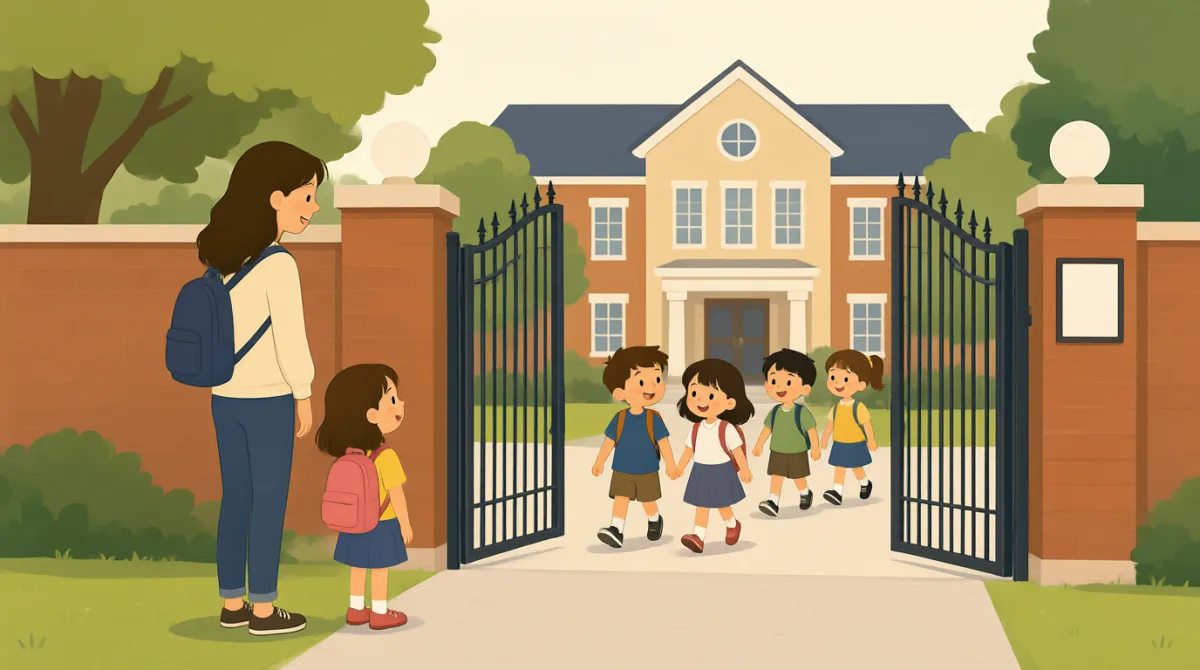
Emma waits at the school gate with Mia, another parent. They talk while the children come out.
艾瑪和另一位家長米婭在校門口等候。孩子們出來前,她們聊了幾句。
對話6

Hi, Mia. Are you waiting for your child, too?
嗨,米婭。你也在等孩子嗎?

Yes. School ends at three today.
是的。今天學校三點放學。
I’m glad the weather is nice.
天氣這麼好,真讓人開心。
Me too. The children are coming out now.
我也這麼覺得。孩子們現在出來了。
I see my son. He has his blue bag.
我看到我兒子了。他揹著藍色的包。
There’s my daughter, too. Let’s go say hi.
我女兒也出來了。我們過去打個招呼吧。
詞彙6
- waiting for your child等孩子
This means staying until your child arrives. You can use “waiting for” when you are expecting someone.
這表示一直等到孩子來。等人時,可以用“waiting for”(等待)。
- ends at three三點結束
This tells the time when school finishes. You can say “The movie ends at six” to give an end time.
這說明學校幾點放學。你也可以說“The movie ends at six”(電影六點結束)來說明結束時間。
- the weather is nice天氣很好
This means the weather is pleasant. You can use it to make friendly conversation.
這表示天氣宜人。你可以用這句話來友好地開啟聊天。
- coming out出來
Here, this means the children are leaving the school building. You can use “coming out” when people leave a place.
這裡指孩子們正從學校大樓裡出來。人們離開某個地方時,可以用“coming out”(出來)。
- blue bag藍色的包
This means a bag that is blue. You can use a color before a thing to describe it.
這表示一個藍色的包。你可以把顏色放在物品前面來描述它。
- say hi打招呼
This means to greet someone. You can say “Let’s go say hi” when you want to greet a person.
這表示向別人問好。想和別人打招呼時,可以說“Let’s go say hi”(我們過去打個招呼吧)。
關鍵句8
- 1
Are you waiting for your child, too?
你也在等孩子嗎?
Use this question to ask if someone is waiting for their child as well. Change “your child” to another person or thing to ask what someone is waiting for.
用這個問句詢問對方是不是也在等孩子。把“your child”換成其他人或東西,就可以詢問對方在等什麼。
- 2
School ends at three today.
今天學校三點放學。
This gives the time school finishes. You can use “___ ends at ___” to talk about when an event finishes.
這句話說明學校幾點放學。你可以用“___ ends at ___”來談某項活動什麼時候結束。
- 3
I’m glad the weather is nice.
天氣這麼好,真讓人開心。
This is a friendly way to say you feel happy about the pleasant weather. You can change “the weather is nice” to share another reason you are glad.
這是一種友好的說法,表達你很高興天氣宜人。你可以把“the weather is nice”換成讓你開心的其他原因。
- 4
The children are coming out now.
孩子們現在出來了。
Use this to say that children are leaving a place at this moment. You can replace “the children” with other people, such as “The students are coming out now.”
用這句話表示孩子們此刻正離開某個地方。你可以把“the children”換成其他人,比如“The students are coming out now.”(學生們現在出來了。)
- 5
I see my son.
我看到我兒子了。
This is a simple way to say you can see your son. You can replace “my son” with another person or thing you notice.
這是一種簡單的說法,表示你看到了兒子。你可以把“my son”換成其他你注意到的人或東西。
- 6
He has his blue bag.
他揹著藍色的包。
Use this sentence to describe what someone has with them. You can change “blue bag” to another item, such as “a red coat.”
用這句話描述某人帶著什麼東西。你可以把“blue bag”換成其他物品,比如“a red coat”(一件紅色外套)。
- 7
There’s my daughter, too.
我女兒也出來了。
Use this when you notice someone and want to point them out. “Too” shows that she is there as well.
注意到某人並想指出來時,可以用這句話。“Too”表示她也在這裡。
- 8
Let’s go say hi.
我們過去打個招呼吧。
This is a friendly way to suggest greeting someone together. You can use “Let’s go” to suggest doing an activity with another person.
這是一種友好的說法,提議一起去和別人打招呼。你可以用“Let’s go”來提議和別人一起做某件事。