Waiting at the School Gate
Esperando en la puerta de la escuela
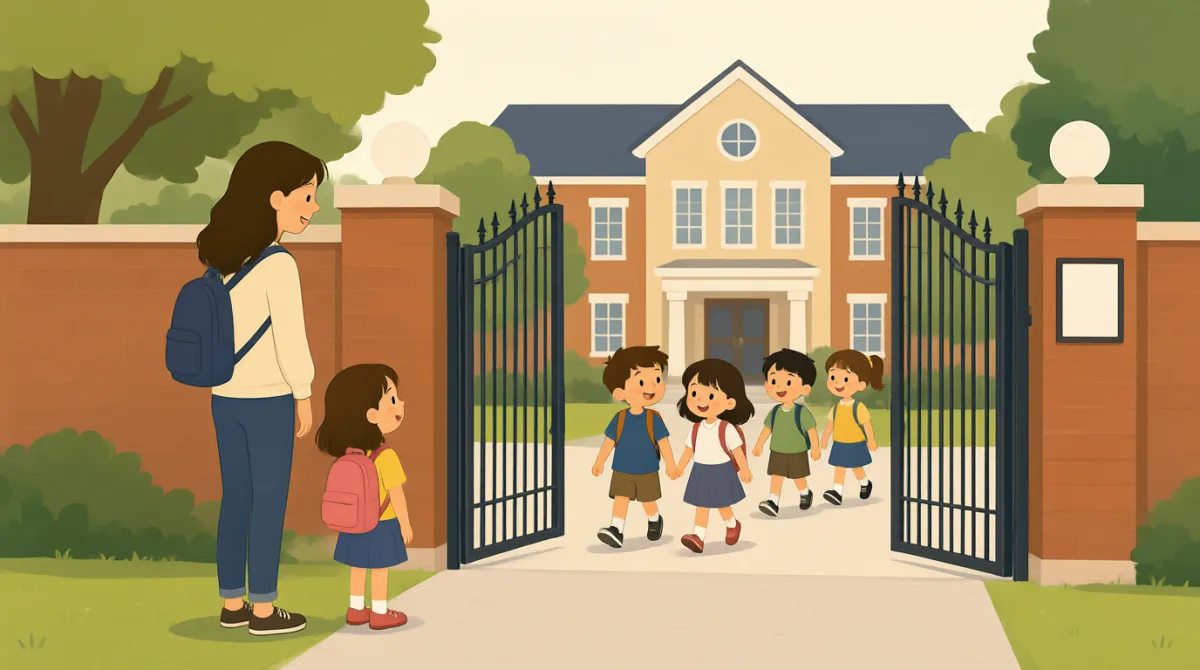
Emma waits at the school gate with Mia, another parent. They talk while the children come out.
Emma espera en la puerta de la escuela con Mia, otra madre. Hablan mientras salen los niños.
Diálogo6

Hi, Mia. Are you waiting for your child, too?
Hola, Mia. ¿Tú también estás esperando a tu hijo?

Yes. School ends at three today.
Sí. Hoy salen de la escuela a las tres.
I’m glad the weather is nice.
Me alegra que haga buen tiempo.
Me too. The children are coming out now.
A mí también. Los niños están saliendo ahora.
I see my son. He has his blue bag.
Veo a mi hijo. Lleva su mochila azul.
There’s my daughter, too. Let’s go say hi.
Ahí está también mi hija. Vamos a saludarla.
Vocabulario6
- waiting for your childesperar a tu hijo
This means staying until your child arrives. You can use “waiting for” when you are expecting someone.
Significa quedarse hasta que llegue tu hijo. Puedes usar “waiting for” (esperando a) cuando esperas a alguien.
- ends at threetermina a las tres
This tells the time when school finishes. You can say “The movie ends at six” to give an end time.
Indica la hora a la que termina la jornada escolar. Puedes decir “The movie ends at six” (La película termina a las seis) para indicar a qué hora acaba algo.
- the weather is nicehace buen tiempo
This means the weather is pleasant. You can use it to make friendly conversation.
Significa que el tiempo es agradable. Puedes decirlo para iniciar una conversación amistosa.
- coming outsaliendo
Here, this means the children are leaving the school building. You can use “coming out” when people leave a place.
Aquí significa que los niños están dejando el edificio de la escuela. Puedes usar “coming out” (saliendo) cuando alguien deja un lugar.
- blue bagmochila azul
This means a bag that is blue. You can use a color before a thing to describe it.
Significa una mochila de color azul. En inglés, puedes poner un color antes de una cosa para describirla.
- say hisaludar
This means to greet someone. You can say “Let’s go say hi” when you want to greet a person.
Significa saludar a alguien. Puedes decir “Let’s go say hi” (Vamos a saludar) cuando quieres saludar a una persona.
Frases clave8
- 1
Are you waiting for your child, too?
¿Tú también estás esperando a tu hijo?
Use this question to ask if someone is waiting for their child as well. Change “your child” to another person or thing to ask what someone is waiting for.
Usa esta pregunta para saber si alguien también está esperando a su hijo. Cambia “your child” por otra persona o cosa para preguntar qué está esperando alguien.
- 2
School ends at three today.
Hoy salen de la escuela a las tres.
This gives the time school finishes. You can use “___ ends at ___” to talk about when an event finishes.
Esta frase indica a qué hora termina la jornada escolar. Puedes usar “___ ends at ___” para hablar de cuándo termina un evento.
- 3
I’m glad the weather is nice.
Me alegra que haga buen tiempo.
This is a friendly way to say you feel happy about the pleasant weather. You can change “the weather is nice” to share another reason you are glad.
Es una manera amistosa de decir que te alegra que el tiempo sea agradable. Puedes cambiar “the weather is nice” por otro motivo por el que te alegres.
- 4
The children are coming out now.
Los niños están saliendo ahora.
Use this to say that children are leaving a place at this moment. You can replace “the children” with other people, such as “The students are coming out now.”
Usa esta frase para decir que los niños están dejando un lugar en este momento. Puedes sustituir “the children” por otras personas, como en “The students are coming out now.”
- 5
I see my son.
Veo a mi hijo.
This is a simple way to say you can see your son. You can replace “my son” with another person or thing you notice.
Es una manera sencilla de decir que puedes ver a tu hijo. Puedes sustituir “my son” por otra persona o cosa que hayas visto.
- 6
He has his blue bag.
Lleva su mochila azul.
Use this sentence to describe what someone has with them. You can change “blue bag” to another item, such as “a red coat.”
Usa esta frase para describir lo que alguien lleva consigo. Puedes cambiar “blue bag” por otra prenda u objeto, como “a red coat.”
- 7
There’s my daughter, too.
Ahí está también mi hija.
Use this when you notice someone and want to point them out. “Too” shows that she is there as well.
Usa esta frase cuando ves a alguien y quieres señalarlo. “Too” indica que ella también está ahí.
- 8
Let’s go say hi.
Vamos a saludar.
This is a friendly way to suggest greeting someone together. You can use “Let’s go” to suggest doing an activity with another person.
Es una manera amistosa de proponer que saluden a alguien juntos. Puedes usar “Let’s go” para proponerle a otra persona hacer algo contigo.