Talking About a Favorite Painting
Hablar sobre una pintura favorita
After seeing the exhibits, Emma and Jack talk about their favorite painting. They share what they liked about it.
Después de ver las obras, Emma y Jack hablan sobre su pintura favorita. Comparten qué les gustó de ella.
Diálogo8
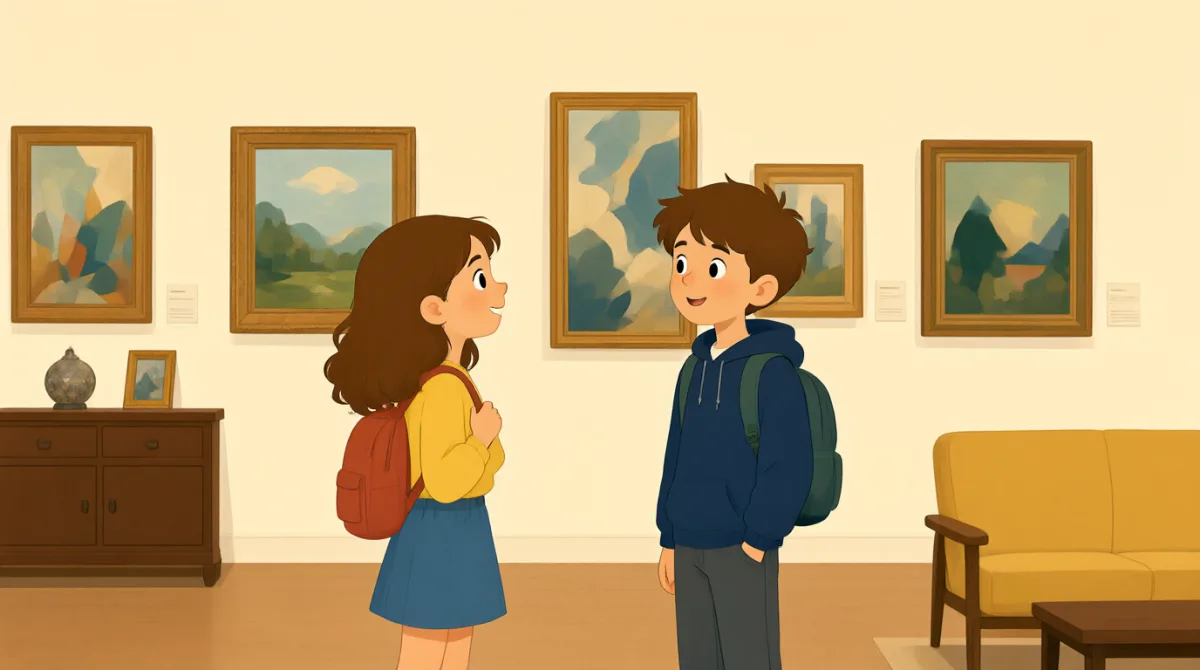

That blue painting was my favorite. The little boat looked so real.
Esa pintura azul fue mi favorita. El barquito parecía tan real.

I liked it too. The colors were bright, but the scene felt peaceful.
A mí también me gustó. Los colores eran vivos, pero la escena transmitía paz.
Yes, and I noticed the waves near the boat. They looked like they were moving.
Sí, y me fijé en las olas cerca del barco. Parecía que se estaban moviendo.
The artist did a great job. I wanted to look at it for a long time.
El artista hizo un trabajo excelente. Quería mirarla durante mucho tiempo.
Did you see the small house on the hill? I almost missed it.
¿Viste la casita en la colina? Casi no la veo.
I saw it. It made me wonder who lived there.
Sí, la vi. Me hizo preguntarme quién vivía allí.
I wish we knew the story behind the painting. Maybe the sign said more.
Ojalá supiéramos la historia detrás de la pintura. Quizá el cartel decía algo más.
Maybe. We can read about it online later. I took a photo of the sign.
Puede ser. Podemos buscar información en internet más tarde. Le saqué una foto al cartel.
Vocabulario8
- my favoritemi favorita
This means the one you like best. Use it to say which painting or other thing you enjoyed most.
Significa que es la que más te gusta. Úsalo para decir qué pintura u otra cosa te gustó más.
- looked so realparecía muy real
This means something seemed very lifelike. Use it to describe a picture or object that looks true to life.
Significa que algo parecía muy realista. Úsalo para describir una imagen o un objeto que parece de verdad.
- felt peacefultransmitía paz
This means it gave you a calm feeling. Use it to describe a place, picture, or moment.
Significa que te daba una sensación de calma. Úsalo para describir un lugar, una imagen o un momento.
- did a great jobhizo un trabajo excelente
This means someone did something very well. Use it to praise an artist or another person's work.
Significa que alguien hizo algo muy bien. Úsalo para elogiar el trabajo de un artista o de otra persona.
- for a long timedurante mucho tiempo
This means for a long period. Use it to say how long you looked at or did something.
Significa durante un período largo. Úsalo para decir cuánto tiempo miraste algo o hiciste una actividad.
- almost missed itcasi no lo vi
This means you nearly did not notice or see something. Use it when a detail is easy to overlook.
Significa que estuviste a punto de no notar o no ver algo. Úsalo cuando un detalle es fácil de pasar por alto.
- the story behindla historia detrás de
This means the background or events connected to something. Use it to ask about the meaning or history of a painting.
Significa los antecedentes o los acontecimientos relacionados con algo. Úsalo para preguntar por el significado o la historia de una pintura.
- read about itbuscar información sobre ello
This means to find information about something by reading. Use it when you want to learn more about a place, person, or artwork.
Significa encontrar información sobre algo leyendo. Úsalo cuando quieras aprender más sobre un lugar, una persona o una obra de arte.
Frases clave8
- 1
That blue painting was my favorite.
Esa pintura azul fue mi favorita.
Use this sentence to say which artwork you liked best. You can replace “blue painting” with another thing, such as “that sculpture” or “the landscape.”
Usa esta frase para decir qué obra de arte te gustó más. Puedes cambiar “blue painting” por otra cosa, como “that sculpture” o “the landscape”.
- 2
The colors were bright, but the scene felt peaceful.
Los colores eran vivos, pero la escena transmitía paz.
This sentence describes two different qualities of a painting. Use “but” to connect a contrast, such as bright colors and a calm feeling.
Esta frase describe dos características diferentes de una pintura. Usa “but” para unir ideas opuestas, como unos colores vivos y una sensación de calma.
- 3
I noticed the waves near the boat.
Me fijé en las olas cerca del barco.
Use this sentence to point out a detail you saw. Replace “the waves near the boat” with another feature or object.
Usa esta frase para señalar un detalle que viste. Puedes sustituir “the waves near the boat” por otro rasgo u objeto.
- 4
The artist did a great job.
El artista hizo un trabajo excelente.
This is a simple way to praise an artist's work. You can also use it to praise someone who did something well.
Esta es una forma sencilla de elogiar el trabajo de un artista. También puedes usarla para felicitar a alguien que hizo algo bien.
- 5
I almost missed it.
Casi no lo vi.
Use this sentence when you nearly failed to see or notice something. It is useful for talking about small or hidden details.
Usa esta frase cuando estuviste a punto de no ver o notar algo. Es útil para hablar de detalles pequeños o escondidos.
- 6
It made me wonder who lived there.
Me hizo preguntarme quién vivía allí.
Use this sentence to say that something made you curious. You can change “who lived there” to another question, such as “what happened there.”
Usa esta frase para decir que algo te despertó la curiosidad. Puedes cambiar “who lived there” por otra pregunta, como “what happened there”.
- 7
I wish we knew the story behind the painting.
Ojalá supiéramos la historia detrás de la pintura.
Use “I wish we knew” to express that you would like to have information you do not have. You can replace “the story behind the painting” with another unknown detail.
Usa “I wish we knew” para expresar que te gustaría tener información que no tienes. Puedes cambiar “the story behind the painting” por otro detalle desconocido.
- 8
We can read about it online later.
Podemos buscar información sobre ello en internet más tarde.
Use this sentence to suggest finding information on the internet at a later time. Replace “it” with the subject you want to learn about.
Usa esta frase para sugerir buscar información en internet más adelante. Sustituye “it” por el tema sobre el que quieras aprender.