Talking About a Favorite Painting
After seeing the exhibits, Emma and Jack talk about their favorite painting. They share what they liked about it.
Dialogue8
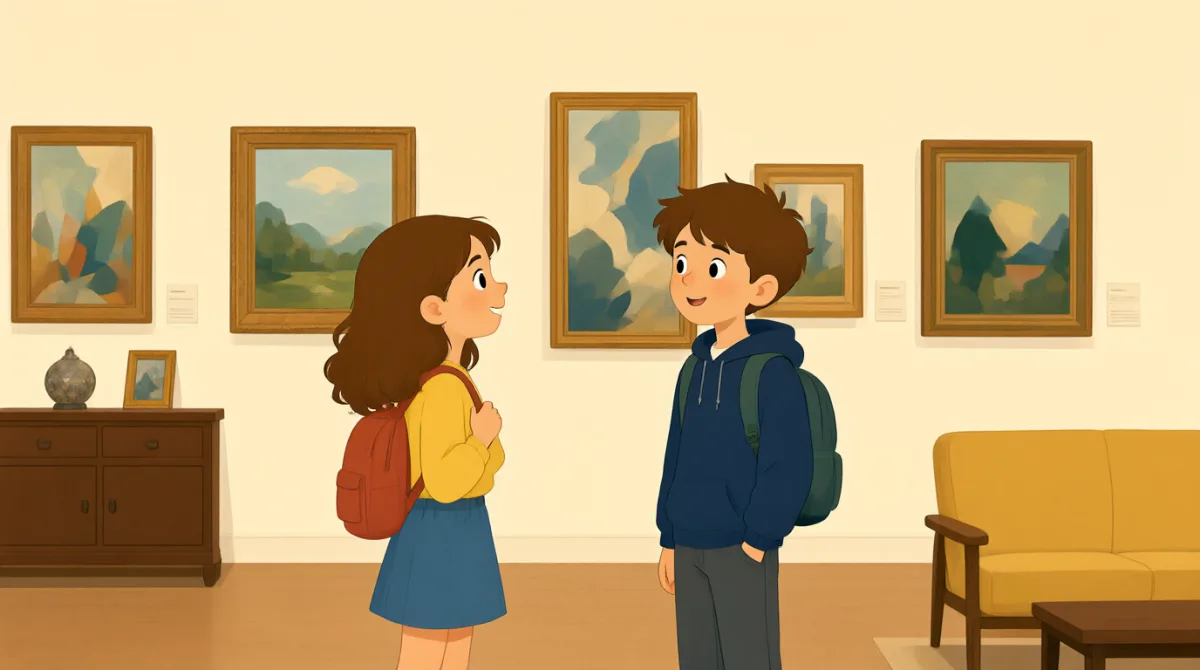

That blue painting was my favorite. The little boat looked so real.

I liked it too. The colors were bright, but the scene felt peaceful.
Yes, and I noticed the waves near the boat. They looked like they were moving.
The artist did a great job. I wanted to look at it for a long time.
Did you see the small house on the hill? I almost missed it.
I saw it. It made me wonder who lived there.
I wish we knew the story behind the painting. Maybe the sign said more.
Maybe. We can read about it online later. I took a photo of the sign.
Vocabulary8
- my favorite
This means the one you like best. Use it to say which painting or other thing you enjoyed most.
- looked so real
This means something seemed very lifelike. Use it to describe a picture or object that looks true to life.
- felt peaceful
This means it gave you a calm feeling. Use it to describe a place, picture, or moment.
- did a great job
This means someone did something very well. Use it to praise an artist or another person's work.
- for a long time
This means for a long period. Use it to say how long you looked at or did something.
- almost missed it
This means you nearly did not notice or see something. Use it when a detail is easy to overlook.
- the story behind
This means the background or events connected to something. Use it to ask about the meaning or history of a painting.
- read about it
This means to find information about something by reading. Use it when you want to learn more about a place, person, or artwork.
Key Sentences8
- 1
That blue painting was my favorite.
Use this sentence to say which artwork you liked best. You can replace “blue painting” with another thing, such as “that sculpture” or “the landscape.”
- 2
The colors were bright, but the scene felt peaceful.
This sentence describes two different qualities of a painting. Use “but” to connect a contrast, such as bright colors and a calm feeling.
- 3
I noticed the waves near the boat.
Use this sentence to point out a detail you saw. Replace “the waves near the boat” with another feature or object.
- 4
The artist did a great job.
This is a simple way to praise an artist's work. You can also use it to praise someone who did something well.
- 5
I almost missed it.
Use this sentence when you nearly failed to see or notice something. It is useful for talking about small or hidden details.
- 6
It made me wonder who lived there.
Use this sentence to say that something made you curious. You can change “who lived there” to another question, such as “what happened there.”
- 7
I wish we knew the story behind the painting.
Use “I wish we knew” to express that you would like to have information you do not have. You can replace “the story behind the painting” with another unknown detail.
- 8
We can read about it online later.
Use this sentence to suggest finding information on the internet at a later time. Replace “it” with the subject you want to learn about.