Asking the Chef a Question
Poser une question au chef
Emma asks Grace how to make the sauce less salty. Grace suggests adding a little water and tasting it again.
Emma demande à Grace comment rendre la sauce moins salée. Grace lui conseille d’ajouter un peu d’eau, puis de goûter la sauce à nouveau.
Dialogue8
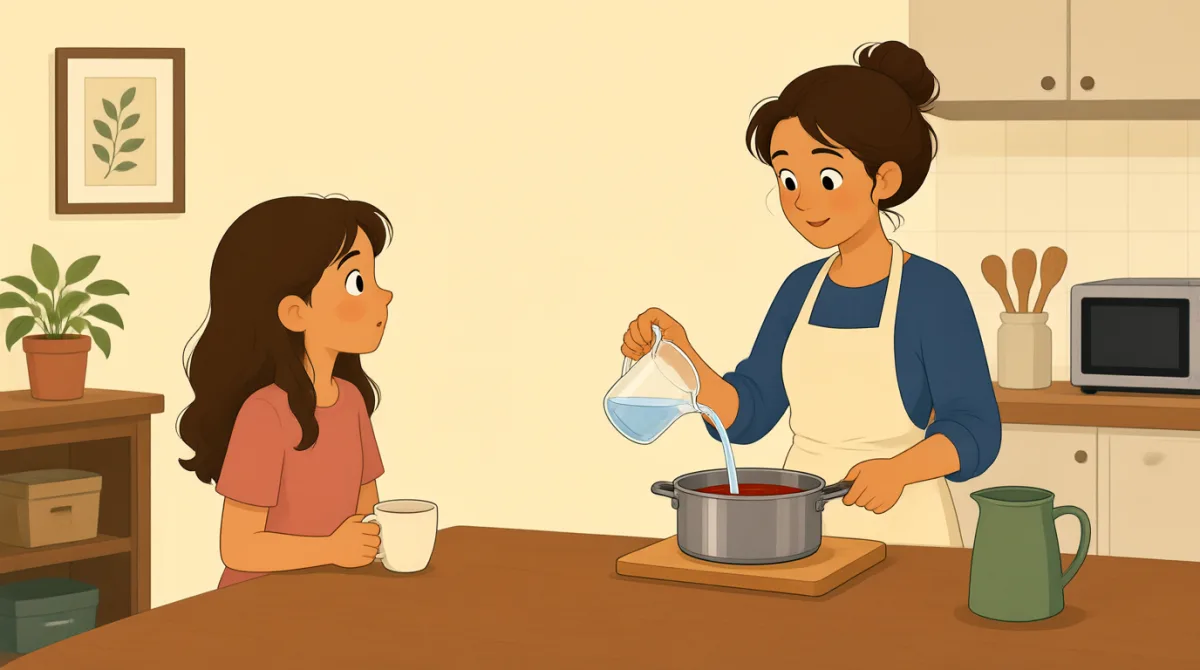

Grace, I think the sauce is too salty. Can I fix it?
Grace, je trouve que la sauce est trop salée. Je peux arranger ça ?

Yes. Add a little water, and then stir it well.
Oui. Ajoute un peu d’eau, puis mélange bien.
Should I add the water now, while it’s still hot?
Je dois ajouter l’eau maintenant, pendant que c’est encore chaud ?
Yes, that’s fine. Add just a little at first.
Oui, ça va. Commence par en ajouter juste un peu.
Okay, I added some. Should I taste it again?
D’accord, j’en ai ajouté un peu. Je goûte à nouveau ?
Yes, use a clean spoon and taste it carefully.
Oui, prends une cuillère propre et goûte avec précaution.
It tastes much better now. Should I add more water?
C’est beaucoup mieux maintenant. Je dois ajouter encore de l’eau ?
No, it’s good now. A little water made a big difference.
Non, c’est bon comme ça. Un peu d’eau a fait une grande différence.
Vocabulaire7
- too saltytrop salé
This means the sauce has more salt than you want. You can use “too” before an adjective to say something is more than you like.
Cela signifie que la sauce contient plus de sel que tu ne le souhaites. Tu peux placer “too” devant un adjectif pour dire que quelque chose est plus… que tu ne le voudrais.
- fix itarranger ça
Here, this means to make the sauce taste better. You can use “fix it” when you want to correct a problem.
Ici, cela signifie améliorer le goût de la sauce. Tu peux dire “fix it” quand tu veux corriger un problème.
- stir it wellbien mélanger
This means to mix the sauce thoroughly with a spoon. You can say “stir it well” when giving someone a cooking instruction.
Cela signifie mélanger soigneusement la sauce avec une cuillère. Tu peux dire “stir it well” pour donner une consigne de cuisine.
- at firstau début
This means at the beginning. Here, Grace says to add only a small amount of water at the beginning.
Cela signifie au commencement. Ici, Grace conseille de n’ajouter qu’une petite quantité d’eau au début.
- taste it againgoûter à nouveau
This means to try the sauce once more to check its flavor. You can use this phrase after changing or adding something to food.
Cela signifie goûter la sauce une nouvelle fois pour vérifier sa saveur. Tu peux employer cette expression après avoir modifié un plat ou ajouté quelque chose.
- a clean spoonune cuillère propre
This means a spoon that has been washed and is ready to use. It is useful advice when tasting food while cooking.
Cela signifie une cuillère qui a été lavée et qui est prête à être utilisée. C’est un conseil pratique quand tu goûtes un plat en cuisinant.
- made a big differencea fait une grande différence
This means caused a noticeable change. You can use it to describe how a small action improved a situation.
Cela signifie avoir provoqué un changement notable. Tu peux employer cette expression pour décrire comment une petite action a amélioré une situation.
Phrases clés7
- 1
I think the sauce is too salty.
Je trouve que la sauce est trop salée.
Use this sentence to describe a problem with food. You can replace “the sauce” and “too salty” to talk about other dishes or problems.
Utilise cette phrase pour décrire un problème avec un plat. Tu peux remplacer “the sauce” et “too salty” pour parler d’autres plats ou problèmes.
- 2
Can I fix it?
Je peux arranger ça ?
This is a simple way to ask if you can correct a problem. You can use “Can I fix it?” in many everyday situations.
C’est une façon simple de demander si tu peux corriger un problème. Tu peux utiliser “Can I fix it?” dans de nombreuses situations du quotidien.
- 3
Add a little water, and then stir it well.
Ajoute un peu d’eau, puis mélange bien.
This gives two clear cooking instructions in order. You can use “Add a little [ingredient], and then stir it well” for other recipes.
Cette phrase donne deux consignes de cuisine claires, dans l’ordre. Pour d’autres recettes, tu peux utiliser “Add a little [ingredient], and then stir it well”.
- 4
Should I add the water now, while it’s still hot?
Je dois ajouter l’eau maintenant, pendant que c’est encore chaud ?
Use this question to ask if it is the right time to do something. You can replace “add the water” with another action.
Utilise cette question pour demander si c’est le bon moment pour faire quelque chose. Tu peux remplacer “add the water” par une autre action.
- 5
Should I taste it again?
Je goûte à nouveau ?
This is a useful way to check what to do next while cooking. You can use “Should I [action] again?” to ask for advice.
C’est une façon pratique de demander quoi faire ensuite en cuisinant. Tu peux utiliser “Should I [action] again?” pour demander conseil.
- 6
Yes, use a clean spoon and taste it carefully.
Oui, prends une cuillère propre et goûte avec précaution.
This sentence gives practical advice for tasting food safely. You can use “Use a clean [item] and [action] carefully” to give similar instructions.
Cette phrase donne un conseil pratique pour goûter un plat sans risque. Tu peux utiliser “Use a clean [item] and [action] carefully” pour donner des consignes similaires.
- 7
A little water made a big difference.
Un peu d’eau a fait une grande différence.
Use this sentence to say that a small change had a noticeable effect. You can replace “water” with another thing that helped.
Utilise cette phrase pour dire qu’un petit changement a eu un effet notable. Tu peux remplacer “water” par une autre chose qui a aidé.