The Air Conditioner Is Broken
La climatisation est en panne
Emma explains that the air conditioner did not work last night. Grace checks the room details and looks for a solution.
Emma explique que la climatisation n’a pas fonctionné la nuit dernière. Grace vérifie les détails de la chambre et cherche une solution.
Dialogue8
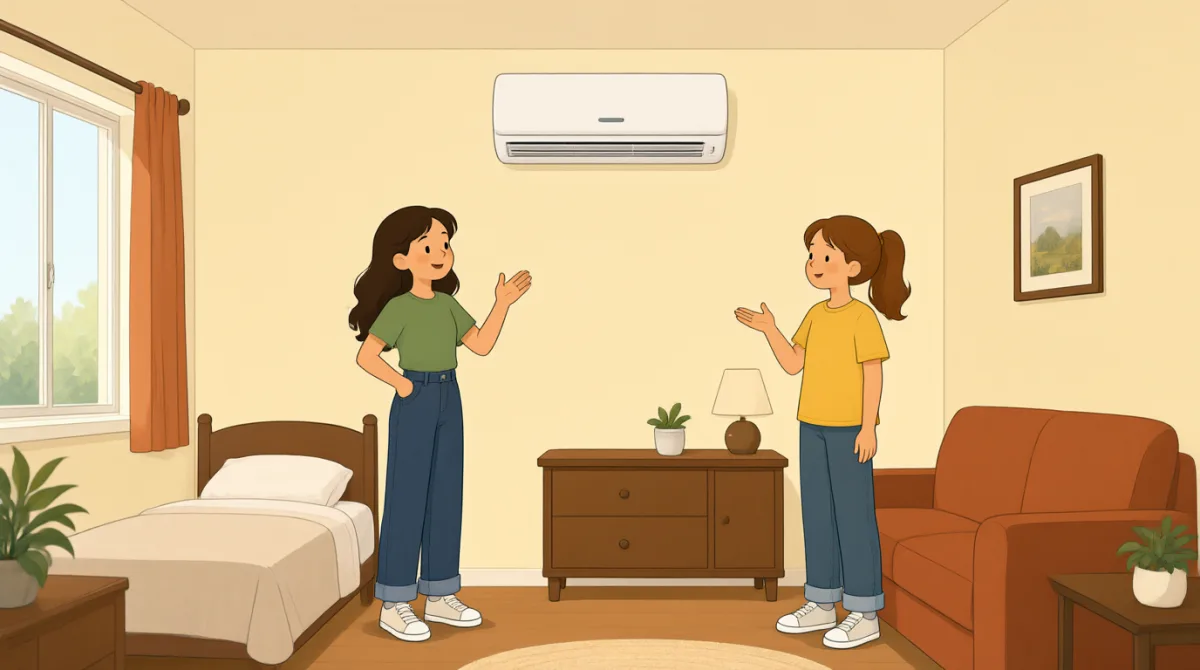

Good morning. The air conditioner in my room didn’t work last night.
Bonjour. La climatisation de ma chambre n’a pas fonctionné la nuit dernière.

I’m sorry about that. What room are you staying in?
Je suis désolée pour ça. Dans quelle chambre êtes-vous ?
I’m in room 214. I tried to turn it on, but nothing happened.
Je suis dans la chambre 214. J’ai essayé de l’allumer, mais rien ne s’est passé.
Thanks for telling me. Did you try the controls on the wall?
Merci de me l’avoir signalé. Avez-vous essayé les commandes au mur ?
Yes, I did. The screen was on, but no cool air came out.
Oui. L’écran était allumé, mais aucun air frais ne sortait.
I understand. Was the room too warm for you last night?
Je comprends. Est-ce que vous avez eu trop chaud dans la chambre la nuit dernière ?
Yes, it was hard to sleep. Could someone come and check it?
Oui, j’ai eu du mal à dormir. Est-ce que quelqu’un pourrait venir vérifier ?
Of course. I’ll ask our maintenance worker to come up and take a look.
Bien sûr. Je vais demander à notre technicien de monter pour vérifier.
Vocabulaire8
- air conditionerclimatisation
A machine that cools the air in a room. You can use this phrase when asking about cooling in a hotel room.
Un appareil qui rafraîchit l’air d’une pièce. Vous pouvez utiliser ce mot pour parler du système de refroidissement dans une chambre d’hôtel.
- didn’t workne pas fonctionner
Means that something did not operate correctly. Use it to explain a problem with a machine or device.
Cela signifie qu’un appareil ne marche pas correctement. Utilisez cette expression pour signaler un problème avec une machine ou un appareil.
- turn it onl’allumer
Means to start a machine or device. You can use it when talking about lights, air conditioners, or other equipment.
Cela signifie mettre une machine ou un appareil en marche. Vous pouvez utiliser cette expression pour parler des lumières, de la climatisation ou d’autres équipements.
- nothing happenedrien ne s’est passé
Means there was no result after you tried to do something. Use it to describe a device that does not respond.
Cela signifie que vous n’avez obtenu aucun résultat après avoir essayé de faire quelque chose. Utilisez cette expression pour décrire un appareil qui ne réagit pas.
- cool airair frais
Air that feels cold or comfortably cool. You can use this phrase to describe what you expect an air conditioner to produce.
De l’air froid ou agréablement frais. Vous pouvez utiliser cette expression pour décrire ce qu’on attend d’une climatisation.
- hard to sleepavoir du mal à dormir
Means difficult to sleep. Use it to explain how a problem, such as a warm room, affected your night.
Cela signifie qu’il est difficile de dormir. Utilisez cette expression pour expliquer comment un problème, comme une chambre trop chaude, a perturbé votre nuit.
- come upmonter
Means to go to a higher floor or to someone’s room. In a hotel, staff may come up to help a guest.
Cela signifie aller à un étage supérieur ou rejoindre quelqu’un dans sa chambre. À l’hôtel, le personnel peut monter pour aider un client.
- take a lookvérifier
Means to examine or check something. You can ask someone to take a look at a problem.
Cela signifie examiner quelque chose. Vous pouvez demander à quelqu’un de vérifier un problème.
Phrases clés8
- 1
The air conditioner in my room didn’t work last night.
The air conditioner in my room didn’t work last night.
This is a clear way to report a problem and say when it happened. You can replace “the air conditioner” with another item that did not work.
C’est une façon claire de signaler un problème et de préciser quand il s’est produit. Vous pouvez remplacer “the air conditioner” par le nom d’un autre appareil qui n’a pas fonctionné.
- 2
I tried to turn it on, but nothing happened.
I tried to turn it on, but nothing happened.
Use this sentence to explain what you did and what happened next. Replace “it” with the device you tried to use.
Utilisez cette phrase pour expliquer ce que vous avez essayé de faire et ce qui s’est passé ensuite. Remplacez “it” par le nom de l’appareil que vous avez essayé d’utiliser.
- 3
Did you try the controls on the wall?
Did you try the controls on the wall?
This is a polite question to check what someone has already tried. You can use it when helping someone solve a problem.
C’est une question polie pour savoir ce que la personne a déjà essayé. Vous pouvez l’utiliser pour aider quelqu’un à résoudre un problème.
- 4
The screen was on, but no cool air came out.
The screen was on, but no cool air came out.
This sentence describes what seemed to work and what was still wrong. You can use “but” to contrast two details about a problem.
Cette phrase décrit ce qui semblait fonctionner et ce qui posait encore problème. Vous pouvez utiliser “but” pour opposer deux éléments d’une même situation.
- 5
Was the room too warm for you last night?
Was the room too warm for you last night?
This question asks whether the temperature caused discomfort. You can change “the room” or “last night” to ask about other situations.
Cette question demande si la température était inconfortable. Vous pouvez remplacer “the room” ou “last night” pour poser une question sur une autre situation.
- 6
Yes, it was hard to sleep.
Yes, it was hard to sleep.
This is a simple way to explain how a problem affected you. You can use “It was hard to…” before an activity to describe a difficulty.
C’est une façon simple d’expliquer comment un problème vous a affecté. Vous pouvez utiliser “It was hard to…” avant une activité pour parler d’une difficulté.
- 7
Could someone come and check it?
Could someone come and check it?
This is a polite way to ask staff for help. Replace “it” with the item or problem you want someone to check.
C’est une façon polie de demander de l’aide au personnel. Remplacez “it” par le nom de l’objet ou du problème que vous souhaitez faire vérifier.
- 8
I’ll ask our maintenance worker to come up and take a look.
I’ll ask our maintenance worker to come up and take a look.
This sentence explains what someone will do to help. You can reuse “I’ll ask [person] to…” when offering to arrange assistance.
Cette phrase explique ce que quelqu’un va faire pour aider. Vous pouvez réutiliser “I’ll ask [person] to…” pour proposer d’organiser de l’aide.