The Air Conditioner Is Broken
Die Klimaanlage ist kaputt
Emma explains that the air conditioner did not work last night. Grace checks the room details and looks for a solution.
Emma erklärt, dass die Klimaanlage letzte Nacht nicht funktioniert hat. Grace überprüft die Zimmerdetails und sucht nach einer Lösung.
Dialog8
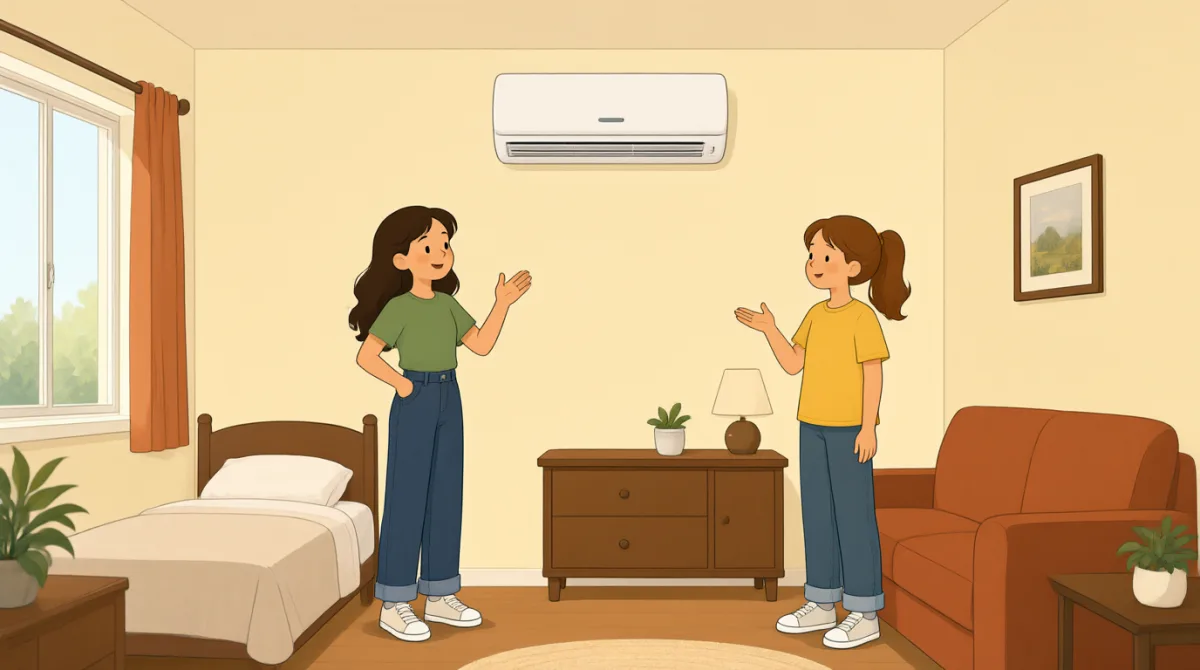

Good morning. The air conditioner in my room didn’t work last night.
Guten Morgen. Die Klimaanlage in meinem Zimmer hat letzte Nacht nicht funktioniert.

I’m sorry about that. What room are you staying in?
Das tut mir leid. In welchem Zimmer wohnen Sie?
I’m in room 214. I tried to turn it on, but nothing happened.
Ich bin in Zimmer 214. Ich habe versucht, sie einzuschalten, aber es ist nichts passiert.
Thanks for telling me. Did you try the controls on the wall?
Danke, dass Sie mir Bescheid sagen. Haben Sie es mit den Bedienelementen an der Wand versucht?
Yes, I did. The screen was on, but no cool air came out.
Ja, das habe ich. Das Display war an, aber es kam keine kühle Luft heraus.
I understand. Was the room too warm for you last night?
Ich verstehe. War es letzte Nacht zu warm für Sie im Zimmer?
Yes, it was hard to sleep. Could someone come and check it?
Ja, ich konnte nur schwer schlafen. Könnte jemand kommen und sich das ansehen?
Of course. I’ll ask our maintenance worker to come up and take a look.
Natürlich. Ich bitte unseren Hausmeister, hochzukommen und sich das anzusehen.
Wortschatz8
- air conditionerKlimaanlage
A machine that cools the air in a room. You can use this phrase when asking about cooling in a hotel room.
Ein Gerät, das die Luft in einem Raum kühlt. Mit diesem Ausdruck kannst du nach der Kühlung in einem Hotelzimmer fragen.
- didn’t worknicht funktioniert hat
Means that something did not operate correctly. Use it to explain a problem with a machine or device.
Das bedeutet, dass etwas nicht richtig funktioniert hat. Damit kannst du ein Problem mit einer Maschine oder einem Gerät erklären.
- turn it oneinschalten
Means to start a machine or device. You can use it when talking about lights, air conditioners, or other equipment.
Das bedeutet, eine Maschine oder ein Gerät zu starten. Du kannst den Ausdruck verwenden, wenn du über Lampen, Klimaanlagen oder andere Geräte sprichst.
- nothing happenedes ist nichts passiert
Means there was no result after you tried to do something. Use it to describe a device that does not respond.
Das bedeutet, dass nichts dabei herauskam, nachdem du etwas versucht hast. Verwende den Ausdruck, um zu beschreiben, dass ein Gerät nicht reagiert.
- cool airkühle Luft
Air that feels cold or comfortably cool. You can use this phrase to describe what you expect an air conditioner to produce.
Luft, die sich kalt oder angenehm kühl anfühlt. Mit diesem Ausdruck kannst du beschreiben, was eine Klimaanlage liefern soll.
- hard to sleepschwer zu schlafen
Means difficult to sleep. Use it to explain how a problem, such as a warm room, affected your night.
Das bedeutet, dass es schwierig war zu schlafen. So kannst du erklären, wie sich ein Problem, zum Beispiel ein zu warmes Zimmer, auf deine Nacht ausgewirkt hat.
- come uphochkommen
Means to go to a higher floor or to someone’s room. In a hotel, staff may come up to help a guest.
Das bedeutet, in ein höheres Stockwerk oder zu jemandem ins Zimmer zu gehen. In einem Hotel kann das Personal hochkommen, um einem Gast zu helfen.
- take a looksich etwas ansehen
Means to examine or check something. You can ask someone to take a look at a problem.
Das bedeutet, etwas zu untersuchen oder zu überprüfen. Du kannst jemanden bitten, sich ein Problem anzusehen.
Wichtige Sätze8
- 1
The air conditioner in my room didn’t work last night.
Die Klimaanlage in meinem Zimmer hat letzte Nacht nicht funktioniert.
This is a clear way to report a problem and say when it happened. You can replace “the air conditioner” with another item that did not work.
So kannst du klar ein Problem melden und sagen, wann es aufgetreten ist. Du kannst “the air conditioner” durch etwas anderes ersetzen, das nicht funktioniert hat.
- 2
I tried to turn it on, but nothing happened.
Ich habe versucht, sie einzuschalten, aber es ist nichts passiert.
Use this sentence to explain what you did and what happened next. Replace “it” with the device you tried to use.
Mit diesem Satz erklärst du, was du getan hast und was danach passiert ist. Ersetze “it” durch das Gerät, das du zu benutzen versucht hast.
- 3
Did you try the controls on the wall?
Haben Sie es mit den Bedienelementen an der Wand versucht?
This is a polite question to check what someone has already tried. You can use it when helping someone solve a problem.
Das ist eine höfliche Frage, mit der du nachfragst, was jemand bereits ausprobiert hat. Du kannst sie verwenden, wenn du jemandem bei der Lösung eines Problems hilfst.
- 4
The screen was on, but no cool air came out.
Das Display war an, aber es kam keine kühle Luft heraus.
This sentence describes what seemed to work and what was still wrong. You can use “but” to contrast two details about a problem.
Dieser Satz beschreibt, was scheinbar funktioniert hat und was trotzdem noch nicht stimmte. Mit “but” kannst du zwei Aspekte eines Problems gegenüberstellen.
- 5
Was the room too warm for you last night?
War es letzte Nacht zu warm für Sie im Zimmer?
This question asks whether the temperature caused discomfort. You can change “the room” or “last night” to ask about other situations.
Mit dieser Frage erkundigst du dich, ob die Temperatur unangenehm war. Du kannst “the room” oder “last night” ändern, um nach anderen Situationen zu fragen.
- 6
Yes, it was hard to sleep.
Ja, ich konnte nur schwer schlafen.
This is a simple way to explain how a problem affected you. You can use “It was hard to…” before an activity to describe a difficulty.
So kannst du einfach erklären, wie sich ein Problem auf dich ausgewirkt hat. Mit “It was hard to…” kannst du vor einer Aktivität beschreiben, dass sie schwierig war.
- 7
Could someone come and check it?
Könnte jemand kommen und sich das ansehen?
This is a polite way to ask staff for help. Replace “it” with the item or problem you want someone to check.
Das ist eine höfliche Art, das Personal um Hilfe zu bitten. Ersetze “it” durch den Gegenstand oder das Problem, das jemand überprüfen soll.
- 8
I’ll ask our maintenance worker to come up and take a look.
Ich bitte unseren Hausmeister, hochzukommen und sich das anzusehen.
This sentence explains what someone will do to help. You can reuse “I’ll ask [person] to…” when offering to arrange assistance.
Dieser Satz erklärt, was jemand tun wird, um zu helfen. Du kannst “I’ll ask [person] to…” wiederverwenden, wenn du anbietest, Hilfe zu organisieren.