Finding the Right Platform
Trouver le bon quai
Emma and Jack look at the signs and find the right platform. They check that the train is going in the right direction.
Emma et Jack regardent les panneaux et trouvent le bon quai. Ils vérifient que le train va dans la bonne direction.
Dialogue8
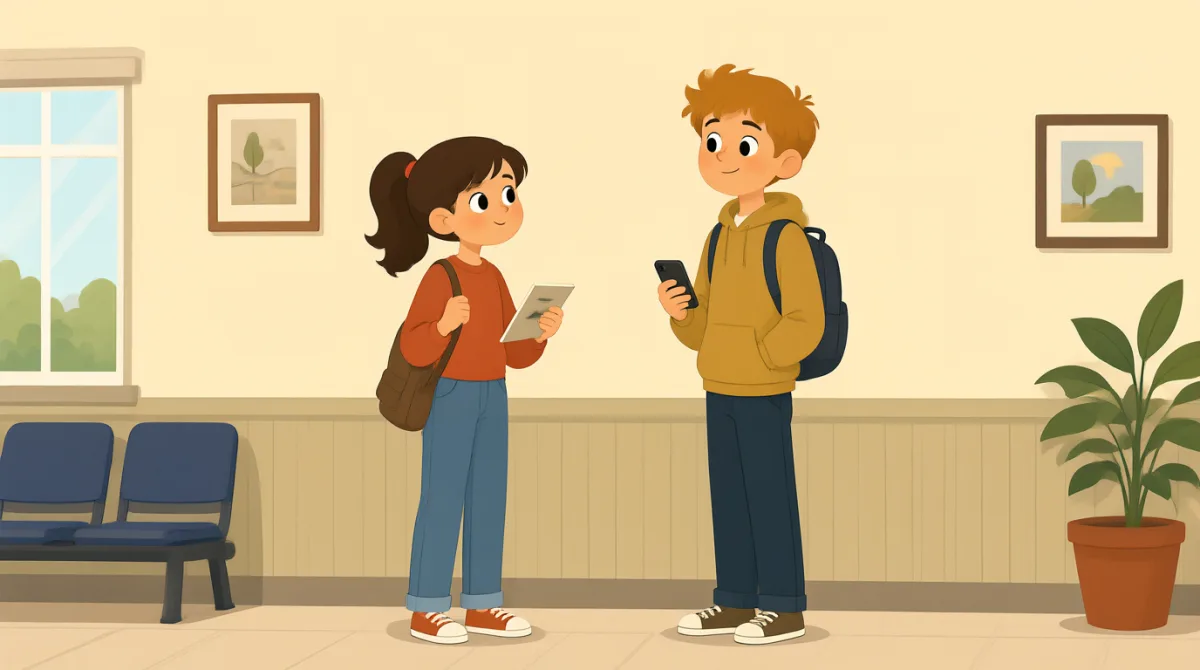

Are we on the right platform?
On est sur le bon quai ?

Let’s check the signs.
Regardons les panneaux.
This says City Center. Is that our train?
Là, c’est écrit « Centre-ville ». C’est notre train ?
Yes. It goes to the city center.
Oui. Il va au centre-ville.
How do we know which way it goes?
Comment savoir dans quelle direction il va ?
Look at the sign. It says East Station.
Regarde le panneau. C’est écrit « Gare de l’Est ».
Great. We need the train to East Station.
Super. Il nous faut le train pour la gare de l’Est.
That’s right. Let’s wait here.
C’est ça. Attendons ici.
Vocabulaire7
- platformquai
A platform is the place where you wait for a train. You can check its signs to find the right train.
Un quai est l’endroit où l’on attend le train. Tu peux consulter les panneaux pour trouver le bon train.
- signspanneaux
Signs show information, such as where a train goes. Look at the signs to find your train.
Les panneaux donnent des informations, par exemple la destination d’un train. Regarde les panneaux pour trouver ton train.
- City CenterCity Center
City Center means the middle or main area of a city. This sign tells Emma and Jack where the train goes.
« City Center » signifie le centre ou le quartier principal d’une ville. Ce panneau indique à Emma et Jack où va le train.
- goes toaller à
Use “goes to” to say where a train travels. For example, “The train goes to the city center.”
Utilise “goes to” pour dire où va un train. Par exemple, “The train goes to the city center.” (Le train va au centre-ville.)
- which waydans quelle direction
“Which way” asks about a direction. You can use it to ask where a train is going.
“Which way” sert à demander une direction. Tu peux l’utiliser pour demander où va un train.
- East StationEast Station
East Station is the station the travelers need to reach. They check the sign to make sure the train goes there.
« East Station » est la gare où les voyageurs doivent se rendre. Ils vérifient le panneau pour s’assurer que le train y va.
- wait hereattendre ici
“Wait here” means stay in this place until something arrives. You can use it while waiting for a train.
“Wait here” signifie rester à cet endroit jusqu’à ce que quelque chose arrive. Tu peux l’utiliser en attendant un train.
Phrases clés8
- 1
Are we on the right platform?
On est sur le bon quai ?
Use this to check if you are waiting in the correct place. You can change “platform” to another place, such as “Are we at the right station?”
Utilise cette phrase pour vérifier si tu attends au bon endroit. Tu peux remplacer “platform” par un autre lieu, par exemple : “Are we at the right station?” (On est à la bonne gare ?)
- 2
Let’s check the signs.
Regardons les panneaux.
This is a simple way to suggest looking at signs for information. You can use “Let’s check” before other things, like a map or a schedule.
C’est une façon simple de proposer de consulter les panneaux pour obtenir des informations. Tu peux utiliser “Let’s check” avant d’autres mots, comme une carte ou un horaire.
- 3
This says City Center.
Là, c’est écrit « City Center ».
Use this when you read information on a sign. Replace “City Center” with the place or words you see.
Utilise cette phrase quand tu lis une information sur un panneau. Remplace “City Center” par le lieu ou les mots que tu vois.
- 4
Is that our train?
C’est notre train ?
Use this to ask if a train is the one you need. You can also use this question for a bus or another vehicle.
Utilise cette phrase pour demander si c’est le train qu’il te faut. Tu peux aussi poser cette question à propos d’un bus ou d’un autre véhicule.
- 5
How do we know which way it goes?
Comment savoir dans quelle direction il va ?
This asks how to find out a train’s direction. You can use “How do we know” to ask how to find out other information.
Cette phrase demande comment connaître la direction d’un train. Tu peux utiliser “How do we know” pour demander comment obtenir d’autres informations.
- 6
Look at the sign.
Regarde le panneau.
Use this to tell someone to read or check a sign. You can replace “the sign” with something else, such as “the map.”
Utilise cette phrase pour dire à quelqu’un de lire ou de consulter un panneau. Tu peux remplacer “the sign” par autre chose, comme “the map.”
- 7
We need the train to East Station.
Il nous faut le train pour East Station.
Use this to say which train or destination you need. Replace “East Station” with the name of your destination.
Utilise cette phrase pour préciser le train ou la destination qu’il te faut. Remplace “East Station” par le nom de ta destination.
- 8
Let’s wait here.
Attendons ici.
This is a simple way to suggest staying in the current place. You can use it while waiting for a train, bus, or person.
C’est une façon simple de proposer de rester à l’endroit où l’on se trouve. Tu peux l’utiliser en attendant un train, un bus ou quelqu’un.