Finding the Right Platform
Den richtigen Bahnsteig finden
Emma and Jack look at the signs and find the right platform. They check that the train is going in the right direction.
Emma und Jack schauen auf die Schilder und finden den richtigen Bahnsteig. Sie prüfen, ob der Zug in die richtige Richtung fährt.
Dialog8
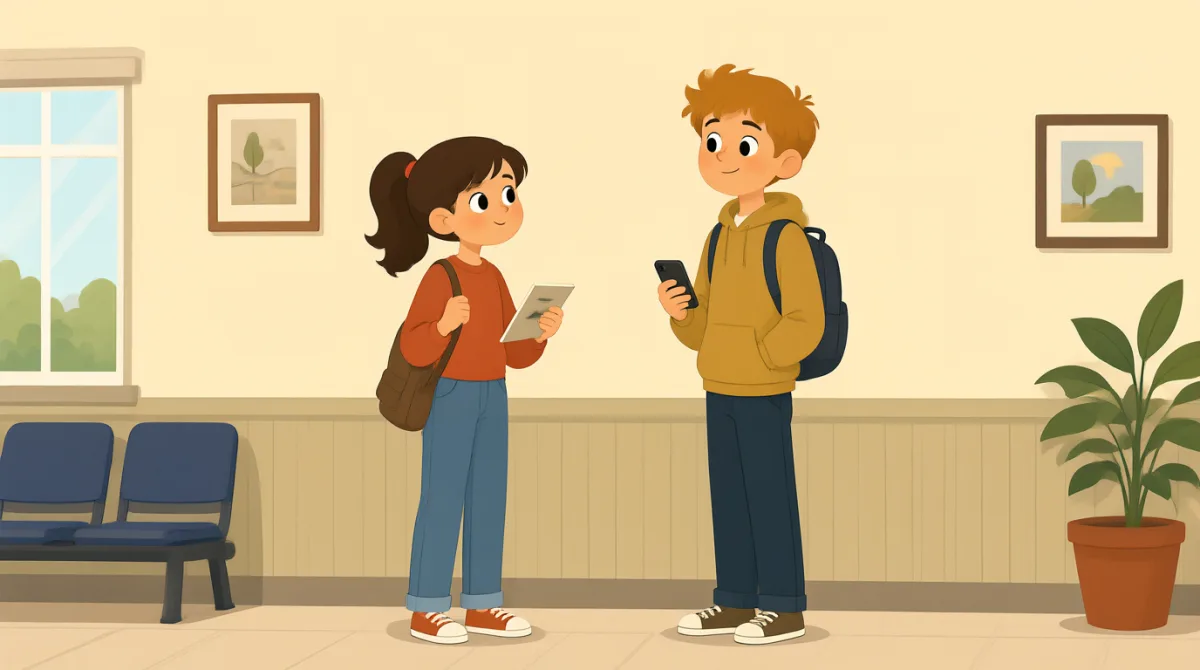

Are we on the right platform?
Sind wir am richtigen Bahnsteig?

Let’s check the signs.
Lass uns auf die Schilder schauen.
This says City Center. Is that our train?
Hier steht „City Center“. Ist das unser Zug?
Yes. It goes to the city center.
Ja. Er fährt ins Stadtzentrum.
How do we know which way it goes?
Woher wissen wir, in welche Richtung er fährt?
Look at the sign. It says East Station.
Schau auf das Schild. Da steht „East Station“.
Great. We need the train to East Station.
Super. Wir brauchen den Zug nach „East Station“.
That’s right. Let’s wait here.
Genau. Lass uns hier warten.
Wortschatz7
- platformBahnsteig
A platform is the place where you wait for a train. You can check its signs to find the right train.
Ein „platform“ ist der Ort, an dem du auf einen Zug wartest. An den Schildern kannst du erkennen, welchen Zug du nehmen musst.
- signsSchilder
Signs show information, such as where a train goes. Look at the signs to find your train.
„Signs“ zeigen Informationen an, zum Beispiel, wohin ein Zug fährt. Schau auf die Schilder, um deinen Zug zu finden.
- City CenterCity Center
City Center means the middle or main area of a city. This sign tells Emma and Jack where the train goes.
„City Center“ bedeutet das Zentrum oder den Hauptbereich einer Stadt. Dieses Schild verrät Emma und Jack, wohin der Zug fährt.
- goes tofährt nach
Use “goes to” to say where a train travels. For example, “The train goes to the city center.”
Mit „goes to“ sagst du, wohin ein Zug fährt. Zum Beispiel: „The train goes to the city center.“ (Der Zug fährt ins Stadtzentrum.)
- which wayin welche Richtung
“Which way” asks about a direction. You can use it to ask where a train is going.
„Which way“ fragt nach einer Richtung. Du kannst damit fragen, wohin ein Zug fährt.
- East StationEast Station
East Station is the station the travelers need to reach. They check the sign to make sure the train goes there.
„East Station“ ist der Bahnhof, den die Reisenden erreichen müssen. Sie prüfen das Schild, um sicherzugehen, dass der Zug dorthin fährt.
- wait herehier warten
“Wait here” means stay in this place until something arrives. You can use it while waiting for a train.
„Wait here“ bedeutet, an diesem Ort zu bleiben, bis etwas ankommt. Du kannst das sagen, wenn du auf einen Zug wartest.
Wichtige Sätze8
- 1
Are we on the right platform?
Sind wir am richtigen Bahnsteig?
Use this to check if you are waiting in the correct place. You can change “platform” to another place, such as “Are we at the right station?”
Damit fragst du, ob du am richtigen Ort wartest. Du kannst „platform“ durch einen anderen Ort ersetzen, zum Beispiel: „Are we at the right station?“ (Sind wir am richtigen Bahnhof?)
- 2
Let’s check the signs.
Lass uns auf die Schilder schauen.
This is a simple way to suggest looking at signs for information. You can use “Let’s check” before other things, like a map or a schedule.
So schlägst du ganz einfach vor, auf Schilder zu schauen, um Informationen zu bekommen. Du kannst „Let’s check“ auch vor andere Dinge setzen, zum Beispiel vor eine Karte oder einen Fahrplan.
- 3
This says City Center.
Hier steht „City Center“.
Use this when you read information on a sign. Replace “City Center” with the place or words you see.
Das sagst du, wenn du Informationen auf einem Schild liest. Ersetze „City Center“ durch den Ort oder die Wörter, die du siehst.
- 4
Is that our train?
Ist das unser Zug?
Use this to ask if a train is the one you need. You can also use this question for a bus or another vehicle.
Damit fragst du, ob das der Zug ist, den du brauchst. Du kannst dieselbe Frage auch zu einem Bus oder einem anderen Fahrzeug stellen.
- 5
How do we know which way it goes?
Woher wissen wir, in welche Richtung er fährt?
This asks how to find out a train’s direction. You can use “How do we know” to ask how to find out other information.
Damit fragst du, wie du herausfinden kannst, in welche Richtung ein Zug fährt. Mit „How do we know“ kannst du auch fragen, wie du andere Informationen herausfindest.
- 6
Look at the sign.
Schau auf das Schild.
Use this to tell someone to read or check a sign. You can replace “the sign” with something else, such as “the map.”
Damit bittest du jemanden, ein Schild zu lesen oder zu prüfen. Du kannst „the sign“ durch etwas anderes ersetzen, zum Beispiel durch „the map“.
- 7
We need the train to East Station.
Wir brauchen den Zug nach „East Station“.
Use this to say which train or destination you need. Replace “East Station” with the name of your destination.
Damit sagst du, welchen Zug oder welches Ziel du brauchst. Ersetze „East Station“ durch den Namen deines Ziels.
- 8
Let’s wait here.
Lass uns hier warten.
This is a simple way to suggest staying in the current place. You can use it while waiting for a train, bus, or person.
So schlägst du einfach vor, am jetzigen Ort zu bleiben. Das kannst du sagen, während ihr auf einen Zug, einen Bus oder jemanden wartet.