Finding the Exit
Trouver la sortie
Emma and Jack get off at their stop and look for the right exit. They check the signs before leaving the station.
Emma et Jack descendent à leur station et cherchent la bonne sortie. Ils vérifient les panneaux avant de quitter la station.
Dialogue8
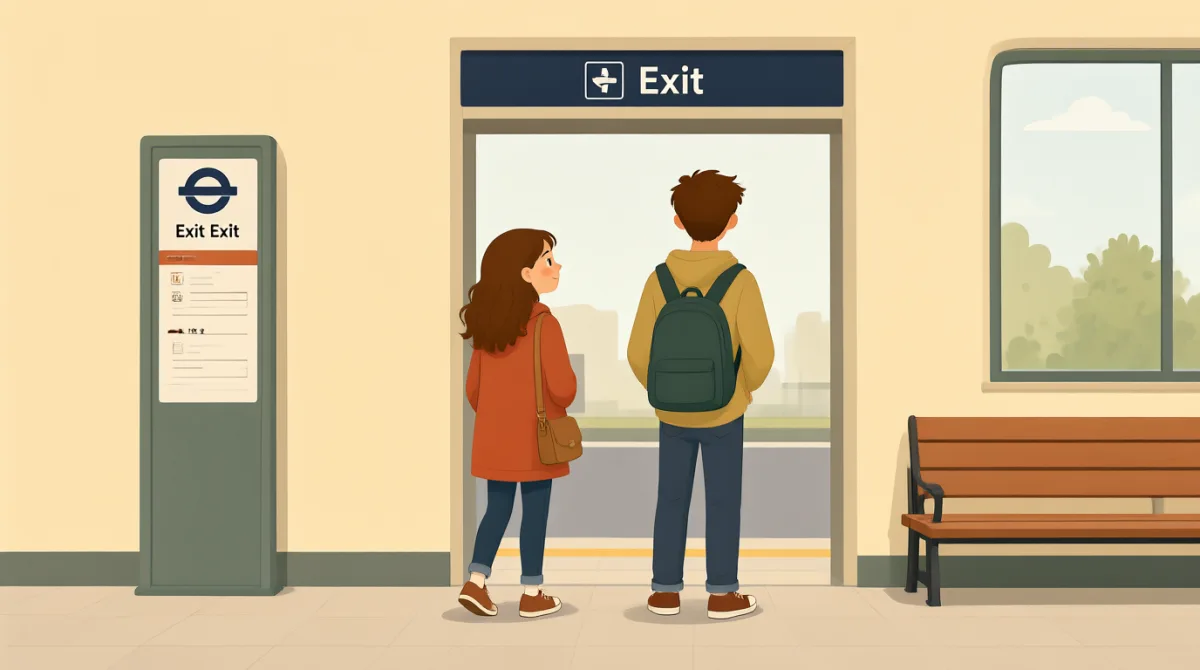

We’re at our stop. Which exit do we need?
On est à notre station. On doit prendre quelle sortie ?

Let’s check the signs. Where do you want to go?
Regardons les panneaux. Tu veux aller où ?
I need the main street. Is this exit right?
Je dois aller dans la rue principale. C’est la bonne sortie ?
Yes. The sign says Main Street. Let’s follow it.
Oui. Le panneau indique « Rue principale ». Suivons-le.
Great. Do we go up these stairs?
Super. On monte ces escaliers ?
Yes. The exit is at the top.
Oui. La sortie est en haut.
Thanks for helping me find the right exit.
Merci de m’avoir aidée à trouver la bonne sortie.
You’re welcome. Now we’re on the right street.
De rien. Maintenant, on est dans la bonne rue.
Vocabulaire8
- at our stopà notre station
We use this when we arrive at the station where we need to get off. You can say, “We’re at our stop” when it is time to leave the train.
On emploie cette expression quand on arrive à la station où l’on doit descendre. Tu peux dire « We’re at our stop » quand c’est le moment de quitter le train.
- exitsortie
An exit is a way to leave a place. You can ask, “Which exit do we need?” when you are looking for the right way out.
Une sortie permet de quitter un endroit. Tu peux demander « Which exit do we need? » quand tu cherches le bon chemin pour sortir.
- check the signsvérifier les panneaux
This means to look at signs for information or directions. You can say, “Let’s check the signs” when you are not sure where to go.
Cela signifie regarder les panneaux pour trouver des informations ou des indications. Tu peux dire « Let’s check the signs » quand tu ne sais pas où aller.
- main streetrue principale
The main street is an important or central street in an area. You can say, “I need the main street” to explain where you want to go.
La rue principale est une rue importante ou centrale d’un quartier. Tu peux dire « I need the main street » pour expliquer où tu veux aller.
- follow itsuivre les indications
This means to go in the direction shown by a sign or route. You can say, “Let’s follow it” after finding the right direction.
Cela signifie aller dans la direction indiquée par un panneau ou un itinéraire. Tu peux dire « Let’s follow it » après avoir trouvé la bonne direction.
- go up these stairsmonter ces escaliers
This means to walk up the stairs. You can ask, “Do we go up these stairs?” when checking how to reach an exit.
Cela signifie monter les marches. Tu peux demander « Do we go up these stairs? » pour vérifier comment rejoindre une sortie.
- at the topen haut
This means at the highest point of something, such as a set of stairs. You can say, “The exit is at the top” to give a simple direction.
Cela désigne le point le plus élevé de quelque chose, comme un escalier. Tu peux dire « The exit is at the top » pour donner une indication simple.
- You’re welcome.Je t’en prie.
This is a polite reply when someone says thank you. You can use it after helping someone.
C’est une réponse polie quand quelqu’un te remercie. Tu peux l’utiliser après avoir aidé quelqu’un.
Phrases clés8
- 1
Which exit do we need?
On doit prendre quelle sortie ?
Use this question when you need to find the right way out. You can replace “exit” with another place, such as “Which platform do we need?”
Utilise cette question quand tu cherches le bon chemin pour sortir. Tu peux remplacer « exit » par un autre lieu, comme dans « Which platform do we need? »
- 2
Let’s check the signs.
Regardons les panneaux.
This is a simple way to suggest looking for directions or information. Use “Let’s” plus an action to suggest doing something together.
C’est une façon simple de proposer de chercher des indications ou des informations. Utilise « Let’s » suivi d’une action pour proposer de faire quelque chose ensemble.
- 3
Where do you want to go?
Tu veux aller où ?
Use this question to ask someone about their destination. You can answer with a place, such as “I want to go to the main street.”
Utilise cette question pour demander à quelqu’un quelle est sa destination. Tu peux répondre en indiquant un lieu, par exemple « I want to go to the main street. »
- 4
Is this exit right?
C’est la bonne sortie ?
Use this question to check if an exit is the correct one. You can change “exit” to another choice, such as “Is this door right?”
Utilise cette question pour vérifier si c’est la bonne sortie. Tu peux remplacer « exit » par une autre option, comme dans « Is this door right? »
- 5
The sign says Main Street.
Le panneau indique « Rue principale ».
Use this sentence to share information written on a sign. You can replace “Main Street” with the words you see.
Utilise cette phrase pour transmettre une information écrite sur un panneau. Tu peux remplacer « Main Street » par les mots que tu vois.
- 6
Do we go up these stairs?
On monte ces escaliers ?
Use this question to check if you should take a set of stairs. You can replace “up” with “down” to ask about going down.
Utilise cette question pour vérifier si vous devez prendre un escalier. Tu peux remplacer « up » par « down » pour demander s’il faut descendre.
- 7
The exit is at the top.
La sortie est en haut.
This sentence gives a clear location for the exit. You can use “at the top” to describe where something is on stairs or a hill.
Cette phrase indique clairement où se trouve la sortie. Tu peux utiliser « at the top » pour décrire où se trouve quelque chose dans un escalier ou sur une colline.
- 8
Thanks for helping me find the right exit.
Merci de m’avoir aidée à trouver la bonne sortie.
Use this sentence to thank someone for helping you. You can replace “exit” with another thing, such as “the station.”
Utilise cette phrase pour remercier quelqu’un de t’avoir aidé. Tu peux remplacer « exit » par autre chose, comme « the station ».