Arriving at the Hotel
Llegada al hotel
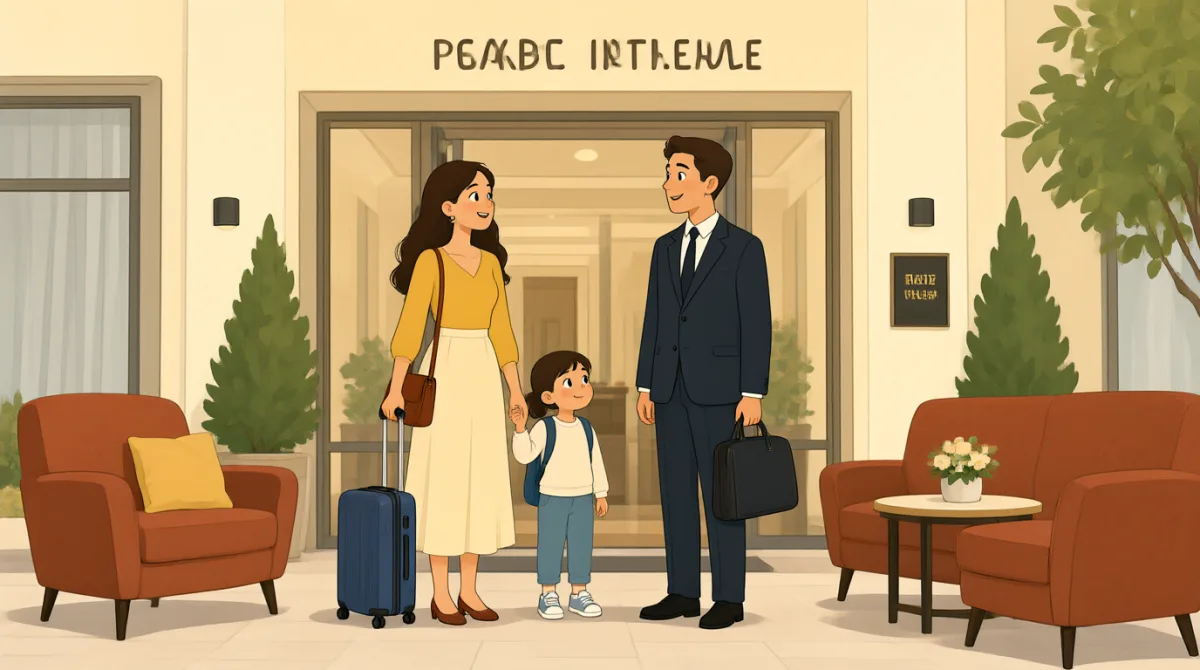
The shuttle arrives at the hotel, and Emma and Leo get their bags. They thank David and ask where to go for the hotel entrance.
El transporte llega al hotel y Emma y Leo recogen sus maletas. Le dan las gracias a David y preguntan por dónde se entra al hotel.
Diálogo8

Here we are. The hotel entrance is just around the corner, on your right.
Ya llegamos. La entrada del hotel está justo a la vuelta de la esquina, a la derecha.

Great, thank you. Is this where we should get off?
Genial, gracias. ¿Aquí es donde tenemos que bajarnos?
Yes, you can get off here. I’ll open the luggage door for you.
Sí, pueden bajarse aquí. Les abro el compartimento del equipaje.

Thanks! I’ll take my suitcase. Emma, can you grab your bag?
¡Gracias! Yo me llevo mi maleta. Emma, ¿puedes agarrar tu bolso?
Got it. Thank you for the ride, David. The trip was nice and easy.
Listo. Gracias por el viaje, David. El trayecto fue agradable y tranquilo.
You’re welcome. Go through those glass doors, and the front desk is inside.
De nada. Pasen por esas puertas de vidrio; la recepción está adentro.
Perfect. We’ll check in now. Have a good day!
Perfecto. Vamos a registrarnos ahora. ¡Que tengas un buen día!
Thanks! Enjoy your stay, and watch your step on the curb.
¡Gracias! Que disfruten de su estancia y tengan cuidado al bajar el bordillo.
Vocabulario7
- get offbajarse
To leave a vehicle, such as a shuttle. You can say, “Is this where we should get off?”
Significa salir de un vehículo, como un transporte. Puedes decir: “Is this where we should get off?” (¿Aquí es donde tenemos que bajarnos?).
- luggage doorcompartimento del equipaje
The door or compartment where bags are stored in a vehicle. You can ask someone to open it so you can get your bags.
La puerta o el compartimento de un vehículo donde se guardan las maletas. Puedes pedirle a alguien que lo abra para recoger tu equipaje.
- grab your bagagarrar tu bolso
To pick up your bag quickly. You can use “grab” in casual requests, such as “Can you grab your bag?”
Recoger tu bolso rápidamente. En peticiones informales puedes usar “grab”, como en “Can you grab your bag?” (¿Puedes agarrar tu bolso?).
- front deskrecepción
The place inside a hotel where guests check in and ask for help.
El lugar dentro del hotel donde los huéspedes se registran y piden ayuda.
- check inregistrarse
To arrive at a hotel and register as a guest. You can say, “We’ll check in now.”
Llegar a un hotel y registrarse como huésped. Puedes decir: “We’ll check in now.” (Vamos a registrarnos ahora.).
- enjoy your stayque disfrutes de tu estancia
A friendly way to wish someone a good visit at a hotel or another place.
Una forma amable de desearle a alguien que disfrute de su visita a un hotel o a otro lugar.
- watch your steptener cuidado al caminar
A warning to be careful where you walk. It is useful near a curb, stairs, or an uneven surface.
Una advertencia para que alguien preste atención por dónde camina. Es útil cerca de un bordillo, unas escaleras o una superficie irregular.
Frases clave7
- 1
The hotel entrance is just around the corner, on your right.
La entrada del hotel está justo a la vuelta de la esquina, a la derecha.
This gives someone clear directions. You can reuse “just around the corner” and “on your right” to describe where a place is.
Esta frase da indicaciones claras. Puedes reutilizar “just around the corner” (justo a la vuelta de la esquina) y “on your right” (a tu derecha) para indicar dónde está un lugar.
- 2
Is this where we should get off?
¿Aquí es donde tenemos que bajarnos?
This is a polite way to check if it is time to leave a vehicle. Replace “get off” with another travel action to ask about your next step.
Esta es una forma amable de confirmar si ya es hora de bajarse de un vehículo. Cambia “get off” por otra acción relacionada con el viaje para preguntar cuál es el siguiente paso.
- 3
I’ll open the luggage door for you.
Te abriré el compartimento del equipaje.
This offers help with someone’s bags. You can use “I’ll [action] for you” to offer help in other situations.
Esta frase ofrece ayuda con el equipaje de alguien. Puedes usar “I’ll [action] for you” (Haré [acción] por ti) para ofrecer ayuda en otras situaciones.
- 4
Emma, can you grab your bag?
Emma, ¿puedes agarrar tu bolso?
This is a simple, casual request. You can use “Can you grab your [item]?” when asking someone to pick something up.
Es una petición sencilla e informal. Puedes usar “Can you grab your [item]?” (¿Puedes agarrar tu [objeto]?) cuando le pides a alguien que recoja algo.
- 5
Go through those glass doors, and the front desk is inside.
Pasen por esas puertas de vidrio y la recepción está adentro.
This gives directions to a place inside a building. You can reuse “Go through…” to explain which entrance to use.
Esta frase da indicaciones para llegar a un lugar dentro de un edificio. Puedes reutilizar “Go through…” (Pasen por…) para explicar qué entrada usar.
- 6
We’ll check in now.
Vamos a registrarnos ahora.
This tells someone what you plan to do next at the hotel. Use “We’ll [action] now” to describe your immediate plan.
Esta frase le dice a alguien qué piensan hacer a continuación en el hotel. Usa “We’ll [action] now” (Ahora vamos a [acción]) para describir un plan inmediato.
- 7
Enjoy your stay, and watch your step on the curb.
Que disfruten de su estancia y tengan cuidado al bajar el bordillo.
This combines a friendly wish with a safety warning. You can use “Enjoy your…” to wish someone well and “watch your step” to remind them to be careful.
Esta frase combina un buen deseo con una advertencia de seguridad. Puedes usar “Enjoy your…” (Que disfrutes de tu…) para desearle algo bueno a alguien y “watch your step” (ten cuidado al caminar) para recordarle que vaya con cuidado.