Putting Bags on the Bus
Subir el equipaje al autobús
Emma and Leo put their bags on the shuttle. David helps them with a suitcase and checks that everyone is ready.
Emma y Leo suben sus maletas al autobús lanzadera. David les ayuda con una maleta y comprueba que todos estén listos.
Diálogo9
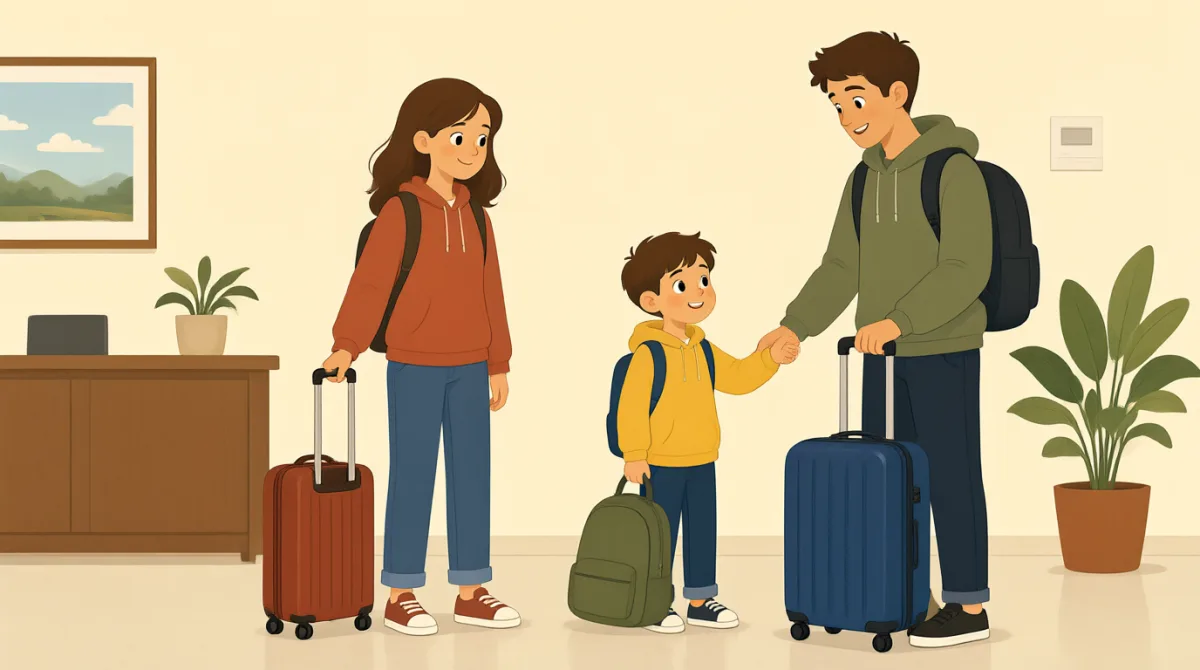

Leo, can you help me put my suitcase on the shuttle?
Leo, ¿me ayudas a subir mi maleta al autobús?

Sure! I'll lift this one. You can put your bag by the door.
¡Claro! Yo levanto esta. Puedes dejar tu bolso junto a la puerta.

Careful with that suitcase. I'll help you lift it into the luggage area.
Cuidado con esa maleta. Te ayudo a subirla al compartimento de equipaje.
Thanks, David. Should we keep our small bags with us?
Gracias, David. ¿Deberíamos llevar con nosotros los bolsos pequeños?
Yes, please keep those with you. There is more room inside the shuttle.
Sí, por favor, llévenlos con ustedes. Hay más espacio dentro del autobús.
I've put my backpack on my seat. Are we ready to go?
Ya puse mi mochila en mi asiento. ¿Estamos listos para irnos?
Almost. Please check that you have everything, then get on the shuttle.
Casi. Comprueben que tengan todo y luego suban al autobús, por favor.
I have my phone and my bag. Leo, do you have your ticket?
Tengo el teléfono y el bolso. Leo, ¿tienes tu boleto?
Yes, I have it. Let's get on before I forget anything else!
Sí, lo tengo. ¡Subamos antes de que se me olvide algo más!
Vocabulario8
- put my suitcase on the shuttlesubir mi maleta al autobús
To place your suitcase on the shuttle. Use this phrase when asking someone to help you load your luggage.
Significa colocar la maleta en el autobús. Usa esta frase cuando le pidas a alguien que te ayude a subir el equipaje.
- lift it into the luggage areasubirla al compartimento de equipaje
To pick something up and put it in the place for suitcases. You can use “lift it into” when moving a heavy item into a space.
Significa levantar algo y ponerlo en el espacio destinado a las maletas. Puedes usar “lift it into” (subirlo a) cuando mueves un objeto pesado a un espacio.
- keep those with youllevarlos contigo
To hold on to some items and not put them away. Use this phrase for small bags or other things you want to keep close.
Significa conservar algunos objetos contigo en lugar de guardarlos. Usa esta frase para hablar de bolsos pequeños u otras cosas que quieras tener cerca.
- I've put my backpack on my seat.Ya puse mi mochila en mi asiento.
This means the speaker has placed their backpack on a seat. Use “I've put” to say something is already in a particular place.
Significa que la persona ya dejó su mochila en un asiento. Usa “I've put” para decir que algo ya está en un lugar específico.
- check that you have everythingcomprobar que tienes todo
To make sure you haven't forgotten anything. This is useful before leaving or getting on a bus.
Significa asegurarte de que no has olvidado nada. Es útil hacerlo antes de salir o subir a un autobús.
- get on the shuttlesubir al autobús
To enter the shuttle and travel on it. Use “get on” for buses, trains, and other forms of public transport.
Significa entrar en el autobús para viajar en él. Usa “get on” con autobuses, trenes y otros medios de transporte público.
- Are we ready to go?¿Estamos listos para irnos?
A way to ask if everyone is prepared to leave. You can use this question before starting a trip.
Es una forma de preguntar si todos están preparados para salir. Puedes hacer esta pregunta antes de comenzar un viaje.
- Do you have your ticket?¿Tienes tu boleto?
A way to check whether someone has their ticket. You can use this question before boarding transport or entering an event.
Es una forma de comprobar si alguien tiene su boleto. Puedes hacer esta pregunta antes de subir a un transporte o entrar a un evento.
Frases clave6
- 1
Leo, can you help me put my suitcase on the shuttle?
Leo, ¿me ayudas a subir mi maleta al autobús?
This is a polite way to ask someone for help. You can reuse “Can you help me [action]?” for everyday tasks.
Es una forma amable de pedir ayuda. Puedes reutilizar “Can you help me [action]?” (¿Me ayudas a [acción]?) para tareas cotidianas.
- 2
I'll help you lift it into the luggage area.
Te ayudo a subirla al compartimento de equipaje.
This offers help with a specific task. Use “I'll help you [action]” when you decide to assist someone.
Esta frase ofrece ayuda con una tarea específica. Usa “I'll help you [action]” (Te ayudaré a [acción]) cuando decidas ayudar a alguien.
- 3
Should we keep our small bags with us?
¿Deberíamos llevar con nosotros los bolsos pequeños?
This asks whether it is better to keep something nearby. You can use “Should we...?” to ask for advice or instructions.
Esta pregunta sirve para saber si es mejor mantener algo cerca. Puedes usar “Should we...?” (¿Deberíamos...?) para pedir consejo o indicaciones.
- 4
Please check that you have everything, then get on the shuttle.
Comprueben que tengan todo y luego suban al autobús, por favor.
This gives two clear instructions: make sure nothing is missing, and then board. You can use “Please check that...” before leaving a place.
Da dos instrucciones claras: asegurarse de que no falte nada y luego subir al autobús. Puedes usar “Please check that...” (Por favor, comprueba que...) antes de salir de un lugar.
- 5
I have my phone and my bag.
Tengo el teléfono y el bolso.
This tells someone which belongings you have with you. You can use “I have my...” to confirm you have important items.
Esta frase le dice a alguien qué pertenencias llevas contigo. Puedes usar “I have my...” (Tengo mi...) para confirmar que tienes objetos importantes.
- 6
Leo, do you have your ticket?
Leo, ¿tienes tu boleto?
This checks whether someone has an important item before departure. You can replace “ticket” with another item, such as “passport” or “keys”.
Esta pregunta comprueba si alguien tiene un objeto importante antes de salir. Puedes cambiar “ticket” por otro objeto, como “passport” o “keys”.