Asking for Directions on the Way
Cómo pedir indicaciones por el camino
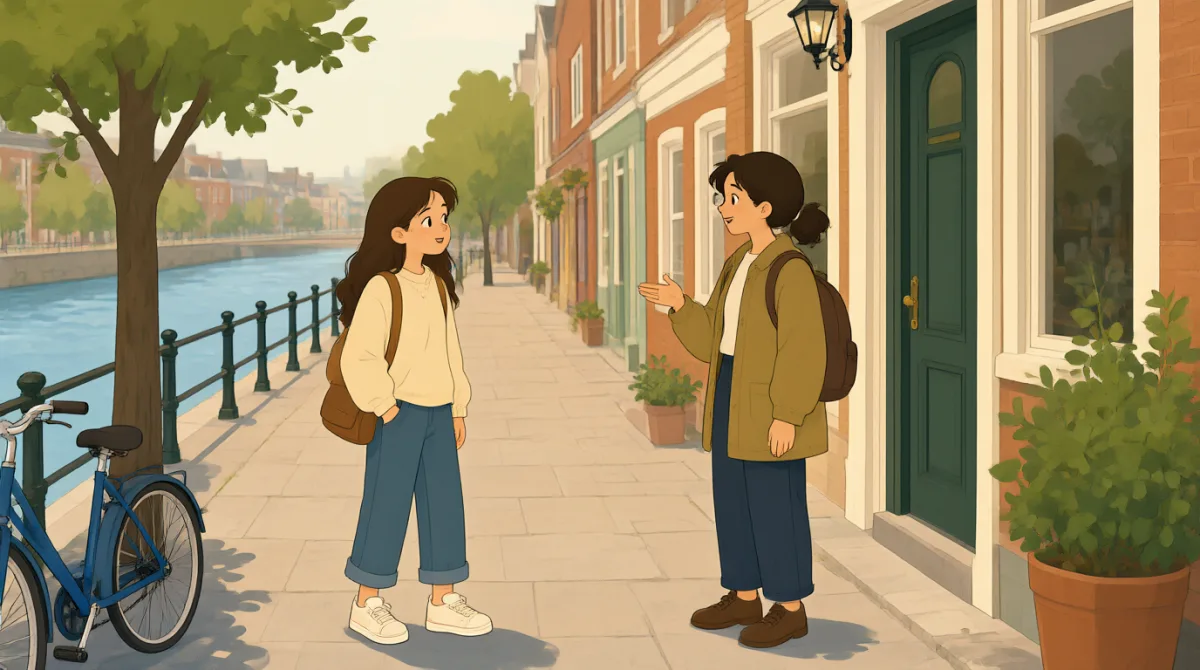
Emma stops to ask Mia, a local, how to get back to the riverside bike path. Mia gives her simple directions and warns her about a busy street.
Emma se detiene para preguntarle a Mia, una vecina, cómo volver al camino para bicicletas junto al río. Mia le da indicaciones sencillas y le advierte sobre una calle muy transitada.
Diálogo8

Excuse me, how do I get back to the riverside bike path?
Disculpa, ¿cómo vuelvo al camino para bicicletas junto al río?

Go straight to the traffic lights, then turn left.
Sigue recto hasta el semáforo y luego gira a la izquierda.
Is the path close to the river from there?
¿Desde ahí el camino está cerca del río?
Yes. Keep going for two blocks, and you’ll see it on your right.
Sí. Sigue dos manzanas y lo verás a tu derecha.
Should I cross the big street near the lights?
¿Tengo que cruzar la calle grande que está cerca del semáforo?
No, that street gets busy. Use the crosswalk and wait for the light.
No, esa calle tiene mucho tráfico. Cruza por el paso de peatones y espera a que cambie el semáforo.
Thanks! I’ll use the crosswalk and stay on the bike path.
¡Gracias! Cruzaré por el paso de peatones y seguiré por el camino para bicicletas.
You’re welcome. Enjoy your ride!
De nada. ¡Que disfrutes el paseo!
Vocabulario7
- Go straightSigue recto
Continue forward without turning. Use it to give someone a simple direction.
Continúa hacia delante sin girar. Usa esta expresión para dar una indicación sencilla.
- traffic lightssemáforo
The lights that control traffic at a road crossing. They are a useful landmark when giving directions.
Las luces que controlan el tráfico en un cruce. Son un punto de referencia útil para dar indicaciones.
- turn leftgirar a la izquierda
Change direction to the left. Use it to tell someone which way to go.
Cambiar de dirección hacia la izquierda. Usa esta expresión para decirle a alguien por dónde ir.
- Keep goingSigue
Continue moving in the same direction. You can add a distance or landmark after this phrase.
Continúa en la misma dirección. Después de esta expresión, puedes añadir una distancia o un punto de referencia.
- on your righta tu derecha
On the right-hand side as you move forward. Use it to describe where someone will find a place.
En el lado derecho mientras avanzas. Usa esta expresión para indicar dónde encontrará alguien un lugar.
- crosswalkpaso de peatones
A marked place where people can safely cross a street. Use it when giving directions or safety advice.
Un lugar señalizado donde las personas pueden cruzar la calle de forma segura. Se usa al dar indicaciones o consejos de seguridad.
- gets busyhay mucho tráfico
Becomes crowded with traffic or people. Use it to warn someone that a place may be less safe or harder to use.
Se llena de vehículos o de gente. Usa esta expresión para advertir que un lugar puede ser menos seguro o más difícil de atravesar.
Frases clave7
- 1
Excuse me, how do I get back to the riverside bike path?
Disculpa, ¿cómo vuelvo al camino para bicicletas junto al río?
Use this polite question when you need directions to a place. Replace “the riverside bike path” with the place you want to reach.
Usa esta pregunta cortés cuando necesites indicaciones para llegar a un lugar. Sustituye “the riverside bike path” por el lugar al que quieres llegar.
- 2
Go straight to the traffic lights, then turn left.
Sigue recto hasta el semáforo y luego gira a la izquierda.
This gives two clear directions in order. Use “then” to show what to do next.
Esta frase da dos indicaciones claras, en orden. Usa “then” para mostrar qué hacer después.
- 3
Is the path close to the river from there?
¿Desde ahí el camino está cerca del río?
Use this question to check whether a place is near a landmark. Replace “the river” with another place or feature.
Usa esta pregunta para comprobar si un lugar está cerca de un punto de referencia. Sustituye “the river” por otro lugar o elemento.
- 4
Keep going for two blocks, and you’ll see it on your right.
Sigue dos manzanas y lo verás a tu derecha.
This explains how far to travel and where to look. You can change “two blocks” and “on your right” to match the directions.
Esta frase explica cuánto hay que avanzar y dónde mirar. Puedes cambiar “two blocks” y “on your right” para adaptar las indicaciones.
- 5
Should I cross the big street near the lights?
¿Tengo que cruzar la calle grande que está cerca del semáforo?
Use “Should I…?” to ask if an action is the right thing to do. Replace “cross the big street” with another action you are unsure about.
Usa “Should I…?” para preguntar si es conveniente hacer algo. Sustituye “cross the big street” por otra acción sobre la que tengas dudas.
- 6
Use the crosswalk and wait for the light.
Cruza por el paso de peatones y espera a que cambie el semáforo.
This gives simple safety instructions for crossing a street. You can use this pattern to give someone two actions in order.
Esta frase da instrucciones sencillas para cruzar una calle de forma segura. Puedes usar esta estructura para indicar dos acciones en orden.
- 7
Thanks! I’ll use the crosswalk and stay on the bike path.
¡Gracias! Cruzaré por el paso de peatones y seguiré por el camino para bicicletas.
Use “I’ll” to say what you plan to do after receiving advice. It is a natural way to thank someone and confirm your plan.
Usa “I’ll” para decir qué piensas hacer después de recibir un consejo. Es una forma natural de agradecerle a alguien y confirmar lo que harás.