Asking for Directions on the Way
Emma stops to ask Mia, a local, how to get back to the riverside bike path. Mia gives her simple directions and warns her about a busy street.
Dialogue8
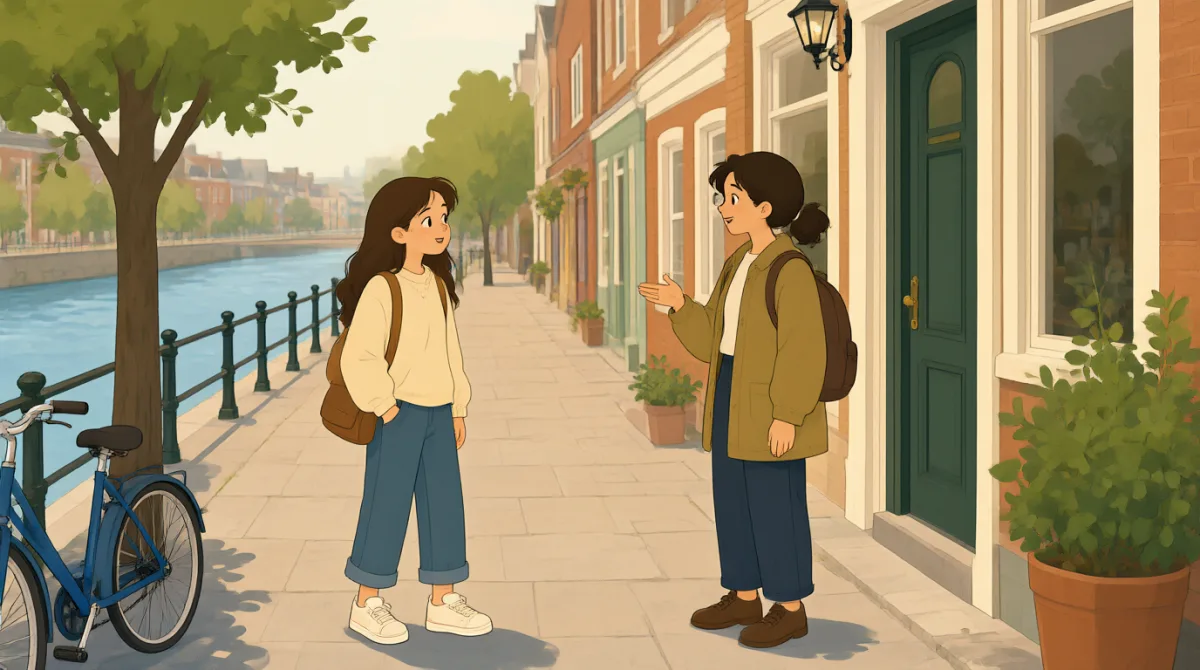

Excuse me, how do I get back to the riverside bike path?

Go straight to the traffic lights, then turn left.
Is the path close to the river from there?
Yes. Keep going for two blocks, and you’ll see it on your right.
Should I cross the big street near the lights?
No, that street gets busy. Use the crosswalk and wait for the light.
Thanks! I’ll use the crosswalk and stay on the bike path.
You’re welcome. Enjoy your ride!
Vocabulary7
- Go straight
Continue forward without turning. Use it to give someone a simple direction.
- traffic lights
The lights that control traffic at a road crossing. They are a useful landmark when giving directions.
- turn left
Change direction to the left. Use it to tell someone which way to go.
- Keep going
Continue moving in the same direction. You can add a distance or landmark after this phrase.
- on your right
On the right-hand side as you move forward. Use it to describe where someone will find a place.
- crosswalk
A marked place where people can safely cross a street. Use it when giving directions or safety advice.
- gets busy
Becomes crowded with traffic or people. Use it to warn someone that a place may be less safe or harder to use.
Key Sentences7
- 1
Excuse me, how do I get back to the riverside bike path?
Use this polite question when you need directions to a place. Replace “the riverside bike path” with the place you want to reach.
- 2
Go straight to the traffic lights, then turn left.
This gives two clear directions in order. Use “then” to show what to do next.
- 3
Is the path close to the river from there?
Use this question to check whether a place is near a landmark. Replace “the river” with another place or feature.
- 4
Keep going for two blocks, and you’ll see it on your right.
This explains how far to travel and where to look. You can change “two blocks” and “on your right” to match the directions.
- 5
Should I cross the big street near the lights?
Use “Should I…?” to ask if an action is the right thing to do. Replace “cross the big street” with another action you are unsure about.
- 6
Use the crosswalk and wait for the light.
This gives simple safety instructions for crossing a street. You can use this pattern to give someone two actions in order.
- 7
Thanks! I’ll use the crosswalk and stay on the bike path.
Use “I’ll” to say what you plan to do after receiving advice. It is a natural way to thank someone and confirm your plan.