Asking About the Clock Tower
Preguntar por la torre del reloj
Emma asks Grace when the clock tower was built and what the bell was used for. Grace gives her a simple answer before the group moves on.
Emma le pregunta a Grace cuándo se construyó la torre del reloj y para qué se usaba la campana. Grace le da una respuesta sencilla antes de que el grupo continúe.
Diálogo8
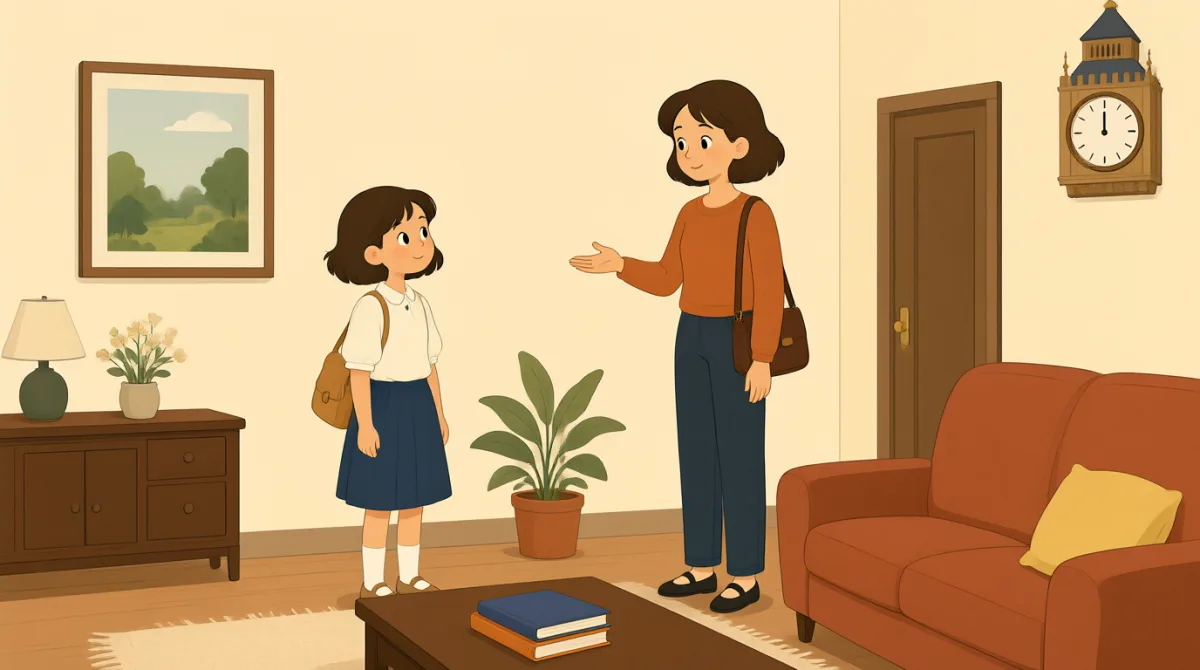

When was the clock tower built? It looks very old.
¿Cuándo se construyó la torre del reloj? Parece muy antigua.

It was built about two hundred years ago, in the early 1800s.
Se construyó hace unos doscientos años, a principios del siglo XIX.
Wow! Did people use the bell to tell the time?
¡Guau! ¿La gente usaba la campana para saber la hora?
Yes, it rang every hour so people could know the time.
Sí, sonaba cada hora para que la gente supiera qué hora era.
Could people hear it from far away?
¿Se podía oír desde lejos?
They could hear it all over town, especially on a quiet day.
Se podía oír por todo el pueblo, sobre todo en un día tranquilo.
That must have been helpful before people had phones.
Debió de ser muy útil antes de que la gente tuviera teléfonos.
It was! Now, let's walk around the tower and see the old door.
¡Sí que lo era! Ahora, vamos a dar una vuelta alrededor de la torre y a ver la puerta antigua.
Vocabulario8
- clock towertorre del reloj
A tall building or structure with a clock on it. Here, Emma is asking about an old tower in town.
Un edificio o estructura alta que tiene un reloj. Aquí, Emma pregunta por una torre antigua del pueblo.
- builtconstruido
Made or constructed. Use “was built” to talk about when a building was made.
Hecho o levantado. Usa “was built” para hablar de cuándo se construyó un edificio.
- two hundred years agohace doscientos años
A way to say that something happened 200 years in the past. You can use “[number] years ago” to talk about when something happened.
Una forma de decir que algo ocurrió hace 200 años. Puedes usar “[number] years ago” para hablar de cuándo ocurrió algo.
- tell the timedar la hora
To show or say what time it is. In the dialogue, people used the bell to help them know the time.
Indicar o decir qué hora es. En el diálogo, la gente usaba la campana para saber la hora.
- rang every hoursonaba cada hora
Made a sound once each hour. Use “rang” to describe the past sound of a bell.
Hacía un sonido una vez cada hora. Usa “rang” para describir el sonido que hacía una campana en el pasado.
- from far awaydesde lejos
At a great distance. You can ask if someone can hear or see something from far away.
A mucha distancia. Puedes preguntar si alguien puede oír o ver algo desde lejos.
- all over townpor todo el pueblo
In every part of the town. It describes how widely people could hear the bell.
En todas las partes del pueblo. Describe lo lejos que se podía oír la campana.
- walk arounddar una vuelta
To walk along or explore the area around something. You can use it when suggesting a relaxed look at a place.
Caminar por la zona alrededor de algo o explorarla. Puedes usar esta expresión para proponer echar un vistazo tranquilo a un lugar.
Frases clave7
- 1
When was the clock tower built?
¿Cuándo se construyó la torre del reloj?
Use this question to ask when a building or other structure was made. You can replace “the clock tower” with another place or object.
Usa esta pregunta para preguntar cuándo se construyó un edificio u otra estructura. Puedes sustituir “the clock tower” por otro lugar u objeto.
- 2
It was built about two hundred years ago, in the early 1800s.
Se construyó hace unos doscientos años, a principios del siglo XIX.
This gives an approximate age and a historical time period. Use “It was built…” to answer questions about when something was made.
Esta respuesta indica una antigüedad aproximada y un período histórico. Usa “It was built…” para responder preguntas sobre cuándo se construyó algo.
- 3
Did people use the bell to tell the time?
¿La gente usaba la campana para saber la hora?
Use “Did people use…?” to ask how something was used in the past. Replace “the bell” with another tool or object.
Usa “Did people use…?” para preguntar cómo se usaba algo en el pasado. Sustituye “the bell” por otra herramienta u objeto.
- 4
Yes, it rang every hour so people could know the time.
Sí, sonaba cada hora para que la gente supiera qué hora era.
This explains what the bell did and why. “So people could…” is useful for describing the purpose of something in the past.
Esto explica qué hacía la campana y por qué. “So people could…” sirve para describir el propósito de algo en el pasado.
- 5
Could people hear it from far away?
¿Se podía oír desde lejos?
Use this question to ask whether a sound could be heard at a distance. “Could” is useful for asking about ability in the past.
Usa esta pregunta para averiguar si se podía oír un sonido a distancia. “Could” sirve para preguntar por una capacidad en el pasado.
- 6
They could hear it all over town, especially on a quiet day.
Se podía oír por todo el pueblo, sobre todo en un día tranquilo.
This describes where the sound could be heard and when it was easiest to hear. You can use “especially on…” to point out a helpful condition.
Esto describe dónde se podía oír el sonido y cuándo era más fácil oírlo. Puedes usar “especially on…” para señalar una condición favorable.
- 7
Now, let's walk around the tower and see the old door.
Ahora, vamos a dar una vuelta alrededor de la torre y a ver la puerta antigua.
This is a friendly way to suggest the group move on and look at something. Use “Let's…” to make a simple suggestion.
Es una forma amable de proponer que el grupo continúe y vaya a ver algo. Usa “Let's…” para hacer una sugerencia sencilla.