Asking About the Day
Preguntar cómo estuvo el día
Emma greets her child, Leo, and asks about his day at school. He tells her what he did.
Emma saluda a su hijo Leo y le pregunta cómo le fue en la escuela. Él le cuenta qué hizo.
Diálogo8
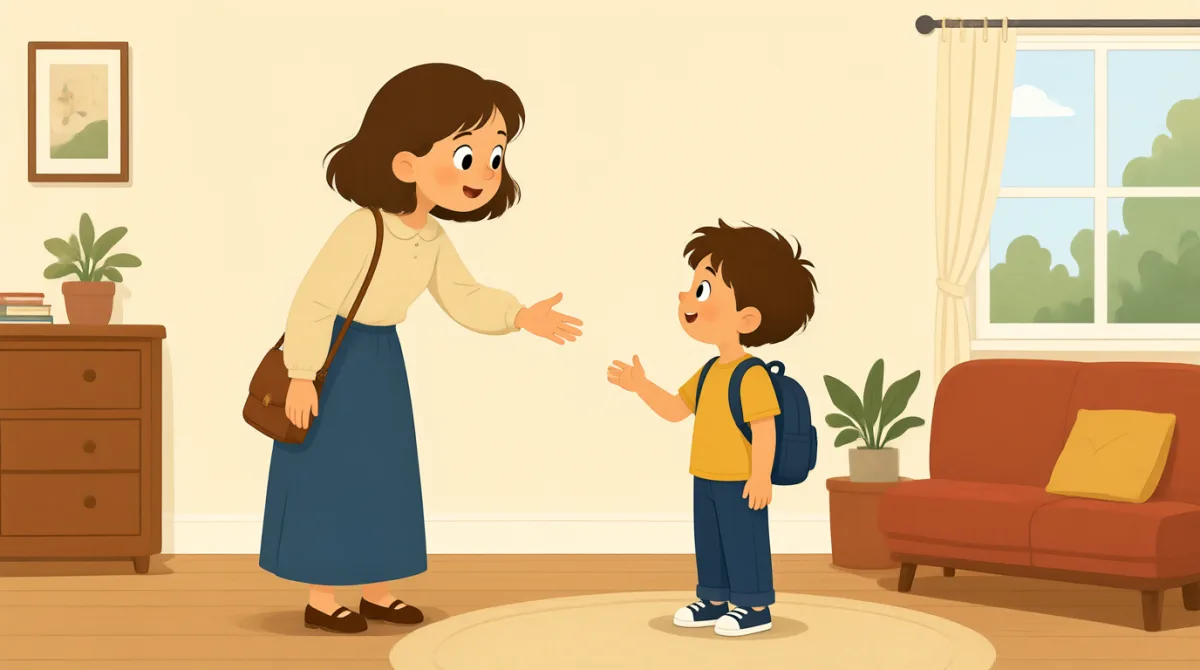

Hi, Leo! How was school today?
¡Hola, Leo! ¿Cómo te fue hoy en la escuela?

It was good! We read a fun story.
¡Bien! Leímos un cuento divertido.
That sounds nice. What else did you do?
Qué bien. ¿Qué más hiciste?
We drew pictures and played outside.
Hicimos dibujos y jugamos afuera.
What did you draw?
¿Qué dibujaste?
I drew a big blue dog.
Dibujé un perro azul y grande.
Great! Are you hungry now?
¡Genial! ¿Tienes hambre ahora?
Yes. Can we have a snack?
Sí. ¿Podemos comer algo?
Vocabulario7
- How was school today?¿Cómo te fue hoy en la escuela?
This is a friendly way to ask about someone's school day. You can change “school” to another place or activity.
Esta es una forma amable de preguntar cómo le fue a alguien en la escuela. Puedes cambiar “school” por otro lugar o actividad.
- It was good!¡Me fue bien!
This is a simple way to say that something went well. You can use it to answer questions about your day or an event.
Esta es una forma sencilla de decir que algo salió bien. Puedes usarla para responder preguntas sobre tu día o algún evento.
- read a fun storyleer un cuento divertido
This means to look at and understand a story that is enjoyable. You can say “read a fun book” or “read a fun story” to talk about reading.
Significa leer y entender un cuento que resulta entretenido. Puedes decir “read a fun book” o “read a fun story” para hablar de leer.
- What else did you do?¿Qué más hiciste?
Use this question to ask about more activities. You can replace “do” with another action, such as “What else did you see?”
Usa esta pregunta para preguntar por otras actividades. Puedes cambiar “do” por otra acción, como en “What else did you see?”.
- played outsidejugar afuera
This means to play outdoors, not inside a building. You can use it to talk about where you played.
Significa jugar al aire libre, fuera de un edificio. Puedes usarlo para hablar del lugar donde jugaste.
- Are you hungry now?¿Tienes hambre ahora?
This is a way to ask if someone wants food at this time. You can change “hungry” to another feeling, such as “tired”.
Esta es una forma de preguntar si alguien quiere comer algo en este momento. Puedes cambiar “hungry” por otra sensación, como “tired”.
- have a snackcomer algo
A snack is a small amount of food between meals. You can use “have a snack” to ask or talk about eating one.
Un refrigerio es una pequeña cantidad de comida que se come entre comidas. Puedes usar “have a snack” para preguntar si alguien quiere comer algo o hablar de ello.
Frases clave8
- 1
Hi, Leo! How was school today?
¡Hola, Leo! ¿Cómo te fue hoy en la escuela?
This is a warm greeting and an easy way to ask about someone's day. Use “How was [place or activity] today?” to ask about another experience.
Es un saludo cariñoso y una forma sencilla de preguntar cómo le fue el día a alguien. Usa “How was [place or activity] today?” para preguntar por otra experiencia.
- 2
It was good! We read a fun story.
¡Me fue bien! Leímos un cuento divertido.
This gives a simple answer and tells one thing that happened. You can use “It was [feeling]!” and add an activity you did.
Esta frase da una respuesta sencilla y cuenta algo que pasó. Puedes usar “It was [feeling]!” y añadir una actividad que hiciste.
- 3
That sounds nice.
Qué bien.
This is a friendly response when someone tells you about something pleasant. You can use it to show interest in their news.
Es una respuesta amable cuando alguien te cuenta algo agradable. Puedes usarla para mostrar interés por lo que te cuenta.
- 4
What else did you do?
¿Qué más hiciste?
Use this question to invite someone to share another activity. You can ask it after they tell you one thing they did.
Usa esta pregunta para animar a alguien a contar otra actividad. Puedes hacerla después de que te cuente algo que hizo.
- 5
We drew pictures and played outside.
Hicimos dibujos y jugamos afuera.
This sentence names two past activities. You can use “We [past action] and [past action]” to describe things you did with a group.
Esta frase menciona dos actividades pasadas. Puedes usar “We [past action] and [past action]” para describir cosas que hiciste con un grupo.
- 6
What did you draw?
¿Qué dibujaste?
This asks someone to say what they made with a pencil, crayons, or paint. You can use “What did you [action]?” to ask about a past activity.
Con esta pregunta le pides a alguien que diga qué hizo con un lápiz, crayones o pintura. Puedes usar “What did you [action]?” para preguntar por una actividad pasada.
- 7
Are you hungry now?
¿Tienes hambre ahora?
This asks about someone's feeling at the present time. Use “Are you [feeling] now?” to ask how someone feels.
Esta pregunta trata sobre cómo se siente alguien en este momento. Usa “Are you [feeling] now?” para preguntar cómo se siente una persona.
- 8
Yes. Can we have a snack?
Sí. ¿Podemos comer algo?
This is a simple way to say yes and politely ask for something to eat. You can use “Can we have [food]?” to ask for food or a drink.
Esta es una forma sencilla de decir que sí y pedir algo de comer con amabilidad. Puedes usar “Can we have [food]?” para pedir comida o una bebida.