Showing Your Ticket
Mostrando el billete
The conductor asks to see Emma’s ticket. Emma shows it and checks her seat.
El revisor le pide a Emma que le enseñe el billete. Emma se lo muestra y comprueba cuál es su asiento.
Diálogo7
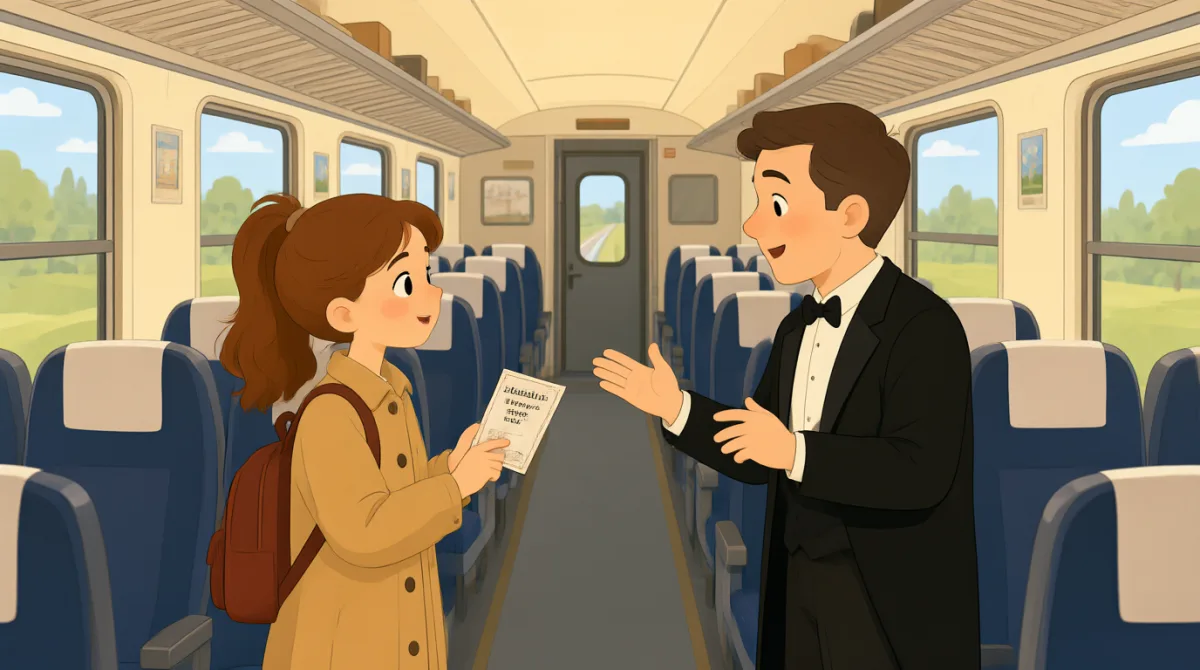

Ticket, please.
El billete, por favor.

Here it is. Is this my train?
Aquí está. ¿Este es mi tren?
Yes. It leaves at ten.
Sí. Sale a las diez.
Great. What is my seat number?
Genial. ¿Cuál es mi número de asiento?
Your seat is 12A, by the window.
Su asiento es el 12A, junto a la ventana.
Thank you. Is this the right car?
Gracias. ¿Este es el vagón correcto?
Yes. You are in the right car.
Sí. Está en el vagón correcto.
Vocabulario6
- Ticket, please.El billete, por favor.
The conductor says this to ask to see your ticket. You can use it when showing tickets or other documents.
El revisor dice esto para pedirte que le enseñes el billete. Puedes usar esta frase cuando muestres billetes u otros documentos.
- Here it is.Aquí está.
This means you are giving or showing the thing someone asked for. Use it to show your ticket.
Esto significa que estás dando o mostrando lo que alguien te pidió. Úsalo para enseñarle tu billete.
- leavessale
Here, “leaves” means the train starts its journey. You can ask, “What time does the train leave?”
Aquí, “leaves” significa que el tren inicia su viaje. Puedes preguntar: “What time does the train leave?” (¿A qué hora sale el tren?).
- seat numbernúmero de asiento
This is the number or code for your place on the train. You can ask, “What is my seat number?”
Es el número o código del lugar que te corresponde en el tren. Puedes preguntar: “What is my seat number?” (¿Cuál es mi número de asiento?).
- by the windowjunto a la ventana
This means the seat is next to the window. You can use it to describe where a seat is.
Significa que el asiento está al lado de la ventana. Puedes usar esta expresión para describir dónde está un asiento.
- right carvagón correcto
A train car is one section of a train. “The right car” means the correct section for your seat.
Un vagón es una sección del tren. “The right car” significa el vagón que corresponde a tu asiento.
Frases clave7
- 1
Here it is.
Aquí está.
Use this short phrase when you show someone something they asked for. You can say it while handing over a ticket or ID.
Usa esta frase corta cuando le muestres algo que alguien te pidió. Puedes decirla mientras le entregas un billete o un documento de identidad.
- 2
Is this my train?
¿Este es mi tren?
Use this question to check that you are getting on the correct train. You can replace “train” with another thing you want to check.
Usa esta pregunta para comprobar que vas a subir al tren correcto. Puedes sustituir “train” por otra cosa que quieras comprobar.
- 3
It leaves at ten.
Sale a las diez.
This tells someone when a train or bus starts its journey. Replace “ten” with the departure time.
Con esta frase le dices a alguien a qué hora inicia su viaje un tren o un autobús. Sustituye “ten” por la hora de salida.
- 4
What is my seat number?
¿Cuál es mi número de asiento?
Use this to ask which seat is yours. You can also ask, “What is my room number?” or “What is my table number?”
Usa esta pregunta para saber cuál es tu asiento. También puedes preguntar: “What is my room number?” o “What is my table number?”
- 5
Your seat is 12A, by the window.
Su asiento es el 12A, junto a la ventana.
This gives both the seat number and its location. You can use the same pattern to describe where a seat is.
Esta frase indica tanto el número del asiento como dónde está. Puedes usar la misma estructura para describir la ubicación de un asiento.
- 6
Is this the right car?
¿Este es el vagón correcto?
Use this question to check that you are in the correct section of the train. Replace “car” with another place or item you want to check.
Usa esta pregunta para comprobar que estás en la sección correcta del tren. Sustituye “car” por otro lugar u objeto que quieras comprobar.
- 7
You are in the right car.
Está en el vagón correcto.
This confirms that someone is in the correct train section. You can use “You are in the right…” to reassure someone about a place.
Con esta frase confirmas que alguien está en la sección correcta del tren. Puedes usar “You are in the right…” para tranquilizar a alguien sobre el lugar donde está.