Showing Your Ticket
The conductor asks to see Emma’s ticket. Emma shows it and checks her seat.
Dialogue7
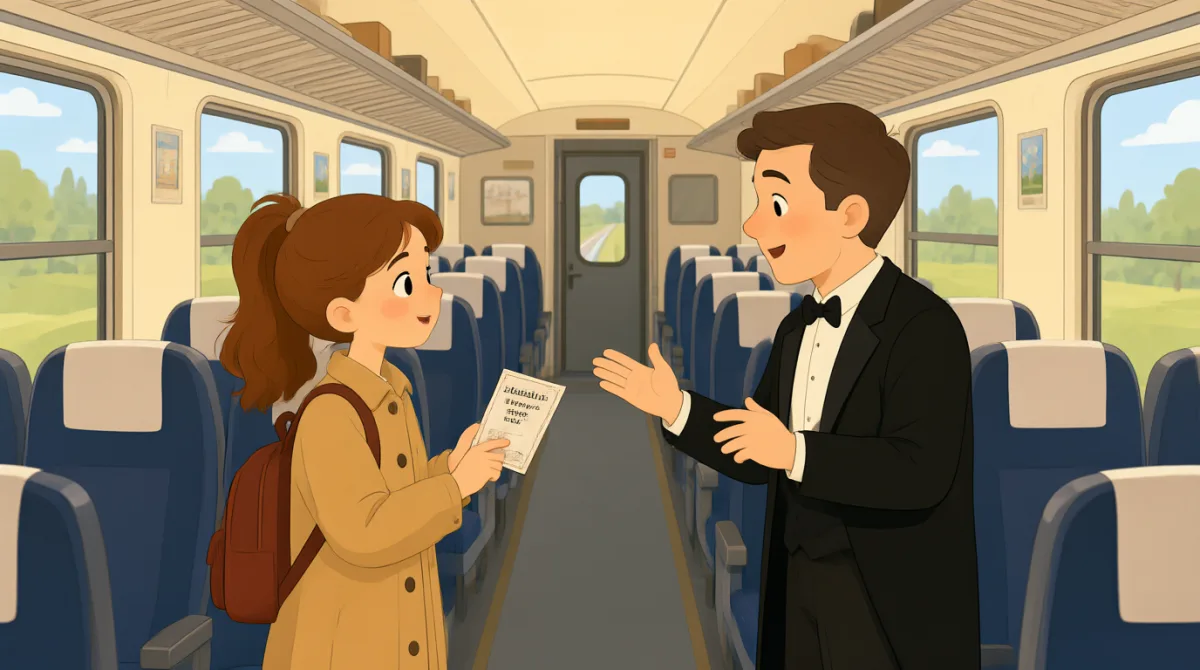

Ticket, please.

Here it is. Is this my train?
Yes. It leaves at ten.
Great. What is my seat number?
Your seat is 12A, by the window.
Thank you. Is this the right car?
Yes. You are in the right car.
Vocabulary6
- Ticket, please.
The conductor says this to ask to see your ticket. You can use it when showing tickets or other documents.
- Here it is.
This means you are giving or showing the thing someone asked for. Use it to show your ticket.
- leaves
Here, “leaves” means the train starts its journey. You can ask, “What time does the train leave?”
- seat number
This is the number or code for your place on the train. You can ask, “What is my seat number?”
- by the window
This means the seat is next to the window. You can use it to describe where a seat is.
- right car
A train car is one section of a train. “The right car” means the correct section for your seat.
Key Sentences7
- 1
Here it is.
Use this short phrase when you show someone something they asked for. You can say it while handing over a ticket or ID.
- 2
Is this my train?
Use this question to check that you are getting on the correct train. You can replace “train” with another thing you want to check.
- 3
It leaves at ten.
This tells someone when a train or bus starts its journey. Replace “ten” with the departure time.
- 4
What is my seat number?
Use this to ask which seat is yours. You can also ask, “What is my room number?” or “What is my table number?”
- 5
Your seat is 12A, by the window.
This gives both the seat number and its location. You can use the same pattern to describe where a seat is.
- 6
Is this the right car?
Use this question to check that you are in the correct section of the train. Replace “car” with another place or item you want to check.
- 7
You are in the right car.
This confirms that someone is in the correct train section. You can use “You are in the right…” to reassure someone about a place.