Missing the Train
Perder el tren
Leo misses his train and asks Grace when the next one leaves. She tells him the time.
Leo pierde su tren y le pregunta a Grace cuándo sale el siguiente. Ella le dice la hora.
Diálogo7
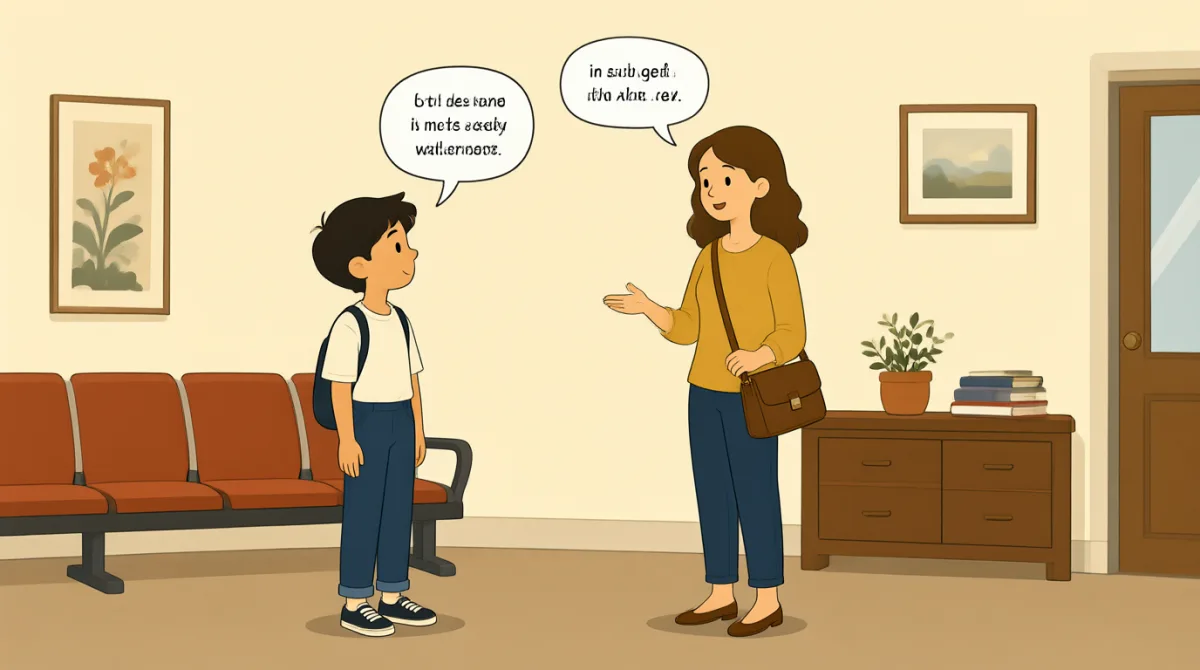

Oh no, I missed my train!
¡Ay, no! ¡Perdí el tren!

I’m sorry. Where are you going?
Lo siento. ¿Adónde vas?
I’m going to Boston. When is the next train?
Voy a Boston. ¿Cuándo sale el próximo tren?
The next train leaves at three o’clock.
El próximo tren sale a las tres.
Is there a seat on that train?
¿Hay algún asiento en ese tren?
Yes, there are seats. You can buy a ticket here.
Sí, hay asientos. Puedes comprar un boleto aquí.
Great. One ticket to Boston, please.
Genial. Un boleto a Boston, por favor.
Vocabulario8
- missed my trainperdí el tren
This means the train left before I got on it. Use “I missed my train” to explain why you need another train.
Significa que el tren se fue antes de que pudieras subir. Usa “I missed my train” para explicar por qué necesitas tomar otro tren.
- Where are you going?¿Adónde vas?
This asks about someone’s destination. You can answer with “I’m going to” and a place.
Esta pregunta sirve para saber cuál es el destino de alguien. Puedes responder con “I’m going to” y un lugar.
- I’m going to Boston.Voy a Boston.
This tells someone where you plan to travel. Replace “Boston” with another place, such as “I’m going to work.”
Con esta frase le dices a alguien adónde piensas viajar. Puedes reemplazar “Boston” por otro lugar, como en “I’m going to work.”
- the next trainel próximo tren
This means the train that leaves after the current or missed one. You can ask, “When is the next train?”
Se refiere al tren que sale después del tren actual o del que perdiste. Puedes preguntar: “When is the next train?”
- three o’clocklas tres
This is a way to say the time: 3:00. Replace it with another time to say when something happens.
Es una forma de decir la hora: 3:00. Puedes cambiarla por otra hora para decir cuándo sucede algo.
- a seatun asiento
A seat is a place to sit on the train. You can ask, “Is there a seat?” when checking if one is available.
Un asiento es un lugar para sentarse en el tren. Puedes preguntar “Is there a seat?” para saber si hay uno disponible.
- buy a ticketcomprar un boleto
This means to pay for a ticket so you can travel. You can say, “Where can I buy a ticket?”
Significa pagar por un boleto para poder viajar. Puedes decir: “Where can I buy a ticket?”
- One ticket to Boston, please.Un boleto a Boston, por favor.
This is a polite way to ask for a ticket to a place. Replace “Boston” with your destination.
Es una forma amable de pedir un boleto a un lugar. Puedes reemplazar “Boston” por tu destino.
Frases clave8
- 1
Oh no, I missed my train!
¡Ay, no! ¡Perdí el tren!
Use this to say that your train left before you got on it. You can replace “my train” with another thing you missed.
Usa esta frase para decir que el tren se fue antes de que pudieras subir. Puedes reemplazar “my train” por otra cosa que hayas perdido.
- 2
Where are you going?
¿Adónde vas?
This is a simple way to ask someone’s destination. You can answer, “I’m going to” plus a place.
Es una forma sencilla de preguntar cuál es el destino de alguien. Puedes responder con “I’m going to” y luego un lugar.
- 3
I’m going to Boston.
Voy a Boston.
Use this sentence to say where you are traveling. Replace “Boston” with a different city or place.
Usa esta frase para decir adónde viajas. Puedes reemplazar “Boston” por otra ciudad o lugar.
- 4
When is the next train?
¿Cuándo sale el próximo tren?
Use this to ask when the next train leaves. Replace “train” with another service, such as “bus.”
Usa esta pregunta para saber cuándo sale el próximo tren. Puedes reemplazar “train” por otro medio de transporte, como “bus.”
- 5
The next train leaves at three o’clock.
El próximo tren sale a las tres.
This tells someone when the next train departs. Replace “three o’clock” with the correct time.
Con esta frase le dices a alguien cuándo sale el próximo tren. Reemplaza “three o’clock” por la hora correcta.
- 6
Is there a seat on that train?
¿Hay algún asiento en ese tren?
Use this to ask if a seat is available. You can replace “that train” with another option, such as “the bus.”
Usa esta pregunta para saber si hay un asiento disponible. Puedes reemplazar “that train” por otra opción, como “the bus.”
- 7
You can buy a ticket here.
Puedes comprar un boleto aquí.
This tells someone where they can get a ticket. Replace “here” with a place, such as “at the desk.”
Con esta frase le dices a alguien dónde puede conseguir un boleto. Puedes reemplazar “here” por un lugar, como “at the desk.”
- 8
One ticket to Boston, please.
Un boleto a Boston, por favor.
Use this polite sentence to ask for a ticket to a destination. Replace “Boston” with the place you want to go.
Usa esta frase amable para pedir un boleto a un destino. Reemplaza “Boston” por el lugar adonde quieres ir.