Asking About the Size
Nach der Größe fragen
Emma asks Jack how wide the sofa is and checks whether it will fit in her living room. Jack helps her compare its measurements.
Emma fragt Jack, wie breit das Sofa ist, und prüft, ob es in ihr Wohnzimmer passt. Jack hilft ihr, die Maße zu vergleichen.
Dialog8
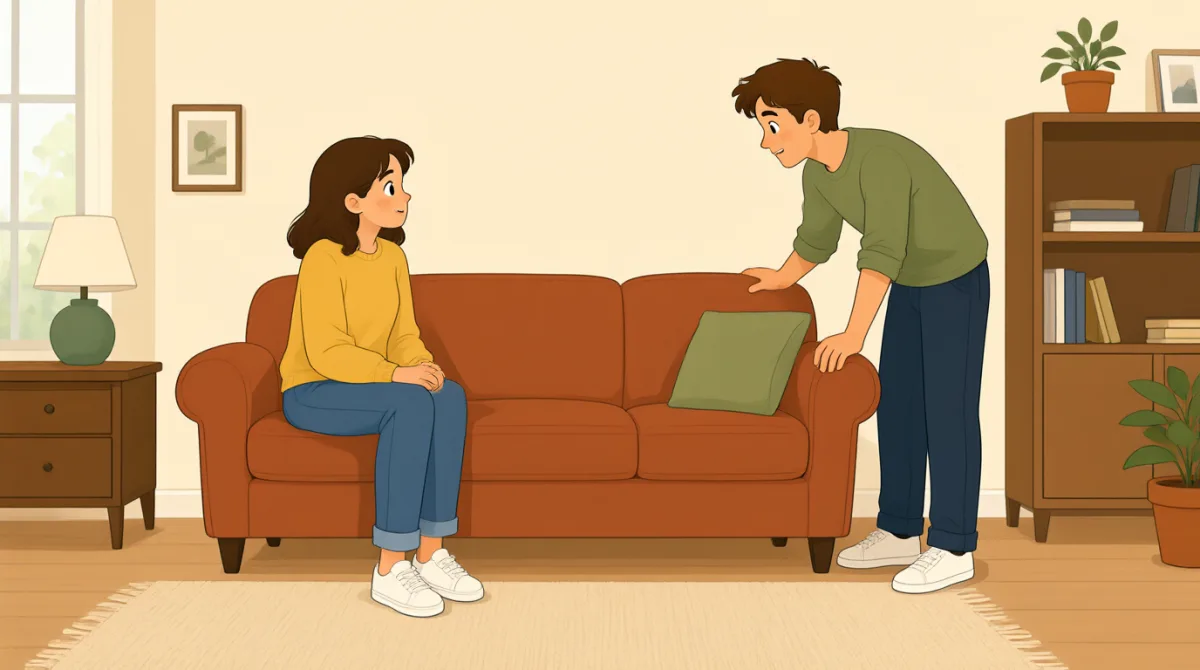

How wide is this sofa? I want to make sure it fits in my living room.
Wie breit ist dieses Sofa? Ich möchte sichergehen, dass es in mein Wohnzimmer passt.

It's eighty inches wide, and the seat is thirty-six inches deep.
Es ist achtzig Zoll breit und die Sitzfläche ist sechsunddreißig Zoll tief.
My living room is about nine feet wide. Is that enough space?
Mein Wohnzimmer ist ungefähr neun Fuß breit. Reicht der Platz?
It should fit, but leave some room to walk around it.
Es sollte passen, aber lass etwas Platz, damit man darum herumgehen kann.
I measured the wall yesterday. It's ten feet long.
Ich habe gestern die Wand ausgemessen. Sie ist zehn Fuß lang.
That gives you about two feet on each side of the sofa.
Dann hast du auf jeder Seite des Sofas ungefähr zwei Fuß Platz.
What about the depth? Will it leave enough room in front?
Und wie sieht es mit der Tiefe aus? Bleibt davor genug Platz?
If you leave three feet between the sofa and the table, you'll have room to walk.
Wenn du zwischen dem Sofa und dem Tisch drei Fuß Platz lässt, kannst du bequem vorbeigehen.
Wortschatz8
- make suresichergehen
To check that something is true or will happen. Use it when you want to confirm that furniture will fit.
Damit prüfst du, ob etwas stimmt oder passieren wird. Verwende den Ausdruck, wenn du sicherstellen möchtest, dass ein Möbelstück passt.
- fits in my living roomin mein Wohnzimmer passen
Means that something is the right size to go in your living room. You can use “fits in” to talk about whether an item will go in a space.
Das bedeutet, dass etwas die richtige Größe hat, um in dein Wohnzimmer zu passen. Mit “fits in” kannst du sagen, ob ein Gegenstand in einen bestimmten Raum passt.
- widebreit
Describes the measurement from one side to the other. Ask “How wide is it?” to find out an item's width.
Damit beschreibst du das Maß von einer Seite zur anderen. Frag “How wide is it?”, um herauszufinden, wie breit etwas ist.
- deeptief
Describes how far something goes from front to back. Ask “How deep is it?” to check how much space it needs.
Damit beschreibst du, wie weit etwas von vorne nach hinten reicht. Frag “How deep is it?”, um herauszufinden, wie viel Platz es braucht.
- leave some roometwas Platz lassen
Means to keep some space free. Use it when planning where to put furniture so people can move around.
Das bedeutet, einen Teil der Fläche freizuhalten. Verwende den Ausdruck, wenn du Möbel so aufstellst, dass man sich noch bewegen kann.
- measured the walldie Wand ausgemessen
Means checked how long or wide the wall is. You can measure a room or wall before buying furniture.
Das bedeutet, dass du geprüft hast, wie lang oder breit die Wand ist. Du kannst einen Raum oder eine Wand ausmessen, bevor du Möbel kaufst.
- on each sideauf jeder Seite
Means on both sides of something. Use it to describe how space is divided around an object.
Das bedeutet auf beiden Seiten von etwas. Verwende den Ausdruck, um zu beschreiben, wie Platz um einen Gegenstand herum verteilt ist.
- room to walkPlatz zum Gehen
Means enough open space for people to move around. You can use this phrase when arranging furniture.
Das bedeutet, dass genug freie Fläche vorhanden ist, damit man sich bewegen kann. Du kannst den Ausdruck verwenden, wenn du Möbel aufstellst.
Wichtige Sätze8
- 1
How wide is this sofa?
Wie breit ist dieses Sofa?
A simple way to ask for the width of an item. You can replace “sofa” with another piece of furniture.
So fragst du auf einfache Weise nach der Breite eines Gegenstands. Du kannst “sofa” durch ein anderes Möbelstück ersetzen.
- 2
I want to make sure it fits in my living room.
Ich möchte sichergehen, dass es in mein Wohnzimmer passt.
Use this to explain that you are checking an item's size before buying it. Replace “living room” with another space.
Verwende diesen Satz, um zu erklären, dass du vor dem Kauf prüfst, ob ein Gegenstand die richtige Größe hat. Ersetze “living room” durch einen anderen Raum.
- 3
My living room is about nine feet wide.
Mein Wohnzimmer ist ungefähr neun Fuß breit.
This sentence gives an approximate measurement. Use “about” when you are not giving an exact number.
Dieser Satz nennt ein ungefähres Maß. Verwende “about”, wenn du keine genaue Zahl angibst.
- 4
It should fit, but leave some room to walk around it.
Es sollte passen, aber lass etwas Platz, damit man darum herumgehen kann.
This gives a helpful opinion about fit and space. Use “It should fit, but…” to mention a condition or concern.
Damit gibst du eine hilfreiche Einschätzung dazu, ob etwas passt und genug Platz bleibt. Verwende “It should fit, but…”, um eine Bedingung oder ein mögliches Problem zu erwähnen.
- 5
I measured the wall yesterday.
Ich habe gestern die Wand ausgemessen.
Use this to say that you checked a wall's size in the past. You can replace “the wall” with “the room” or another object.
Verwende diesen Satz, um zu sagen, dass du früher die Größe einer Wand geprüft hast. Du kannst “the wall” durch “the room” oder einen anderen Gegenstand ersetzen.
- 6
What about the depth?
Und wie sieht es mit der Tiefe aus?
A short way to ask about another measurement. Use “What about…?” to bring up a new detail.
So fragst du kurz nach einem weiteren Maß. Mit “What about…?” kannst du einen neuen Punkt ansprechen.
- 7
Will it leave enough room in front?
Bleibt davor genug Platz?
This asks whether there will be enough open space in front of an item. You can use it when planning a room layout.
Damit fragst du, ob vor einem Gegenstand genug freie Fläche bleibt. Du kannst den Satz verwenden, wenn du die Einrichtung eines Raums planst.
- 8
If you leave three feet between the sofa and the table, you'll have room to walk.
Wenn du zwischen dem Sofa und dem Tisch drei Fuß Platz lässt, kannst du bequem vorbeigehen.
This explains how much space to leave so people can move around. Use “If you leave [space] between [items], you'll have room to walk” for other furniture.
Der Satz erklärt, wie viel Platz frei bleiben sollte, damit man sich bewegen kann. Verwende “If you leave [space] between [items], you'll have room to walk” für andere Möbel.