Calling the Building Manager
Den Hausverwalter anrufen
Jack calls the building manager, Grace, and explains the problem. Grace says she is on her way.
Jack ruft die Hausverwalterin Grace an und erklärt das Problem. Grace sagt, dass sie unterwegs ist.
Dialog7
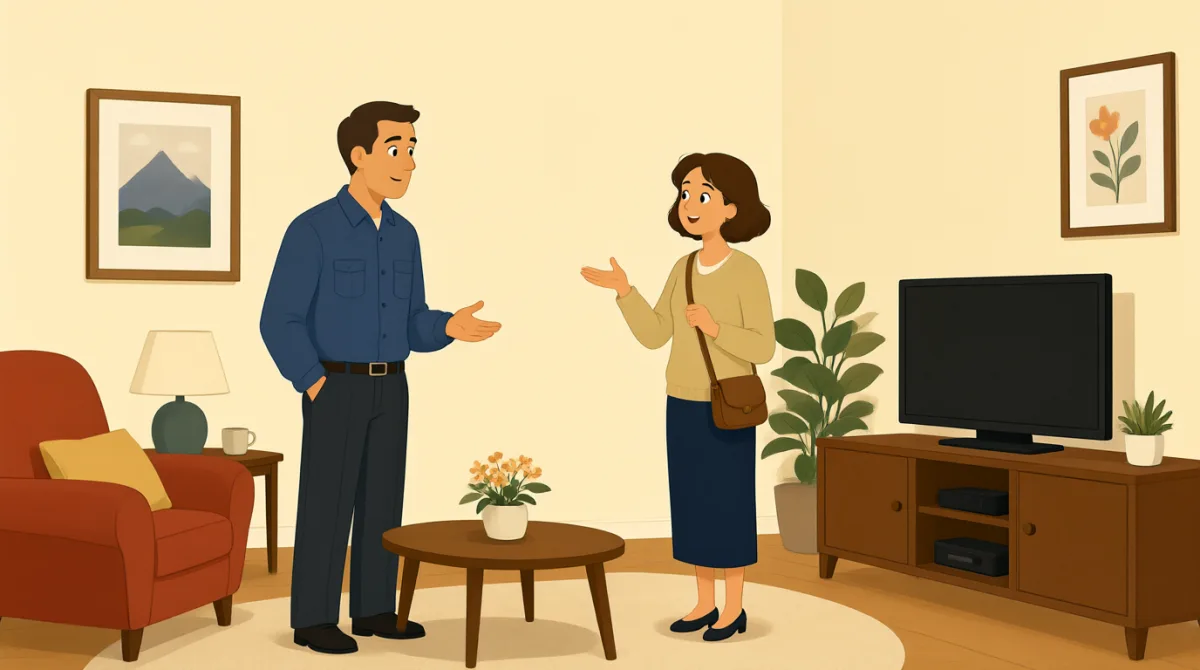

Hi, Grace. Emma is locked out of her apartment.
Hallo, Grace. Emma steht vor ihrer Wohnung und kommt nicht hinein.

Oh no. Are her keys inside?
Oh nein. Sind ihre Schlüssel drinnen?
Yes, her keys are inside. The door is locked.
Ja, ihre Schlüssel sind drinnen. Die Tür ist abgeschlossen.
Is Emma there with you now?
Ist Emma jetzt bei dir?
Yes, she is waiting by the door.
Ja, sie wartet an der Tür.
Okay. I am on my way now.
Okay. Ich bin jetzt unterwegs.
Thank you, Grace. We will wait here.
Danke, Grace. Wir warten hier.
Wortschatz6
- locked outausgesperrt sein
You are locked out when you cannot get into a place. Use “I’m locked out” to explain this problem.
Du bist „locked out“, wenn du nicht in einen Ort hineinkommst. Mit „I’m locked out“ erklärst du, dass du ausgesperrt bist.
- keysSchlüssel
Keys open a door or a lock. You can say “My keys are inside” to explain where they are.
Mit Schlüsseln öffnest du eine Tür oder ein Schloss. Mit „My keys are inside“ erklärst du, wo deine Schlüssel sind.
- insidedrinnen
Inside means in a place, not outside. Use it to say where something is.
„Inside“ bedeutet, dass sich etwas an einem Ort und nicht draußen befindet. Du kannst es verwenden, um zu sagen, wo etwas ist.
- doorTür
A door lets people enter or leave a room or building. You can say “The door is locked” when it will not open.
Durch eine Tür können Menschen einen Raum oder ein Gebäude betreten oder verlassen. Wenn sie sich nicht öffnen lässt, kannst du sagen: „The door is locked“.
- waiting by the dooran der Tür warten
This means staying near the door until something happens. Use it to tell someone where you are waiting.
Das bedeutet, in der Nähe der Tür zu bleiben, bis etwas passiert. Damit kannst du jemandem sagen, wo du wartest.
- on my wayunterwegs sein
This means you are coming to a place now. You can say “I’m on my way” when someone is waiting for you.
Das bedeutet, dass du gerade zu einem Ort kommst. Du kannst „I’m on my way“ sagen, wenn jemand auf dich wartet.
Wichtige Sätze8
- 1
Emma is locked out of her apartment.
Emma steht vor ihrer Wohnung und kommt nicht hinein.
Use this sentence to explain that someone cannot get into their home. Replace “Emma” with the person’s name.
Mit „Emma is locked out of her apartment.“ erklärst du, dass jemand nicht in die eigene Wohnung hineinkommt. Ersetze „Emma“ durch den Namen der betreffenden Person.
- 2
Are her keys inside?
Sind ihre Schlüssel drinnen?
Use this question to ask if someone’s keys are in a place. Replace “her” with “his” or “your” as needed.
Mit „Are her keys inside?“ fragst du, ob die Schlüssel einer Person an einem Ort sind. Ersetze „her“ je nach Situation durch „his“ oder „your“.
- 3
Yes, her keys are inside.
Ja, ihre Schlüssel sind drinnen.
This is a simple way to answer where the keys are. Replace “her keys” with another person’s keys or an item.
„Yes, her keys are inside.“ ist eine einfache Antwort auf die Frage, wo die Schlüssel sind. Ersetze „her keys“ durch die Schlüssel einer anderen Person oder durch einen Gegenstand.
- 4
The door is locked.
Die Tür ist abgeschlossen.
Use this sentence to explain why someone cannot enter. Replace “door” with another thing that is locked.
Mit „The door is locked.“ erklärst du, warum jemand nicht hineinkommt. Ersetze „door“ durch etwas anderes, das abgeschlossen ist.
- 5
Is Emma there with you now?
Ist Emma jetzt bei dir?
Use this question to check if someone is with another person at this moment. Replace the names to fit your situation.
Mit „Is Emma there with you now?“ fragst du, ob jemand gerade bei einer anderen Person ist. Passe die Namen an deine Situation an.
- 6
She is waiting by the door.
Sie wartet an der Tür.
Use this sentence to say where someone is waiting. Replace “She” and “the door” with the right person and place.
Mit „She is waiting by the door.“ sagst du, wo jemand wartet. Ersetze „She“ und „the door“ durch die passende Person und den passenden Ort.
- 7
I am on my way now.
Ich bin jetzt unterwegs.
Use this sentence to tell someone you are coming soon. Replace “I” with another person, or say “I’m on my way” in casual speech.
Mit „I am on my way now.“ sagst du jemandem, dass du bald kommst. Ersetze „I“ durch eine andere Person oder verwende in der lockeren gesprochenen Sprache „I’m on my way“.
- 8
We will wait here.
Wir warten hier.
Use this sentence to say that a group will stay in one place. Replace “here” with another place if needed.
Mit „We will wait here.“ sagst du, dass eine Gruppe an einem Ort bleibt. Ersetze „here“ bei Bedarf durch einen anderen Ort.