Giving the Key Back
Den Schlüssel zurückgeben
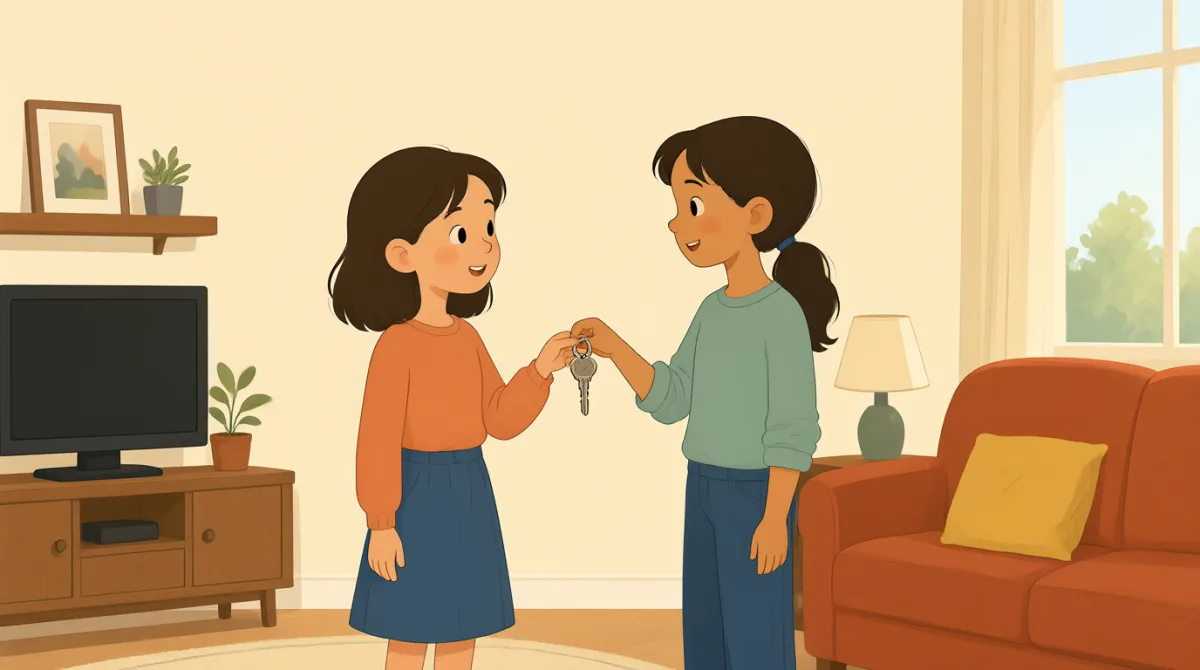
Grace is home, and Emma gives her the key back. They talk briefly about how the cat is doing.
Grace ist zu Hause und Emma gibt ihr den Schlüssel zurück. Sie unterhalten sich kurz darüber, wie es der Katze geht.
Dialog8

Hi, Emma. Thanks for feeding my cat.
Hi, Emma. Danke, dass du meine Katze gefüttert hast.

Of course. Here is your key.
Klar. Hier ist dein Schlüssel.
Thanks. How is the cat doing?
Danke. Wie geht es der Katze?
She is fine. She ate all her food.
Ihr geht’s gut. Sie hat ihr ganzes Futter aufgefressen.
Great! Did you give her fresh water?
Toll! Hast du ihr frisches Wasser hingestellt?
Yes, I did. Her water bowl is full.
Ja. Ihr Wassernapf ist voll.
Thank you so much, Emma.
Vielen lieben Dank, Emma.
You're welcome. She is a sweet cat.
Gern geschehen. Sie ist eine ganz liebe Katze.
Wortschatz8
- Of course.Klar.
This is a friendly way to say yes or that something is no problem. Use it when someone asks for help or thanks you.
Das ist eine freundliche Art, Ja zu sagen oder auszudrücken, dass etwas kein Problem ist. Sag das, wenn dich jemand um Hilfe bittet oder sich bei dir bedankt.
- Here is your key.Hier ist dein Schlüssel.
Use this when you give someone their key back. You can replace “key” with another item.
Das sagst du, wenn du jemandem den Schlüssel zurückgibst. Du kannst „key“ durch einen anderen Gegenstand ersetzen.
- How is the cat doing?Wie geht es der Katze?
This asks how the cat is and if she is okay. You can use “How is [someone or something] doing?” to ask about their well-being.
Damit fragst du, wie es der Katze geht und ob alles in Ordnung ist. Mit “How is [someone or something] doing?” kannst du dich nach dem Wohlbefinden einer Person oder Sache erkundigen.
- She ate all her food.Sie hat ihr ganzes Futter aufgefressen.
This means the cat finished all the food. Use “ate all” to say someone or an animal finished everything.
Das bedeutet, dass die Katze das ganze Futter aufgefressen hat. Mit “ate all” sagst du, dass jemand oder ein Tier alles aufgegessen hat.
- fresh waterfrisches Wasser
This means clean water that is new, not old. You can use “fresh” with food and drinks, too.
Damit ist sauberes, frisch nachgefülltes Wasser gemeint. Du kannst “fresh” auch für Lebensmittel und Getränke verwenden.
- water bowlWassernapf
This is a bowl that holds water for an animal to drink. You can use “food bowl” for a bowl that holds pet food.
Das ist ein Napf, aus dem ein Tier Wasser trinkt. Für einen Napf mit Tierfutter kannst du “food bowl” sagen.
- You're welcome.Gern geschehen.
This is a polite reply when someone says “thank you.”
Das ist eine höfliche Antwort, wenn sich jemand mit “thank you” bedankt.
- sweet catliebe Katze
This means the cat is kind or nice. You can use “sweet” to describe a kind person or animal.
Damit sagst du, dass die Katze lieb oder nett ist. Mit “sweet” kannst du eine freundliche Person oder ein liebes Tier beschreiben.
Wichtige Sätze8
- 1
Thanks for feeding my cat.
Danke, dass du meine Katze gefüttert hast.
Use this to thank someone for giving your cat food. You can say “Thanks for [verb]-ing” to thank someone for an action.
Damit bedankst du dich bei jemandem dafür, dass die Person deiner Katze Futter gegeben hat. Mit “Thanks for [verb]-ing” bedankst du dich für etwas, das jemand getan hat.
- 2
Here is your key.
Hier ist dein Schlüssel.
Use this when you give someone their key back. Replace “key” with the item you are returning.
Das sagst du, wenn du jemandem den Schlüssel zurückgibst. Ersetze “key” durch den Gegenstand, den du zurückgibst.
- 3
How is the cat doing?
Wie geht es der Katze?
This is a simple way to ask if the cat is okay. Replace “the cat” with a person or another thing you want to ask about.
So kannst du einfach fragen, ob es der Katze gut geht. Ersetze “the cat” durch eine Person oder etwas anderes, nach dem du fragen möchtest.
- 4
She ate all her food.
Sie hat ihr ganzes Futter aufgefressen.
Use this to say that someone or an animal finished all the food. Replace “she” and “her food” to talk about someone else.
Damit sagst du, dass jemand oder ein Tier das ganze Futter aufgegessen hat. Ersetze “she” und “her food”, wenn du von jemand anderem sprichst.
- 5
Did you give her fresh water?
Hast du ihr frisches Wasser hingestellt?
Use this to ask if someone gave the cat clean water. “Did you” is useful for asking about a past action.
Damit fragst du, ob jemand der Katze sauberes Wasser gegeben hat. Mit “Did you” fragst du nach etwas, das in der Vergangenheit passiert ist.
- 6
Her water bowl is full.
Ihr Wassernapf ist voll.
This tells someone that the cat has plenty of water. Replace “water bowl” with another thing to describe what is full.
Damit sagst du jemandem, dass die Katze genug Wasser hat. Ersetze “water bowl” durch etwas anderes, von dem du sagen möchtest, dass es voll ist.
- 7
Thank you so much, Emma.
Vielen lieben Dank, Emma.
This is a warm way to say thank you. You can use it when you feel very grateful.
Das ist eine herzliche Art, sich zu bedanken. Du kannst es sagen, wenn du besonders dankbar bist.
- 8
She is a sweet cat.
Sie ist eine ganz liebe Katze.
Use this to say the cat is kind or nice. Replace “cat” with another person or animal.
Damit sagst du, dass die Katze lieb oder nett ist. Ersetze “cat” durch eine andere Person oder ein anderes Tier.