Asking for Route Confirmation
詢問路線確認
A passenger asks the bus driver if the bus goes to a specific destination, confirming they are on the correct bus.
乘客向公交司機詢問公交車是否開往某個特定目的地,確認自己是否搭乘了正確的公交車。
對話8
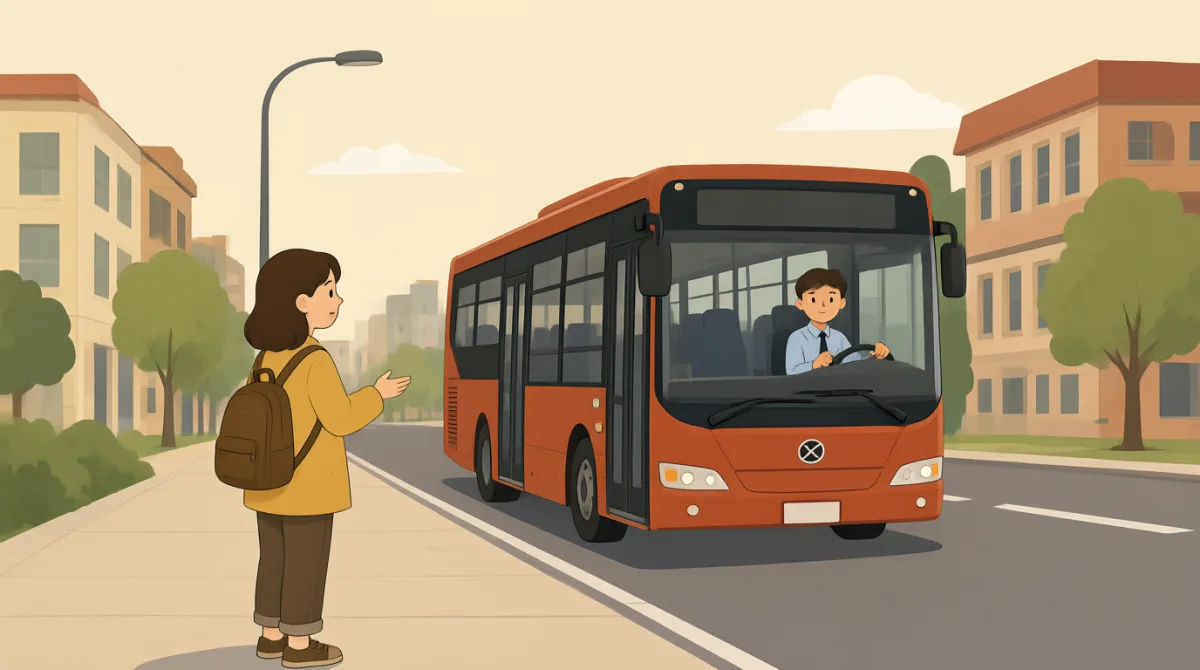

Excuse me, driver? Does this bus go to the City Art Museum?
不好意思,司機?這趟車到市藝術博物館嗎?

Yes, it does. You're on the right bus.
是的,到。你上對車了。
Oh, perfect! And how many stops is it from here?
哦,太好了!從這裡還有多少站呢?
Let's see... about five or six stops. It's across from Central Park.
讓我想想……大概五六站。就在中央公園對面。
Okay, got it. Will you announce the stop, or should I keep an eye out?
好的,知道了。到時候你會報站嗎,還是我得自己留意?
The announcements are automatic. You'll hear it for the 'Central Park South' stop. That's the one you want.
廣播是自動的。你會聽到‘中央公園南’那一站的報站。那就是你要找的。
Great, thanks so much for your help!
太好了,非常感謝您的幫助!
No problem. Enjoy your visit!
不客氣。祝你玩得愉快!
詞彙6
- excuse me不好意思
A polite phrase used to get someone's attention or interrupt politely, like starting a conversation on a bus.
這是一個禮貌用語,用來引起別人的注意或禮貌地打斷對方,比如在公交車上開始詢問時使用。
- bus公交車
A large public vehicle that carries passengers along a fixed route; essential for talking about transportation.
一種按照固定路線運送乘客的大型公共交通工具;談論交通出行時經常會用到這個詞。
- stop車站
A place where a bus pauses to let passengers get on or off; often used in questions about distance or location.
公交車停靠、讓乘客上下車的地方;詢問距離或位置時經常會用到這個詞。
- announce報出;宣佈
To make a public statement, like telling passengers about the next stop over a speaker system.
指公開說出某條資訊,比如透過廣播告訴乘客下一站是哪裡。
- automatic自動的
Something that happens by itself without needing manual control, like bus announcements that play on their own.
指不需要人工操作就會自行發生的事情,比如公交車自動播放報站資訊。
- across from在……對面
Directly opposite something, used to describe the location of a place relative to a landmark like a park.
表示某個地方正好位於另一個地方的對面,常用來根據公園等地標描述位置。
關鍵句7
- 1
Excuse me, driver? Does this bus go to the City Art Museum?
不好意思,司機?這趟車到市藝術博物館嗎?
This is a polite way to ask for route information; 'Does this bus go to' is a yes/no question pattern useful for confirming destinations on public transport. Use it when unsure if you're on the correct vehicle.
這是詢問公交路線的一種禮貌說法;'Does this bus go to' 是一個很實用的“這趟車到……嗎?”一般疑問句結構,可以在不確定自己是否搭對車時使用。
- 2
Yes, it does. You're on the right bus.
是的,到。你上對車了。
A simple affirmative response using 'it does' to answer the question; 'on the right bus' means you've chosen correctly. This pattern reassures someone and is common in service interactions.
這是用 'it does' 作出的簡單肯定回答;'on the right bus' 表示你選對了車。這種表達可以讓對方放心,在服務場景中很常見。
- 3
Oh, perfect! And how many stops is it from here?
哦,太好了!從這裡還有多少站呢?
'How many stops' asks about the number of bus halts to a destination; 'from here' specifies the starting point. This sentence helps plan travel time and is practical for bus rides.
'How many stops' 用來詢問到目的地還要經過幾站;'from here' 指明起點是“從這裡”。這句話有助於乘客安排出行時間,在乘坐公交車時非常實用。
- 4
Let's see... about five or six stops. It's across from Central Park.
讓我想想……大概五六站。就在中央公園對面。
'Let's see' is a thinking filler; 'about five or six' uses approximation for estimates. 'Across from' describes location. Useful for giving directions with landmarks in travel scenarios.
'Let's see' 是思考時使用的填充語;'about five or six' 表示“大約五六個”,用於給出估計值。'Across from' 用來描述位置。在旅行場景中根據地標指路時,這些表達很有用。
- 5
Will you announce the stop, or should I keep an eye out?
到時候你會報站嗎,還是我得自己留意?
This is an alternative question ('or') seeking confirmation on alerts; 'keep an eye out' idiom means to watch carefully. Grammar: future 'will' for predictions. Use when checking for notifications on transport.
這是一個用 'or' 連線的選擇疑問句,用來確認是否會有提醒;習語 'keep an eye out' 意思是“仔細留意”。語法上,'will' 表示對未來情況的預測。乘坐交通工具時,可以用這句話確認如何獲取到站提醒。
- 6
The announcements are automatic. You'll hear it for the 'Central Park South' stop.
廣播是自動的。你會聽到‘中央公園南’那一站的報站。
'Are automatic' describes how something works; 'you'll hear' is future simple tense for expectations. This explains system features and is helpful for informing passengers about audio cues.
'Are automatic' 用來說明某項功能是如何執行的;'you'll hear' 是一般將來時,表示預計會發生的事情。這句話解釋了系統的功能,也可以用來告知乘客注意語音提示。
- 7
Great, thanks so much for your help!
太好了,非常感謝您的幫助!
A polite expression of gratitude; 'thanks so much' emphasizes appreciation. Use this to end helpful conversations, like after getting directions, to show good manners.
這是禮貌地表達感謝的說法;'thanks so much' 加強了感謝的語氣。得到指路等幫助後,可以用這句話結束對話,表達禮貌。