Taking Off Glasses
Tirando os óculos
Jack explains that Emma needs to take off her glasses for the photo. He helps her get ready in front of the camera.
Jack explica que Emma precisa tirar os óculos para a foto. Ele a ajuda a se preparar diante da câmera.
Diálogo8
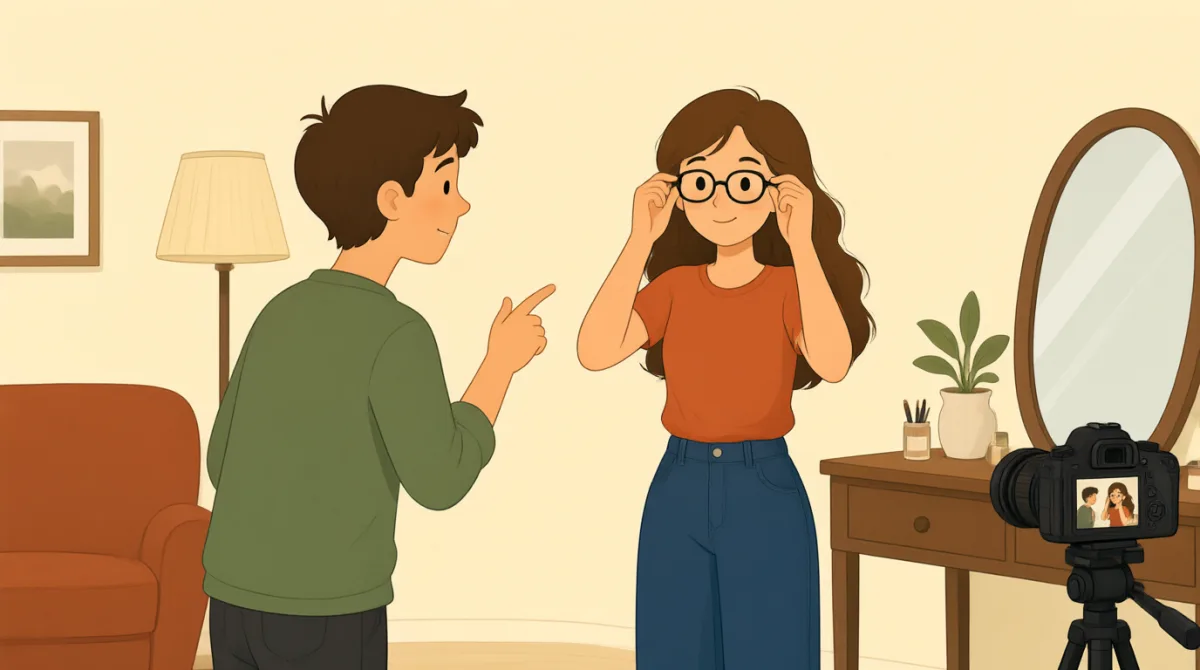

All right, Emma. Please take off your glasses before we take the photo.
Tudo bem, Emma. Por favor, tire os óculos antes de tirarmos a foto.

Oh, sure. Should I put them on the table?
Ah, claro. Devo colocá-los sobre a mesa?
Yes, please. Then stand on the mark in front of the camera.
Sim, por favor. Depois, fique sobre a marca diante da câmera.
Like this? I hope I’m standing in the right place.
Assim? Espero que eu esteja no lugar certo.
That’s right. Move a little closer to the camera, please.
Isso mesmo. Chegue um pouquinho mais perto da câmera, por favor.
Okay. Should I look straight at the camera now?
Está bem. Devo olhar diretamente para a câmera agora?
Yes. Keep your head straight, and I’ll get you ready.
Sim. Mantenha a cabeça reta e vou ajudar você a se preparar.
All right. Let me know when you’re ready to take it.
Está bem. Avise quando estiver pronta para tirar a foto.
Vocabulário8
- take off your glassestirar os óculos
This means to remove your glasses. Use “take off” when you remove something you are wearing.
Isso significa remover os óculos. Use “take off” quando for tirar algo que está usando.
- put them on the tablecolocá-los sobre a mesa
This means to place the glasses on the table. You can use “put [something] on [a place]” to say where you leave an object.
Isso significa pôr os óculos sobre a mesa. Você pode usar “put [something] on [a place]” para dizer onde vai deixar um objeto.
- stand on the markficar sobre a marca
This means to stand on the spot marked on the floor. It is useful when someone tells you where to stand.
Isso significa ficar em pé no ponto marcado no chão. Essa expressão é útil quando alguém diz onde você deve ficar.
- in front of the cameradiante da câmera
This means in the place facing the camera. You can use “in front of” to describe where someone or something is.
Isso significa ficar em um lugar de frente para a câmera. Você pode usar “in front of” para descrever onde uma pessoa ou coisa está.
- a little closerum pouquinho mais perto
This means slightly nearer. Use it to ask someone to move nearer without going too far.
Isso significa um pouco mais próximo. Use essa expressão para pedir que alguém se aproxime sem chegar perto demais.
- look straight at the cameraolhar diretamente para a câmera
This means to face the camera and look directly at it. It is a useful instruction for taking photos.
Isso significa ficar de frente para a câmera e olhar diretamente para ela. É uma instrução útil para tirar fotos.
- keep your head straightmanter a cabeça reta
This means to hold your head upright and not tilt it. It is a simple instruction for posing for a photo.
Isso significa manter a cabeça erguida, sem incliná-la. É uma instrução simples para posar para uma foto.
- Let me know when you’re ready to take it.Avise quando estiver pronta para tirar a foto.
This means to tell me when you are ready to take the photo. You can use “Let me know when…” to ask someone to tell you when something happens.
Isso significa me dizer quando você estiver pronta para tirar a foto. Você pode usar “Let me know when…” para pedir que alguém avise quando algo acontecer.
Frases-chave8
- 1
Please take off your glasses before we take the photo.
Por favor, tire os óculos antes de tirarmos a foto.
Use this polite sentence to ask someone to remove their glasses before a photo. You can replace “your glasses” with another item of clothing or accessory.
Use esta frase educada para pedir que alguém tire os óculos antes de uma foto. Você pode substituir “your glasses” por outra peça de roupa ou acessório.
- 2
Should I put them on the table?
Devo colocá-los sobre a mesa?
Use “Should I…?” to ask what you ought to do. “Them” refers to the glasses, and you can replace it with another object.
Use “Should I…?” para perguntar o que você deve fazer. “Them” se refere aos óculos, mas você pode substituí-lo por outro objeto.
- 3
Then stand on the mark in front of the camera.
Depois, fique sobre a marca diante da câmera.
This gives someone a clear direction about where to stand. You can change the place or object to give other simple instructions.
Esta frase indica com clareza onde alguém deve ficar. Você pode mudar o lugar ou o objeto para dar outras instruções simples.
- 4
I hope I’m standing in the right place.
Espero que eu esteja no lugar certo.
Use this sentence when you are unsure whether you are in the correct spot. You can replace “standing” with another action, such as “waiting” or “sitting.”
Use esta frase quando não tiver certeza de que está no lugar correto. Você pode substituir “standing” por outra ação, como “waiting” ou “sitting.”
- 5
Move a little closer to the camera, please.
Chegue um pouquinho mais perto da câmera, por favor.
This is a polite way to ask someone to come nearer. Replace “the camera” with the person or place they should move closer to.
Esta é uma maneira educada de pedir que alguém se aproxime. Substitua “the camera” pela pessoa ou pelo lugar de que a pessoa deve se aproximar.
- 6
Should I look straight at the camera now?
Devo olhar diretamente para a câmera agora?
Use this question to check what you should do next. You can replace “look straight at the camera” with another action.
Use esta pergunta para confirmar o que você deve fazer em seguida. Você pode substituir “look straight at the camera” por outra ação.
- 7
Keep your head straight, and I’ll get you ready.
Mantenha a cabeça reta e vou ajudar você a se preparar.
This combines an instruction with an offer to help. You can use “Keep your…” to give someone a simple direction.
Esta frase combina uma instrução com uma oferta de ajuda. Você pode usar “Keep your…” para dar uma instrução simples a alguém.
- 8
Let me know when you’re ready to take it.
Avise quando estiver pronta para tirar a foto.
Use this to ask someone to tell you when they are ready. Here, “it” means the photo; in other situations, it can refer to another activity or item.
Use esta frase para pedir que alguém avise quando estiver pronto. Aqui, “it” significa a foto; em outras situações, pode se referir a outra atividade ou coisa.