Taking Off Glasses
ถอดแว่นตา
Jack explains that Emma needs to take off her glasses for the photo. He helps her get ready in front of the camera.
แจ็กอธิบายว่าเอมมาต้องถอดแว่นก่อนถ่ายรูป แล้วช่วยเธอเตรียมตัวหน้ากล้อง
บทสนทนา8
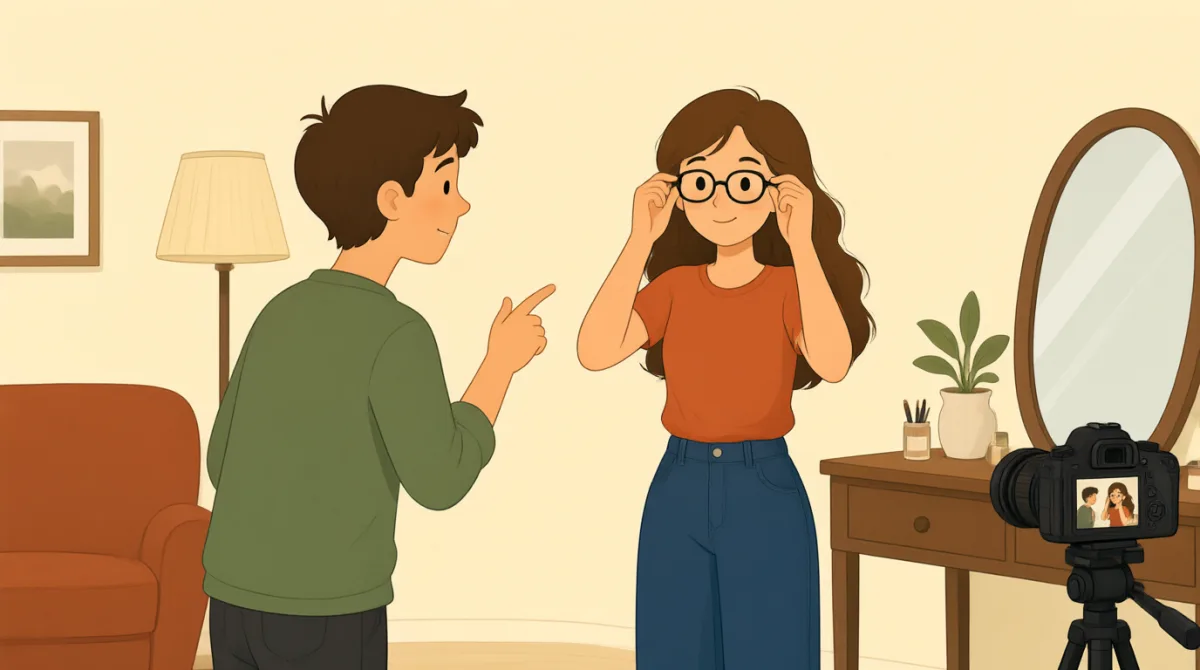

All right, Emma. Please take off your glasses before we take the photo.
เอาล่ะ เอมมา ถอดแว่นก่อนถ่ายรูปนะ

Oh, sure. Should I put them on the table?
อ๋อ ได้สิ วางไว้บนโต๊ะได้ไหม?
Yes, please. Then stand on the mark in front of the camera.
ได้เลย แล้วไปยืนตรงเครื่องหมายหน้ากล้องนะ
Like this? I hope I’m standing in the right place.
แบบนี้เหรอ? หวังว่าฉันจะยืนถูกที่นะ
That’s right. Move a little closer to the camera, please.
ใช่แล้ว ขยับเข้ามาใกล้กล้องอีกนิดนะ
Okay. Should I look straight at the camera now?
โอเค ตอนนี้ฉันมองตรงไปที่กล้องเลยไหม?
Yes. Keep your head straight, and I’ll get you ready.
ใช่ ตั้งหัวตรงไว้นะ แล้วฉันจะจัดท่าให้
All right. Let me know when you’re ready to take it.
ได้เลย บอกฉันนะเมื่อพร้อมถ่ายแล้ว
คำศัพท์8
- take off your glassesถอดแว่นตา
This means to remove your glasses. Use “take off” when you remove something you are wearing.
หมายถึงถอดแว่นออก ใช้ “take off” เมื่อถอดสิ่งที่กำลังสวมใส่อยู่
- put them on the tableวางไว้บนโต๊ะ
This means to place the glasses on the table. You can use “put [something] on [a place]” to say where you leave an object.
หมายถึงวางแว่นไว้บนโต๊ะ ใช้ “put [something] on [a place]” เพื่อบอกว่าวางสิ่งของไว้ที่ไหน
- stand on the markยืนตรงเครื่องหมาย
This means to stand on the spot marked on the floor. It is useful when someone tells you where to stand.
หมายถึงยืนบนจุดที่ทำเครื่องหมายไว้บนพื้น วลีนี้มีประโยชน์เมื่อมีคนบอกว่าควรยืนตรงไหน
- in front of the cameraหน้ากล้อง
This means in the place facing the camera. You can use “in front of” to describe where someone or something is.
หมายถึงอยู่ตรงตำแหน่งที่หันหน้าเข้าหากล้อง ใช้ “in front of” เพื่อบอกตำแหน่งของคนหรือสิ่งของได้
- a little closerใกล้เข้ามาอีกนิด
This means slightly nearer. Use it to ask someone to move nearer without going too far.
หมายถึงเข้ามาใกล้อีกเล็กน้อย ใช้ขอให้ใครสักคนขยับเข้ามาใกล้ โดยไม่ต้องเข้ามาใกล้มากเกินไป
- look straight at the cameraมองตรงไปที่กล้อง
This means to face the camera and look directly at it. It is a useful instruction for taking photos.
หมายถึงหันหน้าเข้าหากล้องและมองตรงไปที่กล้อง เป็นคำบอกที่ใช้ได้ดีเวลาถ่ายรูป
- keep your head straightตั้งหัวให้ตรง
This means to hold your head upright and not tilt it. It is a simple instruction for posing for a photo.
หมายถึงตั้งศีรษะให้ตรง ไม่เอียง เป็นคำบอกง่ายๆ สำหรับการโพสท่าถ่ายรูป
- Let me know when you’re ready to take it.บอกฉันนะเมื่อพร้อมถ่ายแล้ว
This means to tell me when you are ready to take the photo. You can use “Let me know when…” to ask someone to tell you when something happens.
หมายถึงบอกฉันเมื่อพร้อมถ่ายรูป ใช้ “Let me know when…” เพื่อขอให้ใครบอกเมื่อมีบางอย่างเกิดขึ้น
ประโยคสำคัญ8
- 1
Please take off your glasses before we take the photo.
ถอดแว่นก่อนถ่ายรูปนะ
Use this polite sentence to ask someone to remove their glasses before a photo. You can replace “your glasses” with another item of clothing or accessory.
ใช้ประโยคสุภาพนี้ขอให้ใครสักคนถอดแว่นก่อนถ่ายรูป คุณเปลี่ยน “your glasses” เป็นเสื้อผ้าหรือเครื่องประดับอย่างอื่นได้
- 2
Should I put them on the table?
ฉันวางแว่นไว้บนโต๊ะได้ไหม?
Use “Should I…?” to ask what you ought to do. “Them” refers to the glasses, and you can replace it with another object.
ใช้ “Should I…?” เพื่อถามว่าควรทำอะไร “Them” หมายถึงแว่น และคุณเปลี่ยนเป็นสิ่งของอย่างอื่นได้
- 3
Then stand on the mark in front of the camera.
แล้วไปยืนตรงเครื่องหมายหน้ากล้องนะ
This gives someone a clear direction about where to stand. You can change the place or object to give other simple instructions.
ประโยคนี้บอกตำแหน่งที่ให้ใครสักคนไปยืนอย่างชัดเจน คุณเปลี่ยนสถานที่หรือสิ่งของเพื่อใช้บอกคำสั่งง่ายๆ อย่างอื่นได้
- 4
I hope I’m standing in the right place.
หวังว่าฉันจะยืนถูกที่นะ
Use this sentence when you are unsure whether you are in the correct spot. You can replace “standing” with another action, such as “waiting” or “sitting.”
ใช้ประโยคนี้เมื่อไม่แน่ใจว่าตัวเองอยู่ถูกตำแหน่งหรือเปล่า คุณเปลี่ยน “standing” เป็นการกระทำอื่นได้ เช่น “waiting” หรือ “sitting”
- 5
Move a little closer to the camera, please.
ขยับเข้ามาใกล้กล้องอีกนิดนะ
This is a polite way to ask someone to come nearer. Replace “the camera” with the person or place they should move closer to.
นี่เป็นวิธีสุภาพในการขอให้ใครสักคนขยับเข้ามาใกล้ คุณเปลี่ยน “the camera” เป็นคนหรือสถานที่ที่อยากให้เขาขยับเข้าไปใกล้ได้
- 6
Should I look straight at the camera now?
ตอนนี้ฉันมองตรงไปที่กล้องเลยไหม?
Use this question to check what you should do next. You can replace “look straight at the camera” with another action.
ใช้คำถามนี้เพื่อตรวจสอบว่าควรทำอะไรต่อไป คุณเปลี่ยน “look straight at the camera” เป็นการกระทำอย่างอื่นได้
- 7
Keep your head straight, and I’ll get you ready.
ตั้งหัวให้ตรงไว้นะ แล้วฉันจะจัดท่าให้
This combines an instruction with an offer to help. You can use “Keep your…” to give someone a simple direction.
ประโยคนี้รวมคำบอกให้ทำสิ่งหนึ่งเข้ากับการเสนอตัวช่วย ใช้ “Keep your…” เพื่อบอกทางง่ายๆ ให้ใครสักคนได้
- 8
Let me know when you’re ready to take it.
บอกฉันนะเมื่อพร้อมถ่ายแล้ว
Use this to ask someone to tell you when they are ready. Here, “it” means the photo; in other situations, it can refer to another activity or item.
ใช้ประโยคนี้ขอให้ใครบอกเมื่อพร้อม ในที่นี้ “it” หมายถึงรูปถ่าย แต่ในสถานการณ์อื่นอาจหมายถึงกิจกรรมหรือสิ่งของอย่างอื่น