Taking Off Glasses
摘下眼镜
Jack explains that Emma needs to take off her glasses for the photo. He helps her get ready in front of the camera.
Jack告诉Emma拍照时需要摘下眼镜,并帮她在相机前做好准备。
对话8
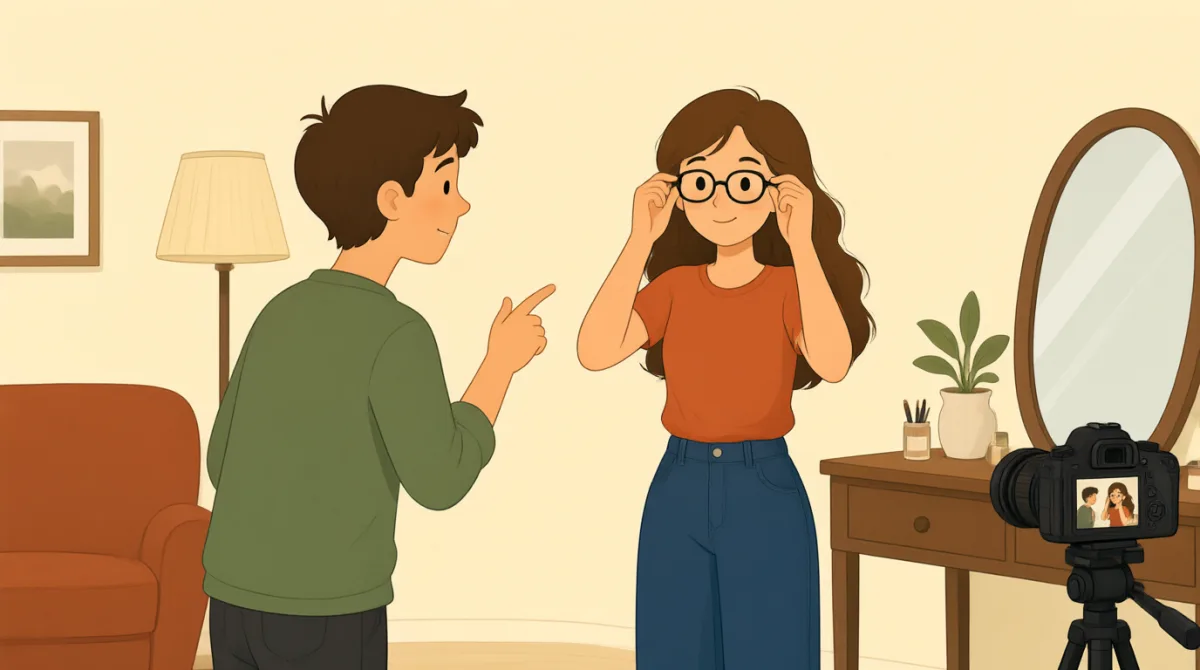

All right, Emma. Please take off your glasses before we take the photo.
好了,Emma。拍照前请把眼镜摘下来。

Oh, sure. Should I put them on the table?
哦,好的。我把眼镜放在桌上吗?
Yes, please. Then stand on the mark in front of the camera.
是的,请放在桌上。然后站到相机前的标记上。
Like this? I hope I’m standing in the right place.
这样吗?希望我站的位置对了。
That’s right. Move a little closer to the camera, please.
对了。请再靠近相机一点。
Okay. Should I look straight at the camera now?
好的。我现在要直视相机吗?
Yes. Keep your head straight, and I’ll get you ready.
是的。头摆正,我来帮你做好准备。
All right. Let me know when you’re ready to take it.
好的。准备好拍照时告诉我。
词汇8
- take off your glasses摘下眼镜
This means to remove your glasses. Use “take off” when you remove something you are wearing.
意思是把眼镜摘下来。摘下身上戴着的东西时,可以用“take off”。
- put them on the table把眼镜放在桌上
This means to place the glasses on the table. You can use “put [something] on [a place]” to say where you leave an object.
意思是把眼镜放在桌上。你可以用“put [something] on [a place]”来说明把某样东西放在哪里。
- stand on the mark站在标记处
This means to stand on the spot marked on the floor. It is useful when someone tells you where to stand.
意思是站在地板上做了标记的位置。别人告诉你该站在哪里时,这个表达很实用。
- in front of the camera在相机前面
This means in the place facing the camera. You can use “in front of” to describe where someone or something is.
意思是面对相机的位置。你可以用“in front of”来描述某人或某物的位置。
- a little closer再近一点
This means slightly nearer. Use it to ask someone to move nearer without going too far.
意思是稍微近一些。请别人靠近一点、但不要靠得太近时,可以用这个表达。
- look straight at the camera直视相机
This means to face the camera and look directly at it. It is a useful instruction for taking photos.
意思是面向相机并直接看着它。这是拍照时很实用的指示。
- keep your head straight把头摆正
This means to hold your head upright and not tilt it. It is a simple instruction for posing for a photo.
意思是让头保持端正,不要歪着。拍照摆姿势时,这是一个简单的指示。
- Let me know when you’re ready to take it.准备好拍照时告诉我。
This means to tell me when you are ready to take the photo. You can use “Let me know when…” to ask someone to tell you when something happens.
意思是准备好拍照时告诉我。你可以用“Let me know when…”请别人告诉你某件事什么时候发生。
重点句子8
- 1
Please take off your glasses before we take the photo.
拍照前请把眼镜摘下来。
Use this polite sentence to ask someone to remove their glasses before a photo. You can replace “your glasses” with another item of clothing or accessory.
用这句礼貌地请别人拍照前摘下眼镜。你可以把“your glasses”换成其他衣物或配饰。
- 2
Should I put them on the table?
我把眼镜放在桌上吗?
Use “Should I…?” to ask what you ought to do. “Them” refers to the glasses, and you can replace it with another object.
用“Should I…?”询问自己应该做什么。“Them”指眼镜,你也可以把它换成其他物品。
- 3
Then stand on the mark in front of the camera.
然后站到相机前的标记上。
This gives someone a clear direction about where to stand. You can change the place or object to give other simple instructions.
这句话清楚地告诉别人应该站在哪里。你可以换成其他地点或物品,来给出简单的指示。
- 4
I hope I’m standing in the right place.
希望我站的位置对了。
Use this sentence when you are unsure whether you are in the correct spot. You can replace “standing” with another action, such as “waiting” or “sitting.”
不确定自己是否站对位置时,可以用这句话。你可以把“standing”换成其他动作,比如“waiting”或“sitting”。
- 5
Move a little closer to the camera, please.
请再靠近相机一点。
This is a polite way to ask someone to come nearer. Replace “the camera” with the person or place they should move closer to.
这是一种礼貌地请别人靠近的说法。你可以把“the camera”换成对方应该靠近的人或地点。
- 6
Should I look straight at the camera now?
我现在要直视相机吗?
Use this question to check what you should do next. You can replace “look straight at the camera” with another action.
用这个问题确认接下来该做什么。你可以把“look straight at the camera”换成其他动作。
- 7
Keep your head straight, and I’ll get you ready.
把头摆正,我来帮你做好准备。
This combines an instruction with an offer to help. You can use “Keep your…” to give someone a simple direction.
这句话把指示和主动帮忙结合在一起。你可以用“Keep your…”给别人一个简单的指示。
- 8
Let me know when you’re ready to take it.
准备好拍照时告诉我。
Use this to ask someone to tell you when they are ready. Here, “it” means the photo; in other situations, it can refer to another activity or item.
用这句话请别人准备好时告诉你。这里的“it”指照片;在其他情况下,它也可以指另一项活动或物品。