Taking Off Glasses
メガネを外す
Jack explains that Emma needs to take off her glasses for the photo. He helps her get ready in front of the camera.
ジャックは、写真を撮る前にエマがメガネを外す必要があると説明します。カメラの前で撮影の準備を手伝います。
会話8
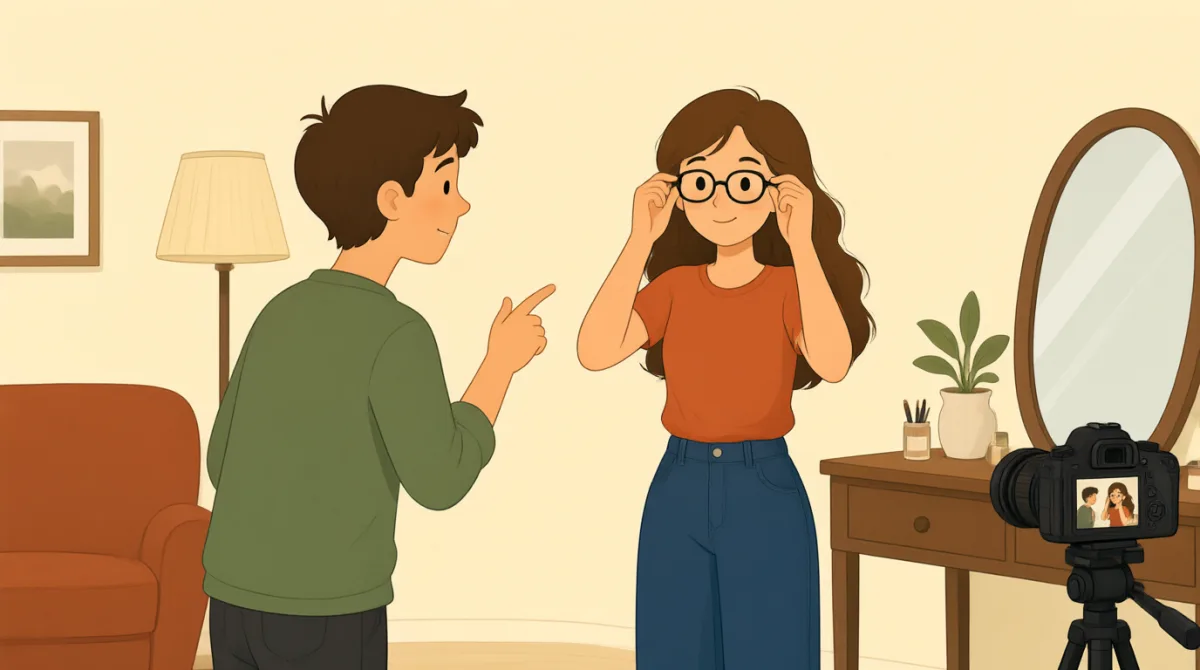

All right, Emma. Please take off your glasses before we take the photo.
じゃあ、エマ。写真を撮る前にメガネを外してね。

Oh, sure. Should I put them on the table?
あ、わかった。テーブルに置けばいい?
Yes, please. Then stand on the mark in front of the camera.
うん、お願い。それからカメラの前の印の上に立って。
Like this? I hope I’m standing in the right place.
こんな感じ?ちゃんと正しい場所に立ててるかな。
That’s right. Move a little closer to the camera, please.
そうだよ。カメラにもう少し近づいてね。
Okay. Should I look straight at the camera now?
わかった。今、カメラをまっすぐ見ればいい?
Yes. Keep your head straight, and I’ll get you ready.
そうだよ。頭をまっすぐにしてね。こっちで準備するから。
All right. Let me know when you’re ready to take it.
わかった。撮る準備ができたら教えてね。
語彙8
- take off your glassesメガネを外す
This means to remove your glasses. Use “take off” when you remove something you are wearing.
これは、かけているメガネを取るという意味です。身につけているものを取るときは “take off” を使います。
- put them on the tableメガネをテーブルに置く
This means to place the glasses on the table. You can use “put [something] on [a place]” to say where you leave an object.
これは、メガネをテーブルの上に置くという意味です。“put [something] on [a place]” を使うと、物をどこに置くかを表せます。
- stand on the mark印の上に立つ
This means to stand on the spot marked on the floor. It is useful when someone tells you where to stand.
これは、床に付けられた印の上に立つという意味です。立つ場所を指示するときに便利な表現です。
- in front of the cameraカメラの前に
This means in the place facing the camera. You can use “in front of” to describe where someone or something is.
これは、カメラに向かい合う場所に、という意味です。“in front of” は、人や物がどこにあるかを説明するときに使えます。
- a little closerもう少し近くに
This means slightly nearer. Use it to ask someone to move nearer without going too far.
これは、少し近くに、という意味です。近づきすぎないように、もう少し近くに来てほしいと伝えるときに使います。
- look straight at the cameraカメラをまっすぐ見る
This means to face the camera and look directly at it. It is a useful instruction for taking photos.
これは、カメラのほうを向いて、直接見るという意味です。写真を撮るときによく使われる指示です。
- keep your head straight頭をまっすぐに保つ
This means to hold your head upright and not tilt it. It is a simple instruction for posing for a photo.
これは、頭を傾けずにまっすぐにしておくという意味です。写真のポーズを取るときに使う簡単な指示です。
- Let me know when you’re ready to take it.撮る準備ができたら教えてね。
This means to tell me when you are ready to take the photo. You can use “Let me know when…” to ask someone to tell you when something happens.
これは、写真を撮る準備ができたら教えて、という意味です。“Let me know when…” は、何かが起きたときに教えてほしいと頼む表現です。
重要な文8
- 1
Please take off your glasses before we take the photo.
写真を撮る前にメガネを外してください。
Use this polite sentence to ask someone to remove their glasses before a photo. You can replace “your glasses” with another item of clothing or accessory.
写真を撮る前にメガネを外してほしいと、丁寧に頼む表現です。“your glasses” を別の衣類やアクセサリーに置き換えて使えます。
- 2
Should I put them on the table?
メガネをテーブルに置けばいい?
Use “Should I…?” to ask what you ought to do. “Them” refers to the glasses, and you can replace it with another object.
“Should I…?” は、何をしたらいいか尋ねる表現です。“Them” はメガネを指しています。別の物を表す言葉に置き換えることもできます。
- 3
Then stand on the mark in front of the camera.
それからカメラの前の印の上に立って。
This gives someone a clear direction about where to stand. You can change the place or object to give other simple instructions.
立つ場所を相手にはっきり伝える表現です。場所や物を変えれば、ほかの簡単な指示にも使えます。
- 4
I hope I’m standing in the right place.
ちゃんと正しい場所に立ててるかな。
Use this sentence when you are unsure whether you are in the correct spot. You can replace “standing” with another action, such as “waiting” or “sitting.”
自分が正しい場所にいるかどうか自信がないときに使う文です。“standing” を “waiting” や “sitting” など、別の動作に置き換えることもできます。
- 5
Move a little closer to the camera, please.
カメラにもう少し近づいてください。
This is a polite way to ask someone to come nearer. Replace “the camera” with the person or place they should move closer to.
相手に近くへ来てもらう丁寧な頼み方です。“the camera” を、近づいてほしい人や場所に置き換えられます。
- 6
Should I look straight at the camera now?
今、カメラをまっすぐ見ればいい?
Use this question to check what you should do next. You can replace “look straight at the camera” with another action.
次に何をすればいいか確認するときに使う質問です。“look straight at the camera” を別の動作に置き換えることもできます。
- 7
Keep your head straight, and I’ll get you ready.
頭をまっすぐにしてね。こっちで準備するから。
This combines an instruction with an offer to help. You can use “Keep your…” to give someone a simple direction.
指示と、手伝うという申し出を組み合わせた文です。“Keep your…” を使って、相手に簡単な指示を出せます。
- 8
Let me know when you’re ready to take it.
撮る準備ができたら教えてね。
Use this to ask someone to tell you when they are ready. Here, “it” means the photo; in other situations, it can refer to another activity or item.
相手に準備ができたら教えてほしいと伝える表現です。ここでの “it” は写真を指しますが、別の場面ではほかの活動や物を指すこともあります。