Taking Off Glasses
Gözlükleri Çıkarmak
Jack explains that Emma needs to take off her glasses for the photo. He helps her get ready in front of the camera.
Jack, fotoğraf için Emma’nın gözlüklerini çıkarması gerektiğini açıklar. Kameranın önünde hazırlanmasına yardım eder.
Diyalog8
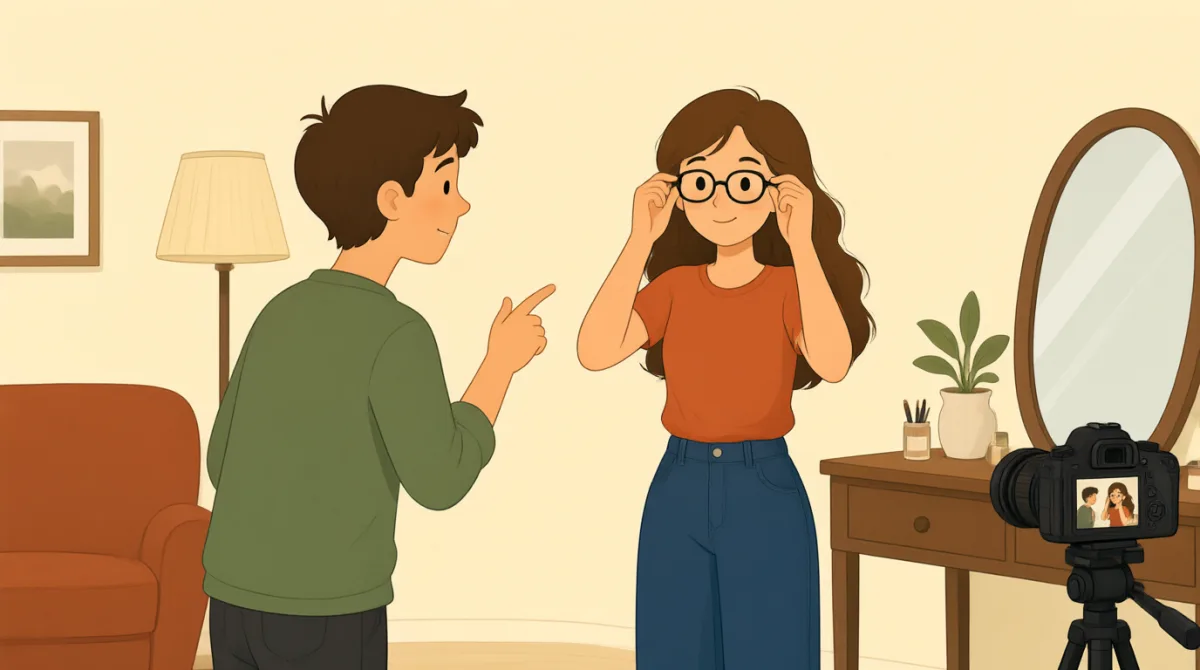

All right, Emma. Please take off your glasses before we take the photo.
Peki Emma. Fotoğrafı çekmeden önce lütfen gözlüklerini çıkar.

Oh, sure. Should I put them on the table?
Aa, tabii. Onları masanın üzerine mi koyayım?
Yes, please. Then stand on the mark in front of the camera.
Evet, lütfen. Sonra kameranın önündeki işaretin üzerine geç.
Like this? I hope I’m standing in the right place.
Böyle mi? Umarım doğru yerde duruyorumdur.
That’s right. Move a little closer to the camera, please.
Aynen. Lütfen kameraya biraz daha yaklaş.
Okay. Should I look straight at the camera now?
Tamam. Şimdi doğrudan kameraya mı bakayım?
Yes. Keep your head straight, and I’ll get you ready.
Evet. Başını dik tut, seni hazırlayayım.
All right. Let me know when you’re ready to take it.
Peki. Fotoğrafı çekmeye hazır olduğunda bana haber ver.
Kelime Bilgisi8
- take off your glassesgözlüklerini çıkarmak
This means to remove your glasses. Use “take off” when you remove something you are wearing.
Bu, gözlüklerini çıkarmak demektir. Üzerinde taşıdığın bir şeyi çıkardığında “take off” kullanılır.
- put them on the tableonları masanın üzerine koymak
This means to place the glasses on the table. You can use “put [something] on [a place]” to say where you leave an object.
Bu, gözlükleri masanın üzerine bırakmak demektir. Bir nesneyi nereye bıraktığını söylemek için “put [something] on [a place]” kalıbını kullanabilirsin.
- stand on the markişaretin üzerine geçmek
This means to stand on the spot marked on the floor. It is useful when someone tells you where to stand.
Bu, yerde işaretlenmiş noktada durmak demektir. Birisi sana nerede duracağını söylediğinde bu ifade kullanışlıdır.
- in front of the camerakameranın önünde
This means in the place facing the camera. You can use “in front of” to describe where someone or something is.
Bu, kameraya dönük olan yerde demektir. Bir kişinin ya da nesnenin nerede olduğunu anlatmak için “in front of” kullanabilirsin.
- a little closerbiraz daha yakın
This means slightly nearer. Use it to ask someone to move nearer without going too far.
Bu, azıcık daha yakında demektir. Birinden çok fazla yaklaşmadan biraz yaklaşmasını istemek için kullanılır.
- look straight at the cameradoğrudan kameraya bakmak
This means to face the camera and look directly at it. It is a useful instruction for taking photos.
Bu, kameraya dönüp doğrudan ona bakmak demektir. Fotoğraf çekerken verilen kullanışlı bir yönergedir.
- keep your head straightbaşını dik tutmak
This means to hold your head upright and not tilt it. It is a simple instruction for posing for a photo.
Bu, başını eğmeden dik tutmak demektir. Fotoğraf için poz verirken kullanılan basit bir yönergedir.
- Let me know when you’re ready to take it.Fotoğrafı çekmeye hazır olduğunda bana haber ver.
This means to tell me when you are ready to take the photo. You can use “Let me know when…” to ask someone to tell you when something happens.
Bu, fotoğrafı çekmeye hazır olduğunda bana söyle demektir. Birinden bir şey olduğunda sana haber vermesini istemek için “Let me know when…” kullanabilirsin.
Önemli Cümleler8
- 1
Please take off your glasses before we take the photo.
Fotoğrafı çekmeden önce lütfen gözlüklerini çıkar.
Use this polite sentence to ask someone to remove their glasses before a photo. You can replace “your glasses” with another item of clothing or accessory.
Birinden fotoğraf çekilmeden önce gözlüklerini çıkarmasını kibarca istemek için bu cümleyi kullan. “your glasses” yerine başka bir giysi ya da aksesuar da koyabilirsin.
- 2
Should I put them on the table?
Onları masanın üzerine mi koyayım?
Use “Should I…?” to ask what you ought to do. “Them” refers to the glasses, and you can replace it with another object.
Ne yapman gerektiğini sormak için “Should I…?” kalıbını kullan. “Them” gözlükleri ifade eder; yerine başka bir nesne de koyabilirsin.
- 3
Then stand on the mark in front of the camera.
Sonra kameranın önündeki işaretin üzerine geç.
This gives someone a clear direction about where to stand. You can change the place or object to give other simple instructions.
Bu cümle, birine nerede duracağı konusunda açık bir yönerge verir. Başka basit yönergeler vermek için yeri ya da nesneyi değiştirebilirsin.
- 4
I hope I’m standing in the right place.
Umarım doğru yerde duruyorumdur.
Use this sentence when you are unsure whether you are in the correct spot. You can replace “standing” with another action, such as “waiting” or “sitting.”
Doğru yerde olup olmadığından emin olmadığında bu cümleyi kullan. “Standing” yerine “waiting” ya da “sitting” gibi başka bir eylem koyabilirsin.
- 5
Move a little closer to the camera, please.
Lütfen kameraya biraz daha yaklaş.
This is a polite way to ask someone to come nearer. Replace “the camera” with the person or place they should move closer to.
Bu, birinden yaklaşmasını kibarca istemenin bir yoludur. “The camera” yerine yaklaşması gereken kişiyi ya da yeri koyabilirsin.
- 6
Should I look straight at the camera now?
Şimdi doğrudan kameraya mı bakayım?
Use this question to check what you should do next. You can replace “look straight at the camera” with another action.
Bir sonraki adımda ne yapman gerektiğini kontrol etmek için bu soruyu kullan. “Look straight at the camera” yerine başka bir eylem koyabilirsin.
- 7
Keep your head straight, and I’ll get you ready.
Başını dik tut, seni hazırlayayım.
This combines an instruction with an offer to help. You can use “Keep your…” to give someone a simple direction.
Bu cümle bir yönergeyi yardım teklifine bağlar. Birine basit bir yönerge vermek için “Keep your…” kalıbını kullanabilirsin.
- 8
Let me know when you’re ready to take it.
Fotoğrafı çekmeye hazır olduğunda bana haber ver.
Use this to ask someone to tell you when they are ready. Here, “it” means the photo; in other situations, it can refer to another activity or item.
Birinden hazır olduğunda sana haber vermesini istemek için bu ifadeyi kullan. Burada “it” fotoğraf demektir; başka durumlarda başka bir etkinliğe ya da nesneye gönderme yapabilir.