Taking Off Glasses
Zdjęcie okularów
Jack explains that Emma needs to take off her glasses for the photo. He helps her get ready in front of the camera.
Jack wyjaśnia, że Emma musi zdjąć okulary do zdjęcia. Pomaga jej przygotować się przed aparatem.
Dialog8
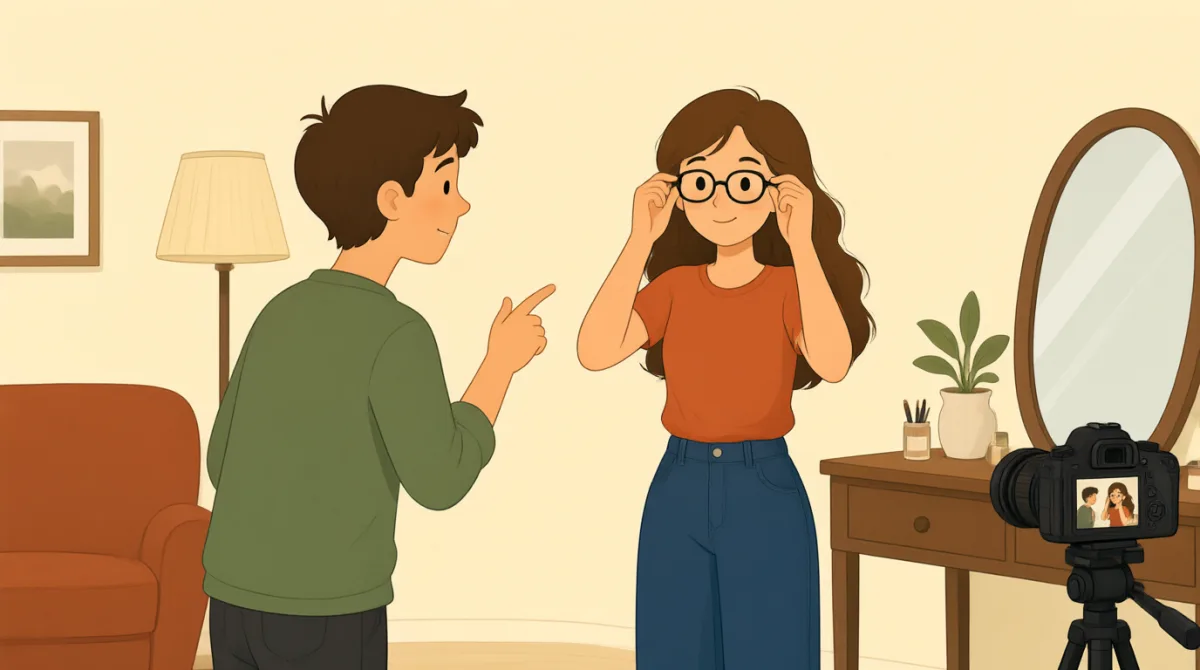

All right, Emma. Please take off your glasses before we take the photo.
Dobrze, Emma. Proszę zdjąć okulary, zanim zrobimy zdjęcie.

Oh, sure. Should I put them on the table?
Och, jasne. Mam je położyć na stole?
Yes, please. Then stand on the mark in front of the camera.
Tak, proszę. A potem proszę stanąć na znaku przed aparatem.
Like this? I hope I’m standing in the right place.
Tak? Mam nadzieję, że stoję w odpowiednim miejscu.
That’s right. Move a little closer to the camera, please.
Zgadza się. Proszę podejść trochę bliżej aparatu.
Okay. Should I look straight at the camera now?
Dobrze. Mam teraz patrzeć prosto w aparat?
Yes. Keep your head straight, and I’ll get you ready.
Tak. Proszę trzymać głowę prosto, a ja panią przygotuję.
All right. Let me know when you’re ready to take it.
Dobrze. Proszę mi powiedzieć, kiedy będzie pan gotowy do zrobienia zdjęcia.
Słownictwo8
- take off your glasseszdjąć okulary
This means to remove your glasses. Use “take off” when you remove something you are wearing.
To znaczy usunąć okulary z twarzy. Wyrażenia “take off” używamy, gdy zdejmujemy coś, co mamy na sobie.
- put them on the tablepołożyć je na stole
This means to place the glasses on the table. You can use “put [something] on [a place]” to say where you leave an object.
To znaczy umieścić okulary na stole. Konstrukcji “put [something] on [a place]” używamy, by powiedzieć, gdzie odkładamy jakiś przedmiot.
- stand on the markstanąć na znaku
This means to stand on the spot marked on the floor. It is useful when someone tells you where to stand.
To znaczy stanąć na oznaczonym miejscu na podłodze. Przydaje się, gdy ktoś mówi ci, gdzie masz stanąć.
- in front of the cameraprzed aparatem
This means in the place facing the camera. You can use “in front of” to describe where someone or something is.
To znaczy w miejscu naprzeciwko aparatu. Wyrażenia “in front of” używamy, by opisać, gdzie znajduje się ktoś lub coś.
- a little closertrochę bliżej
This means slightly nearer. Use it to ask someone to move nearer without going too far.
To znaczy nieco bliżej. Użyj tego wyrażenia, by poprosić kogoś, żeby podszedł bliżej, ale nie za blisko.
- look straight at the camerapatrzeć prosto w aparat
This means to face the camera and look directly at it. It is a useful instruction for taking photos.
To znaczy ustawić się przodem do aparatu i patrzeć bezpośrednio w obiektyw. To przydatna wskazówka podczas robienia zdjęć.
- keep your head straighttrzymać głowę prosto
This means to hold your head upright and not tilt it. It is a simple instruction for posing for a photo.
To znaczy trzymać głowę wyprostowaną, bez przechylania jej. To prosta wskazówka dotycząca pozowania do zdjęcia.
- Let me know when you’re ready to take it.Proszę mi powiedzieć, kiedy będzie pan/pani gotowy/gotowa do zrobienia zdjęcia.
This means to tell me when you are ready to take the photo. You can use “Let me know when…” to ask someone to tell you when something happens.
To znaczy, żeby powiedzieć mi, kiedy będziesz gotowy do zrobienia zdjęcia. Możesz użyć “Let me know when…”, prosząc kogoś, żeby dał ci znać, gdy coś się wydarzy.
Kluczowe zdania8
- 1
Please take off your glasses before we take the photo.
Proszę zdjąć okulary, zanim zrobimy zdjęcie.
Use this polite sentence to ask someone to remove their glasses before a photo. You can replace “your glasses” with another item of clothing or accessory.
Użyj tego uprzejmego zdania, by poprosić kogoś o zdjęcie okularów przed zrobieniem zdjęcia. “your glasses” możesz zastąpić nazwą innego ubrania lub dodatku.
- 2
Should I put them on the table?
Mam je położyć na stole?
Use “Should I…?” to ask what you ought to do. “Them” refers to the glasses, and you can replace it with another object.
Użyj “Should I…?”, by zapytać, co powinieneś lub powinnaś zrobić. “Them” odnosi się do okularów; możesz zastąpić je innym przedmiotem.
- 3
Then stand on the mark in front of the camera.
A potem proszę stanąć na znaku przed aparatem.
This gives someone a clear direction about where to stand. You can change the place or object to give other simple instructions.
To jasna wskazówka, gdzie ktoś ma stanąć. Możesz zmienić miejsce lub przedmiot, by przekazać inne proste polecenia.
- 4
I hope I’m standing in the right place.
Mam nadzieję, że stoję w odpowiednim miejscu.
Use this sentence when you are unsure whether you are in the correct spot. You can replace “standing” with another action, such as “waiting” or “sitting.”
Użyj tego zdania, gdy nie masz pewności, czy stoisz we właściwym miejscu. “standing” możesz zastąpić inną czynnością, na przykład “waiting” lub “sitting.”
- 5
Move a little closer to the camera, please.
Proszę podejść trochę bliżej aparatu.
This is a polite way to ask someone to come nearer. Replace “the camera” with the person or place they should move closer to.
To uprzejmy sposób, by poprosić kogoś, żeby podszedł bliżej. “the camera” możesz zastąpić osobą lub miejscem, do którego ktoś ma się zbliżyć.
- 6
Should I look straight at the camera now?
Mam teraz patrzeć prosto w aparat?
Use this question to check what you should do next. You can replace “look straight at the camera” with another action.
Użyj tego pytania, by upewnić się, co masz zrobić dalej. “look straight at the camera” możesz zastąpić inną czynnością.
- 7
Keep your head straight, and I’ll get you ready.
Proszę trzymać głowę prosto, a ja panią przygotuję.
This combines an instruction with an offer to help. You can use “Keep your…” to give someone a simple direction.
To połączenie polecenia z propozycją pomocy. Możesz użyć “Keep your…”, by przekazać komuś prostą wskazówkę.
- 8
Let me know when you’re ready to take it.
Proszę mi powiedzieć, kiedy będzie pan/pani gotowy/gotowa do zrobienia zdjęcia.
Use this to ask someone to tell you when they are ready. Here, “it” means the photo; in other situations, it can refer to another activity or item.
Użyj tego zdania, by poprosić kogoś, żeby dał ci znać, kiedy będzie gotowy. Tutaj “it” oznacza zdjęcie; w innych sytuacjach może odnosić się do innej czynności lub przedmiotu.