Meeting the Pet Sitter
Emma meets Jack and introduces him to her dog, Buddy. They talk about Buddy’s routine and how Jack can get into the house.
Dialogue8
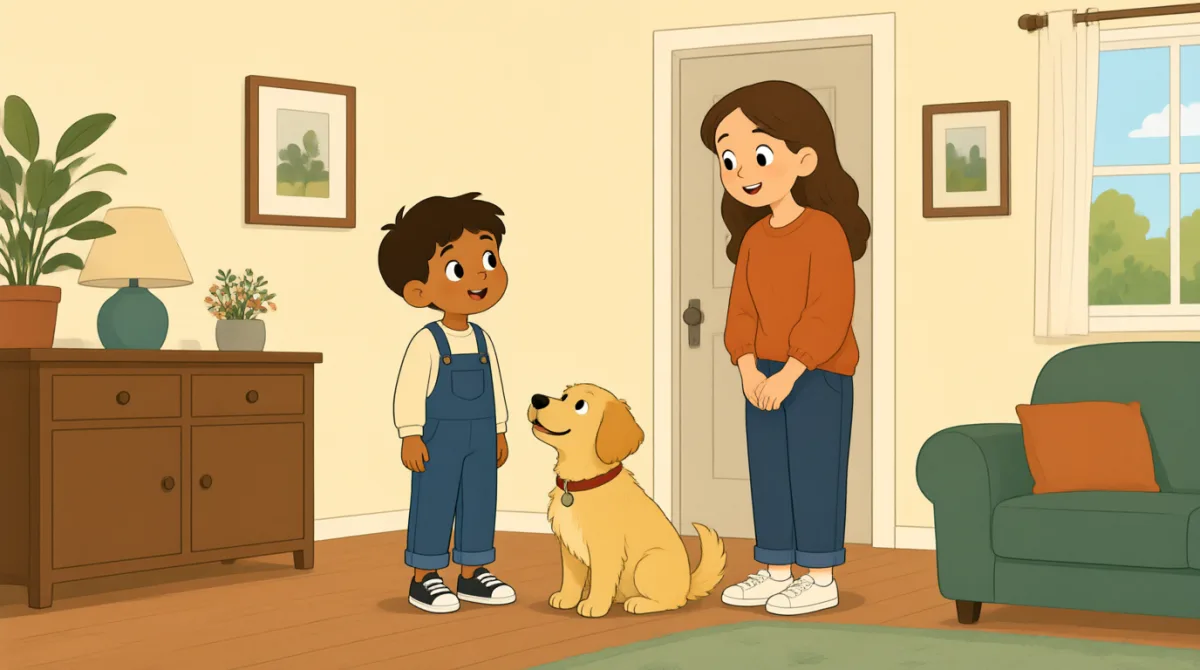

Hi, Jack. Thanks for coming over to meet Buddy.

Hi, Emma. He’s a friendly dog. Can I say hello?
Sure. He may bark at first, but he’ll calm down soon.
That’s okay. What’s his usual routine during the day?
He eats breakfast at seven and dinner at six. He needs two walks.
Got it. Where can I find the leash and the house key?
The leash is by the front door. I’ll leave the key under the mat.
Great. I’ll keep the door closed so Buddy doesn’t run out.
Vocabulary8
- coming over
To come to someone’s home. Here, Jack is visiting Emma to meet Buddy.
- say hello
To greet someone. You can also use this phrase when greeting a pet.
- calm down
To become quiet or relaxed. Here, Buddy may stop barking after a short time.
- usual routine
The things someone usually does each day. You can ask about a person’s or pet’s daily routine.
- walks
Here, walks are times when Buddy goes outside for exercise. You can say a dog needs one or two walks a day.
- front door
The main door at the entrance of a house. This phrase is useful when giving directions.
- under the mat
In the space below a mat. People sometimes leave a key there so someone can get into the house.
- run out
To leave a place quickly, often by running. Here, Jack wants to stop Buddy from getting outside.
Key Sentences7
- 1
Thanks for coming over to meet Buddy.
Use this to thank someone for visiting your home. You can replace “meet Buddy” with another reason for the visit.
- 2
Can I say hello?
Use this to politely ask if you can greet someone. It also works when asking to greet a pet.
- 3
What’s his usual routine during the day?
Use this question to ask what someone usually does each day. You can replace “his” with “your” or “her.”
- 4
He eats breakfast at seven and dinner at six.
This sentence gives a simple daily schedule. You can use the same pattern to talk about meal times.
- 5
Where can I find the leash and the house key?
Use this to ask where two things are. Replace “the leash and the house key” with the items you need.
- 6
I’ll leave the key under the mat.
Use “I’ll” to say what you will do in the future. You can replace “under the mat” with another location.
- 7
I’ll keep the door closed so Buddy doesn’t run out.
Use “I’ll keep” to say you will make sure something stays a certain way. “So” explains the reason.