Explaining Food and Walks
Emma shows Jack where the dog food and leash are. She explains when Buddy eats and how often he needs walks.
Dialogue8
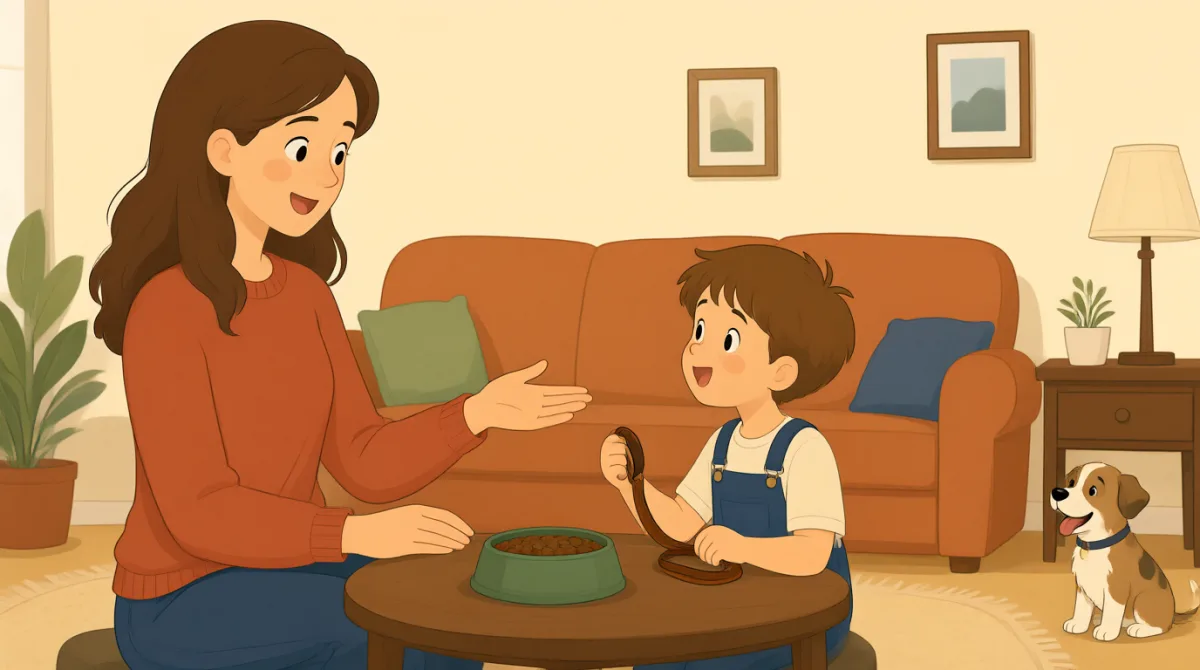

The dog food is in this bin. Buddy eats one cup in the morning and one at night.

Got it. Should I give him breakfast before or after his walk?
After his morning walk, please. He likes to eat when he gets back.
Okay. Where do you keep his leash?
It’s hanging by the front door. Please take him out three times a day.
How long should each walk be?
About twenty minutes is good. Keep him on the leash, please.
Sure. I’ll take him out after breakfast, in the afternoon, and before dinner.
Vocabulary8
- dog food
Food that is made for dogs. You can use this phrase when talking about what a dog eats.
- one cup
A measurement for the amount of food Buddy should eat. You can use it to explain how much to give someone or something.
- morning walk
A walk taken in the morning. You can use this phrase to talk about a regular daily activity.
- gets back
Returns to a place. Here, Buddy gets back home after his walk.
- leash
A strap used to keep a dog safely beside you while walking. You can ask where someone keeps a pet’s leash.
- take him out
Take Buddy outside, usually for a walk. You can use this phrase when talking about caring for a dog.
- three times a day
Three times during each day. You can use this phrase to explain how often an activity should happen.
- keep him on the leash
Make sure Buddy stays attached to his leash. You can use this phrase to give a simple safety instruction.
Key Sentences8
- 1
Buddy eats one cup in the morning and one at night.
This sentence explains a daily feeding schedule. Reuse the pattern “one [amount] in the morning and one at night” to describe routines.
- 2
Should I give him breakfast before or after his walk?
This is a polite way to ask about the order of two activities. Replace “breakfast” and “his walk” with other tasks to ask about a routine.
- 3
After his morning walk, please.
This gives a short, clear answer about when to do something. You can use “After [activity], please” to give a simple instruction.
- 4
It’s hanging by the front door.
This tells someone where an item is. Reuse “It’s hanging by…” to describe where something can be found.
- 5
Please take him out three times a day.
This politely explains how often Buddy needs to go outside. You can use “Please [action] [number] times a day” for regular instructions.
- 6
About twenty minutes is good.
This gives an approximate amount of time. Use “About [length of time] is good” to suggest how long an activity should last.
- 7
Keep him on the leash, please.
This is a polite safety instruction. You can use “Keep [someone or something] on…” to explain what should stay attached or in place.
- 8
I’ll take him out after breakfast, in the afternoon, and before dinner.
This sentence lays out a plan for the day using clear time expressions. Reuse “I’ll [action] after…, in…, and before…” to describe a schedule.