Giving the Key and Details
Emma gives Mia a spare key and explains where to leave the mail. They agree on when Emma will be back.
Dialogue8
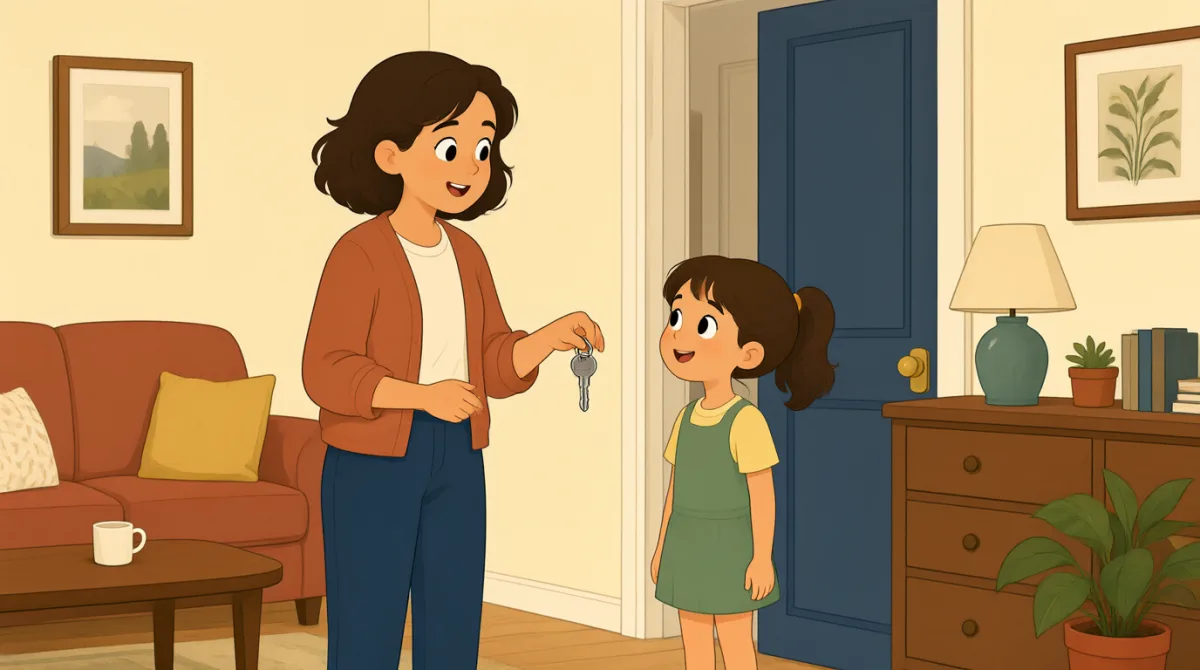

Here’s my spare key. The blue one is for the front door.

Thanks. Where would you like me to leave your mail?
Could you put it on the small table by the door?
Sure. I’ll bring it inside and leave it there.
I’ll be back on Sunday evening. I can pick up the key then.
That works. I’ll keep the key safe until you get back.
Thanks so much, Mia. I’ll text you if my plans change.
You’re welcome! Have a nice trip, and don’t worry about your mail.
Vocabulary8
- spare key
An extra key that you keep in case someone needs to use it. Here, Emma gives Mia an extra key to her home.
- front door
The main door at the front of a home or building. The blue key opens Emma’s front door.
- leave your mail
To put someone’s letters and packages in a place for them to find later. You can use this phrase when asking someone to hold your mail.
- bring it inside
To carry something from outside into a building or home. Use “bring it inside” when asking someone to take something indoors.
- pick up the key
To go and get the key. You can use “pick up” when arranging to collect something from someone.
- keep the key safe
To take care of the key so it is not lost or damaged. You can use this phrase when someone lends you something important.
- get back
To return to a place. Here, Mia will keep the key until Emma returns from her trip.
- my plans change
This means that your arrangements become different. You can say it when you may need to update someone about a change.
Key Sentences8
- 1
Where would you like me to leave your mail?
This is a polite way to ask where someone wants you to put something. Reuse “Where would you like me to leave [something]?” for packages or other items.
- 2
Could you put it on the small table by the door?
This is a polite request that gives a clear place for an item. Replace “it” and the location to explain where something should go.
- 3
I’ll bring it inside and leave it there.
This sentence explains what you will do with an item. Reuse “I’ll [action] and leave it [place]” to describe a simple plan.
- 4
I’ll be back on Sunday evening.
This is a simple way to tell someone when you will return. Replace the day and time to share your own schedule.
- 5
I can pick up the key then.
This sentence offers a time to collect something. Use “I can pick up [item] then” when agreeing on when to get it.
- 6
I’ll keep the key safe until you get back.
This reassures someone that you will take care of their key until they return. Replace “the key” with another item you are looking after.
- 7
I’ll text you if my plans change.
This tells someone how you will let them know if your arrangements become different. You can reuse “I’ll text you if…” to explain when you will send a message.
- 8
Have a nice trip, and don’t worry about your mail.
This is a friendly way to wish someone well and reassure them. You can change “trip” and “your mail” to fit other situations.