Changing Trains
At the transfer station, Emma asks Jack where to go. They follow the signs to the next train.
Dialogue8
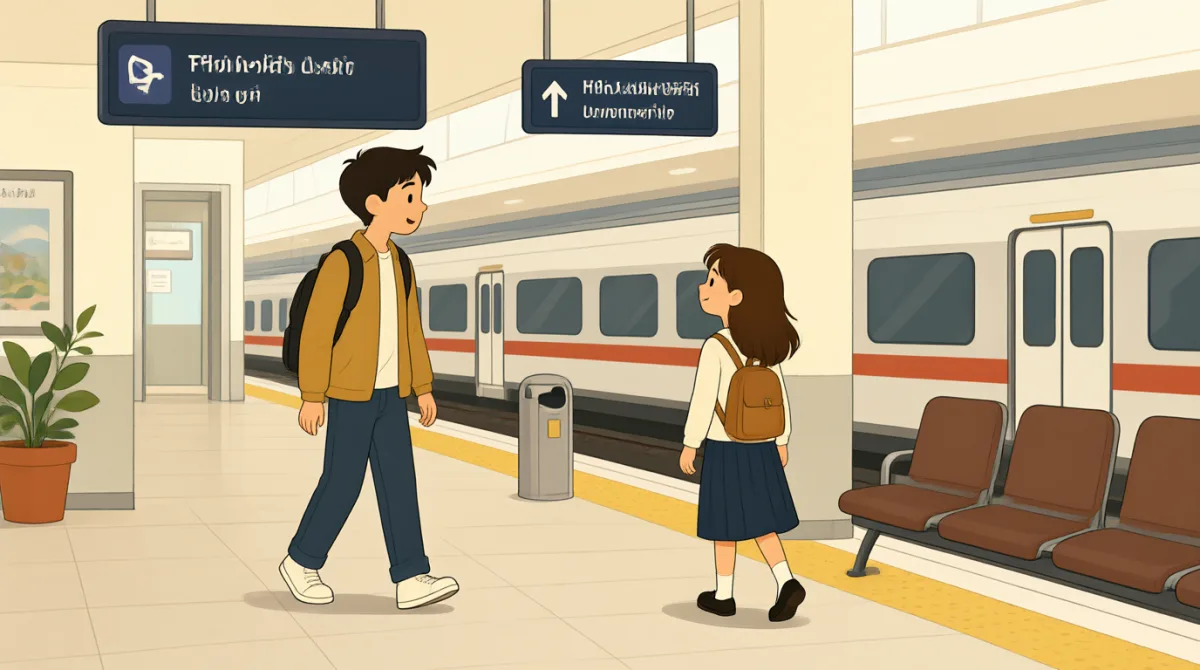

Jack, where do I go for the next train?

Follow the blue signs to Line 2.
Do I need to go upstairs?
Yes. Take the stairs up, then turn left.
Is the train to the city center?
Yes. Check the sign before you get on.
Thanks. I think I can find it now.
No problem. The signs are easy to follow.
Vocabulary8
- next train
This means the train you need to take after your current train. Use it when asking which train to take next.
- blue signs
These are the blue signs that show the way to Line 2. You can follow signs to find a train or place.
- Line 2
This is the name of a subway route. Use “Line” and a number to talk about a subway route.
- upstairs
This means to a higher floor. You can ask if you need to go upstairs to reach a train.
- turn left
This means to go in the direction on your left. Use it when giving or following directions.
- city center
This means the central part of a city. You can use it to ask where a train is going.
- get on
This means to enter a train or bus. Check the sign before you get on the train.
- No problem.
This is a friendly way to say that helping was not difficult. You can say it after someone thanks you.
Key Sentences8
- 1
Jack, where do I go for the next train?
Use this to ask where to go to catch another train. You can change “the next train” to another place or service.
- 2
Follow the blue signs to Line 2.
This gives a simple direction. You can replace “the blue signs” and “Line 2” with other signs or routes.
- 3
Do I need to go upstairs?
Use this to check if you need to go to a higher floor. Replace “upstairs” with another direction, such as “downstairs.”
- 4
Yes. Take the stairs up, then turn left.
This gives two clear steps for finding a place. Use “then” to show what to do next.
- 5
Is the train to the city center?
Use this to check where a train is going. You can replace “the city center” with another destination.
- 6
Check the sign before you get on.
This is useful advice before boarding a train or bus. You can replace “the sign” with other information you need to check.
- 7
I think I can find it now.
Use this to say that you understand how to find a place. Replace “it” with the place or thing you are looking for.
- 8
The signs are easy to follow.
This means the signs make it simple to find the right way. You can use “easy to follow” to describe clear directions or instructions.