Changing Trains
Cambiar de tren
At the transfer station, Emma asks Jack where to go. They follow the signs to the next train.
En la estación de transbordo, Emma le pregunta a Jack adónde tiene que ir. Siguen las señales hasta el siguiente tren.
Diálogo8
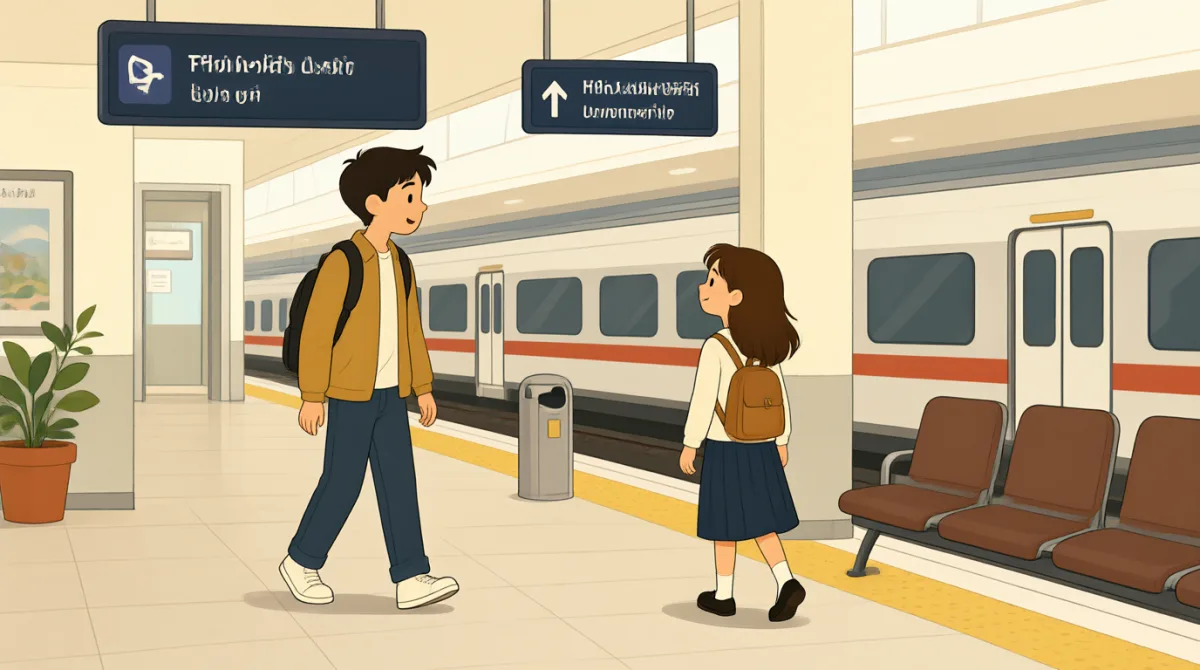

Jack, where do I go for the next train?
Jack, ¿adónde tengo que ir para tomar el siguiente tren?

Follow the blue signs to Line 2.
Sigue las señales azules hasta la línea 2.
Do I need to go upstairs?
¿Tengo que subir las escaleras?
Yes. Take the stairs up, then turn left.
Sí. Sube por las escaleras y luego gira a la izquierda.
Is the train to the city center?
¿Este tren va al centro de la ciudad?
Yes. Check the sign before you get on.
Sí. Mira la señal antes de subir.
Thanks. I think I can find it now.
Gracias. Creo que ya puedo encontrarlo.
No problem. The signs are easy to follow.
No hay problema. Es fácil seguir las señales.
Vocabulario8
- next trainsiguiente tren
This means the train you need to take after your current train. Use it when asking which train to take next.
Se refiere al tren que tienes que tomar después del que estás usando. Úsalo para preguntar qué tren tomar a continuación.
- blue signsseñales azules
These are the blue signs that show the way to Line 2. You can follow signs to find a train or place.
Son las señales azules que indican el camino a la línea 2. Puedes seguir las señales para encontrar un tren o un lugar.
- Line 2línea 2
This is the name of a subway route. Use “Line” and a number to talk about a subway route.
Es el nombre de una ruta del metro. Usa “Line” y un número para hablar de una ruta de metro.
- upstairssubir las escaleras
This means to a higher floor. You can ask if you need to go upstairs to reach a train.
Significa ir a un piso más alto. Puedes preguntar si tienes que subir las escaleras para llegar a un tren.
- turn leftgirar a la izquierda
This means to go in the direction on your left. Use it when giving or following directions.
Significa ir en la dirección que queda a tu izquierda. Úsalo para dar o seguir indicaciones.
- city centercentro de la ciudad
This means the central part of a city. You can use it to ask where a train is going.
Es la parte central de una ciudad. Puedes usarlo para preguntar adónde va un tren.
- get onsubir
This means to enter a train or bus. Check the sign before you get on the train.
Significa entrar en un tren o autobús. Mira la señal antes de subir al tren.
- No problem.No hay problema.
This is a friendly way to say that helping was not difficult. You can say it after someone thanks you.
Es una forma amable de decir que ayudar no fue difícil. Puedes decirlo después de que alguien te dé las gracias.
Frases clave8
- 1
Jack, where do I go for the next train?
Jack, ¿adónde tengo que ir para tomar el siguiente tren?
Use this to ask where to go to catch another train. You can change “the next train” to another place or service.
Usa esta frase para preguntar adónde tienes que ir para tomar otro tren. Puedes cambiar “the next train” por otro lugar o servicio.
- 2
Follow the blue signs to Line 2.
Sigue las señales azules hasta la línea 2.
This gives a simple direction. You can replace “the blue signs” and “Line 2” with other signs or routes.
Esta frase da una indicación sencilla. Puedes sustituir “the blue signs” y “Line 2” por otras señales o rutas.
- 3
Do I need to go upstairs?
¿Tengo que subir las escaleras?
Use this to check if you need to go to a higher floor. Replace “upstairs” with another direction, such as “downstairs.”
Usa esta pregunta para comprobar si tienes que ir a un piso más alto. Puedes cambiar “upstairs” por otra dirección, como “downstairs.”
- 4
Yes. Take the stairs up, then turn left.
Sí. Sube por las escaleras y luego gira a la izquierda.
This gives two clear steps for finding a place. Use “then” to show what to do next.
Esta frase da dos pasos claros para encontrar un lugar. Usa “then” para indicar qué hacer después.
- 5
Is the train to the city center?
¿Este tren va al centro de la ciudad?
Use this to check where a train is going. You can replace “the city center” with another destination.
Usa esta pregunta para comprobar adónde va un tren. Puedes sustituir “the city center” por otro destino.
- 6
Check the sign before you get on.
Mira la señal antes de subir.
This is useful advice before boarding a train or bus. You can replace “the sign” with other information you need to check.
Este consejo es útil antes de subir a un tren o autobús. Puedes sustituir “the sign” por otra información que necesites comprobar.
- 7
I think I can find it now.
Creo que ya puedo encontrarlo.
Use this to say that you understand how to find a place. Replace “it” with the place or thing you are looking for.
Usa esta frase para decir que ya sabes cómo encontrar un lugar. Sustituye “it” por el lugar o la cosa que estás buscando.
- 8
The signs are easy to follow.
Es fácil seguir las señales.
This means the signs make it simple to find the right way. You can use “easy to follow” to describe clear directions or instructions.
Significa que las señales facilitan encontrar el camino correcto. Puedes usar “easy to follow” para describir indicaciones o instrucciones claras.