Picking Up a Friend's Child
Das Kind einer Freundin abholen
Mia asks Emma to take her child home, too. Emma checks the child's name before they leave.
Mia bittet Emma, auch ihr Kind mit nach Hause zu nehmen. Bevor sie losgehen, fragt Emma nach dem Namen des Kindes.
Dialog6
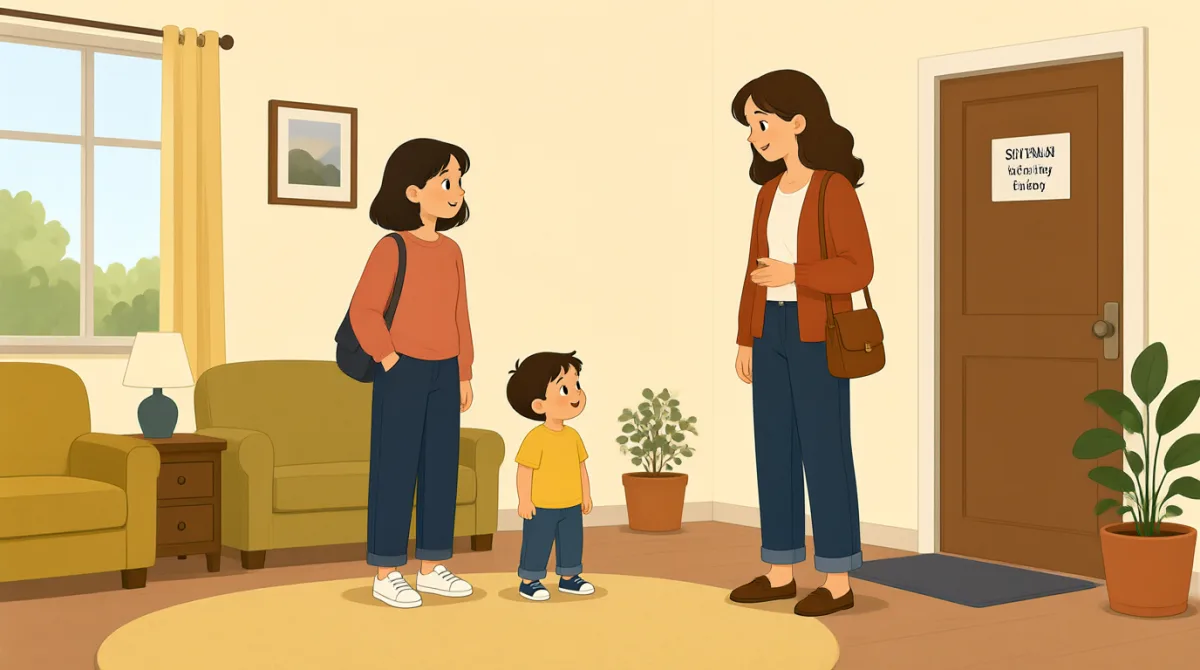

Emma, can you take my child home, too?
Emma, kannst du mein Kind auch mit nach Hause nehmen?

Sure. What is your child's name?
Klar. Wie heißt dein Kind?
Her name is Lily. She is by the gate.
Sie heißt Lily. Sie steht am Tor.
Okay. Is she wearing a blue coat?
Okay. Trägt sie einen blauen Mantel?
Yes, that's her. Thank you so much.
Ja, das ist sie. Vielen Dank!
You're welcome. Let's go find her.
Gern. Lass uns sie suchen gehen.
Wortschatz8
- take my child homemein Kind mit nach Hause nehmen
This means to bring my child to their home. Use “take [someone] home” when you offer to bring someone home.
Das bedeutet, mein Kind nach Hause zu bringen. Mit “take [someone] home” (jemanden nach Hause bringen) kannst du anbieten, jemanden nach Hause zu bringen.
- Sure.Klar.
This is a friendly way to say yes. You can use it when someone asks you for help.
So kannst du freundlich zustimmen. Du kannst das sagen, wenn dich jemand um Hilfe bittet.
- What is your child's name?Wie heißt dein Kind?
Use this question to ask for a child's name. You can also ask, “What is his name?” or “What is her name?”
Mit dieser Frage fragst du nach dem Namen eines Kindes. Du kannst auch “What is his name?” oder “What is her name?” fragen.
- by the gateam Tor
This means near the gate. Use “by” to say that a person or thing is next to a place.
Das bedeutet, dass jemand in der Nähe des Tors ist. Mit “by” kannst du sagen, dass eine Person oder Sache neben einem Ort ist.
- wearing a blue coateinen blauen Mantel tragen
This describes clothes someone has on. You can replace “a blue coat” with another item of clothing.
Damit beschreibst du, was jemand anhat. Du kannst “a blue coat” durch ein anderes Kleidungsstück ersetzen.
- that's herDas ist sie.
This means the person you see is the girl you are talking about. Use “that's him” for a boy.
Das bedeutet, dass die Person, die du siehst, das Mädchen ist, von dem ihr sprecht. Bei einem Jungen sagst du “that's him”.
- Thank you so much.Vielen Dank!
This is a warm way to say thank you. Use it when someone does something helpful for you.
Das ist eine herzliche Art, sich zu bedanken. Du kannst das sagen, wenn jemand dir hilft.
- Let's go find her.Lass uns sie suchen gehen.
This means “Let us go and look for her.” Use “Let's go find [someone]” to suggest looking for a person together.
Das bedeutet: „Lass uns losgehen und sie suchen.“ Mit “Let's go find [someone]” kannst du vorschlagen, gemeinsam nach jemandem zu suchen.
Wichtige Sätze8
- 1
Emma, can you take my child home, too?
Emma, kannst du mein Kind auch mit nach Hause nehmen?
Use “Can you…?” to make a polite request. You can replace “take my child home” with another helpful action.
Mit “Can you…?” formulierst du eine höfliche Bitte. Du kannst “take my child home” durch eine andere hilfreiche Handlung ersetzen.
- 2
Sure.
Klar.
This is a simple, friendly way to agree. You can use it to accept a request or offer.
Das ist eine einfache, freundliche Art zuzustimmen. Du kannst es sagen, wenn du eine Bitte oder ein Angebot annimmst.
- 3
What is your child's name?
Wie heißt dein Kind?
Use this question to ask someone for their child's name. You can change “your child” to “your son” or “your daughter.”
Mit dieser Frage fragst du jemanden nach dem Namen seines Kindes. Du kannst “your child” durch “your son” oder “your daughter” ersetzen.
- 4
Her name is Lily.
Sie heißt Lily.
Use “Her name is…” to tell someone a girl's name. For a boy, say “His name is…”.
Mit “Her name is…” sagst du jemandem den Namen eines Mädchens. Bei einem Jungen sagst du “His name is…”.
- 5
She is by the gate.
Sie steht am Tor.
This tells someone where a girl is. Replace “by the gate” with another place to give a different location.
Damit sagst du jemandem, wo ein Mädchen ist. Ersetze “by the gate” durch einen anderen Ort, um einen anderen Standort anzugeben.
- 6
Is she wearing a blue coat?
Trägt sie einen blauen Mantel?
Use this yes-or-no question to check what someone is wearing. You can replace “a blue coat” with another clothing item.
Mit dieser Ja-Nein-Frage kannst du überprüfen, was jemand anhat. Du kannst “a blue coat” durch ein anderes Kleidungsstück ersetzen.
- 7
Yes, that's her.
Ja, das ist sie.
Use this to confirm that a girl is the person you mean. For a boy, say “Yes, that's him.”
Damit bestätigst du, dass ein Mädchen die Person ist, die du meinst. Bei einem Jungen sagst du “Yes, that's him.”
- 8
Let's go find her.
Lass uns sie suchen gehen.
Use “Let's…” to suggest doing something together. Replace “find her” with another action, such as “go home.”
Mit “Let's…” schlägst du vor, etwas gemeinsam zu tun. Ersetze “find her” durch eine andere Handlung, zum Beispiel “go home.”