Understanding Ambiguous Directions
अस्पष्ट दिशा-निर्देशों को समझना
An employee gives directions that are a bit unclear or use store-specific terminology, and the customer needs to ask for clarification.
एक कर्मचारी थोड़े अस्पष्ट तरीके से या दुकान में इस्तेमाल होने वाले खास शब्दों में रास्ता बताता है, और ग्राहक को और स्पष्ट जानकारी माँगनी पड़ती है।
संवाद8
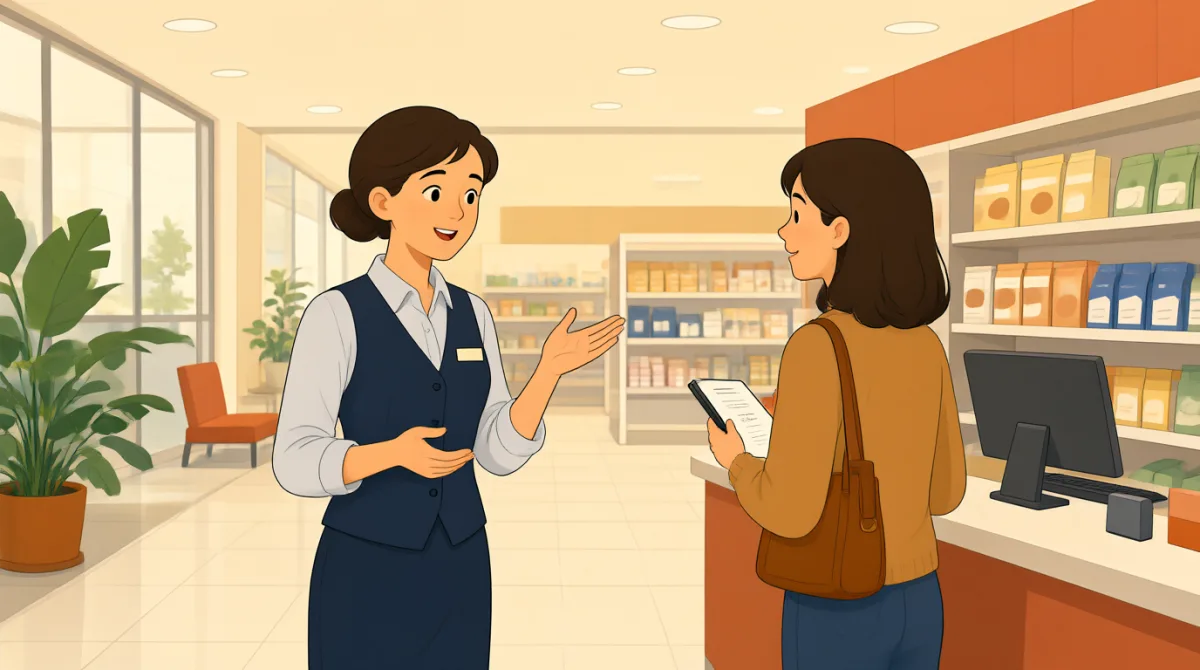

Excuse me, I'm looking for the oat milk. Do you know where it is?
माफ़ कीजिए, मुझे ओट मिल्क चाहिए। क्या आपको पता है कि वह कहाँ मिलेगा?

Yes, it's usually over in the dairy section, near the main chiller.
जी, वह आम तौर पर डेयरी सेक्शन में, मुख्य चिलर के पास होता है।
The main chiller? Is that by the regular milk or the yogurt?
मुख्य चिलर? क्या वह आम दूध के पास है या दही के?
It's on the far side, opposite the fresh produce island. You'll see the big glass doors.
वह दूसरी तरफ़ है, ताज़े फल-सब्ज़ियों वाले हिस्से के सामने। आपको काँच के बड़े दरवाज़े दिखेंगे।
Okay, so if I go past the produce, it'll be on my left or right?
अच्छा, तो फल-सब्ज़ियों वाले हिस्से से आगे जाने पर वह मेरी बाईं तरफ़ होगा या दाईं तरफ़?
You'll want to take a left after the fresh produce, and it's the large section straight ahead. The oat milk is usually on the top shelf.
ताज़े फल-सब्ज़ियों वाले हिस्से के बाद आपको बाएँ मुड़ना होगा। फिर सामने बड़ा डेयरी सेक्शन होगा। ओट मिल्क आम तौर पर ऊपर वाली शेल्फ़ पर होता है।
Got it. So, left past produce, then straight ahead for the big dairy section, top shelf. Thank you so much!
समझ गई। तो फल-सब्ज़ियों वाले हिस्से के आगे बाएँ मुड़ना है, फिर सामने बड़ा डेयरी सेक्शन—ऊपर वाली शेल्फ़ पर। आपका बहुत-बहुत धन्यवाद!
You're welcome! Let me know if you can't find it.
कोई बात नहीं! अगर आपको वह न मिले, तो मुझे बताइएगा।
शब्दावली7
- oat milkओट मिल्क
A non-dairy alternative to milk made from oats, often used by people who avoid animal products.
जई से बना दूध का एक विकल्प, जिसमें डेयरी नहीं होती। इसका इस्तेमाल अक्सर वे लोग करते हैं जो पशु-उत्पादों से परहेज़ करते हैं।
- dairy sectionडेयरी सेक्शन
The area in a supermarket where milk, cheese, and other milk-based products are sold.
सुपरमार्केट का वह हिस्सा जहाँ दूध, चीज़ और दूध से बने दूसरे उत्पाद बेचे जाते हैं।
- chillerचिलर
A refrigerated display case used to keep food and drinks cold in stores.
दुकान में रखा ठंडा रखने वाला रेफ़्रिजरेटेड डिस्प्ले, जिसमें खाने-पीने की चीज़ें ठंडी रखी जाती हैं।
- yogurtदही
A creamy dairy product made from fermented milk, often eaten as a snack or in desserts.
खमीर उठाए हुए दूध से बना एक गाढ़ा डेयरी उत्पाद, जिसे अक्सर नाश्ते या मिठाई के रूप में खाया जाता है।
- fresh produceताज़े फल-सब्ज़ियाँ
Fresh fruits and vegetables sold in the supermarket, usually in a dedicated area.
सुपरमार्केट में बिकने वाले ताज़े फल और सब्ज़ियाँ, जो आम तौर पर एक अलग हिस्से में रखे जाते हैं।
- shelfशेल्फ़
A flat board or surface in a store where products are placed for customers to see and buy.
दुकान में रखी सपाट सतह, जिस पर ग्राहकों के देखने और खरीदने के लिए सामान रखा जाता है।
- aisleगलियारा
A narrow passage between shelves in a store where people walk to find items. (Note: Implied in directions like 'straight ahead.')
दुकान में शेल्फ़ों के बीच का संकरा रास्ता, जहाँ से लोग सामान ढूँढ़ने के लिए गुज़रते हैं। (ध्यान दें: 'straight ahead' जैसे दिशा-निर्देशों में इसका अर्थ निहित होता है।)
मुख्य वाक्य8
- 1
Excuse me, I'm looking for the oat milk. Do you know where it is?
माफ़ कीजिए, मुझे ओट मिल्क चाहिए। क्या आपको पता है कि वह कहाँ मिलेगा?
This is a polite way to start asking for help in a store. Use 'Excuse me' to get attention, and 'I'm looking for' to say what you need. It's useful for any shopping situation.
दुकान में मदद माँगने की शुरुआत करने का यह एक विनम्र तरीका है। ध्यान खींचने के लिए 'Excuse me' कहें और अपनी ज़रूरत बताने के लिए 'I'm looking for' का इस्तेमाल करें। खरीदारी के किसी भी मौक़े पर यह काम आता है।
- 2
Yes, it's usually over in the dairy section, near the main chiller.
जी, वह आम तौर पर डेयरी सेक्शन में, मुख्य चिलर के पास होता है।
This gives basic directions using 'usually' for common locations and prepositions like 'over in' and 'near' to describe position. Practice this to respond as a store helper.
इसमें आम जगह बताने के लिए 'usually' और जगह का वर्णन करने के लिए 'over in' और 'near' जैसे पूर्वसर्ग इस्तेमाल किए गए हैं। दुकान में मदद करने वाले कर्मचारी की तरह जवाब देने के लिए इसका अभ्यास करें।
- 3
The main chiller? Is that by the regular milk or the yogurt?
मुख्य चिलर? क्या वह आम दूध के पास है या दही के?
This asks for clarification when directions are unclear. Use questions with 'or' to choose between options, helping when you're confused about store terms.
जब रास्ता साफ़ न हो, तो यह वाक्य और जानकारी माँगने के लिए है। विकल्पों में से चुनने के लिए 'or' वाले सवाल पूछें। दुकान के किसी शब्द को लेकर उलझन हो, तो इससे मदद मिलती है।
- 4
It's on the far side, opposite the fresh produce island.
वह दूसरी तरफ़ है, ताज़े फल-सब्ज़ियों वाले हिस्से के सामने।
Directions using 'on the far side' and 'opposite' to describe relative positions. 'Island' here means a central display area. Useful for giving or understanding store layouts.
यहाँ जगहों का आपसी संबंध बताने के लिए 'on the far side' और 'opposite' का इस्तेमाल किया गया है। इस वाक्य में 'island' का मतलब बीच में लगा डिस्प्ले है। दुकान की बनावट समझने या बताने में ये शब्द काम आते हैं।
- 5
Okay, so if I go past the produce, it'll be on my left or right?
अच्छा, तो फल-सब्ज़ियों वाले हिस्से से आगे जाने पर वह मेरी बाईं तरफ़ होगा या दाईं तरफ़?
This repeats and clarifies directions with 'if I go past' for sequence and 'on my left or right' for sides. 'It'll be' is a contraction of 'it will be,' common in casual speech.
इस वाक्य में 'if I go past' से रास्ते का क्रम और 'on my left or right' से दिशा दोहराकर स्पष्ट की गई है। 'It'll be', 'it will be' का संक्षिप्त रूप है, जो आम बोलचाल में इस्तेमाल होता है।
- 6
You'll want to take a left after the fresh produce, and it's the large section straight ahead.
ताज़े फल-सब्ज़ियों वाले हिस्से के बाद आपको बाएँ मुड़ना होगा, फिर सामने बड़ा डेयरी सेक्शन होगा।
Imperative directions with 'you'll want to' for suggestions, 'take a left' for turning, and 'straight ahead' for going forward. The 'and' connects steps in a sequence.
दिशा बताने के लिए 'you'll want to' सुझाव देता है, 'take a left' का मतलब बाएँ मुड़ना है और 'straight ahead' का मतलब सीधे आगे जाना है। 'And' रास्ते के क्रम में अगले कदम को जोड़ता है।
- 7
Got it. So, left past produce, then straight ahead for the big dairy section, top shelf.
समझ गई। तो फल-सब्ज़ियों वाले हिस्से के आगे बाएँ मुड़ना है, फिर सामने बड़ा डेयरी सेक्शन—ऊपर वाली शेल्फ़ पर।
This summarizes directions to confirm understanding. Use 'Got it' to show comprehension, and list steps with 'then' for order. Ends with thanks, polite in service talks.
इसमें समझे हुए रास्ते को दोहराकर पुष्टि की गई है। समझ आने का संकेत देने के लिए 'Got it' कहें और क्रम बताने के लिए 'then' के साथ अगले कदम गिनाएँ। अंत में धन्यवाद देना सेवा-संबंधी बातचीत में विनम्रता दिखाता है।
- 8
You're welcome! Let me know if you can't find it.
कोई बात नहीं! अगर आपको वह न मिले, तो मुझे बताइएगा।
A standard polite response after helping. 'Let me know' offers more help, and 'if you can't find it' uses a conditional for future possibilities. Common in customer service.
मदद करने के बाद जवाब देने का यह एक आम विनम्र तरीका है। 'Let me know' कहकर आप आगे भी मदद की पेशकश करते हैं। 'If you can't find it' में भविष्य में हो सकने वाली स्थिति बताने के लिए शर्त का इस्तेमाल किया गया है। ग्राहक सेवा में यह आम है।